
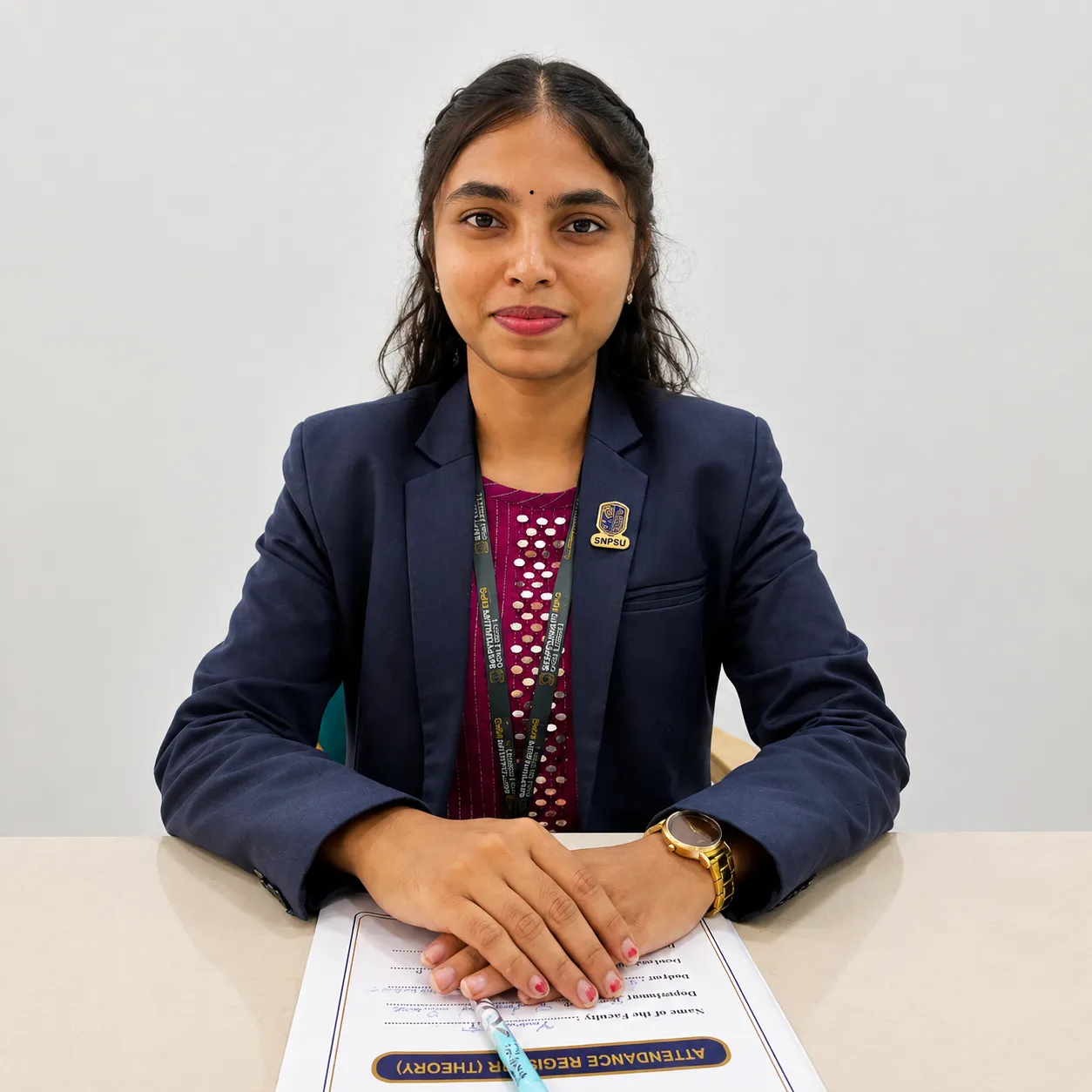
Ms. Tejaswini V Gowda
Assistant Professor
Academic Area: MCA, BCA
Areas of Interest: Data Science
Profile
I am an Assistant Professor with a strong academic interest and passion for Data Science, focusing on developing students analytical thinking, programming skills, and ability to solve real-world problems through data-driven approaches. I have been actively involved in teaching Data Science to MCA and BCA students, providing students with a strong foundation in data science concepts, data analysis, data preprocessing, statistical methods, machine learning, and data visualization. I am particularly interested in exploring the applications of Data Science in various domains and encouraging students to understand how data can be transformed into meaningful insights and informed decisions.
My teaching experience also includes Data Structures and Python Programming, which support the development of strong computational and problem-solving abilities. Currently, I am handling Office Automation Tools, covering MS Word, Microsoft Excel, PowerPoint, and Access, with a special interest in Excel for data analysis, organization, and visualization. I am committed to delivering quality education through practical learning, continuous knowledge enhancement, and innovative teaching methodologies that empower students to develop industry-relevant technical skills and pursue excellence in the field of computing and Data Science.
Published papers
FDPs / MDPs / Workshops
Awards
Training & Consultation
Patents/Projects
Developed a deep learning-based web application for detecting diseases in paddy leaves from uploaded or captured leaf images. The system uses an EfficientNetB0 convolutional neural network with transfer learning to classify paddy leaves into 10 categories: Bacterial Leaf Blight, Bacterial Leaf Streak, Bacterial Panicle Blight, Blast, Brown Spot, Dead Heart, Downy Mildew, Hispa, Normal, and Tungro. The model uses image preprocessing, data augmentation, and 224×224 image input for classification. A Flask-based web interface was developed for user image submission and laboratory-side processing. The system generates automated PDF diagnostic reports containing user information, predicted disease, observed features, recommendations, and the analyzed leaf image, and can send the generated report to the user's email.
Technologies used
Python | TensorFlow | Keras | EfficientNetB0 | Deep Learning | Computer Vision | Flask | NumPy | OpenCV/PIL | FPDF | HTML/CSS | Machine Learning