

Gandhi Jayanti Celebration at Our University – History, Importance & Significance
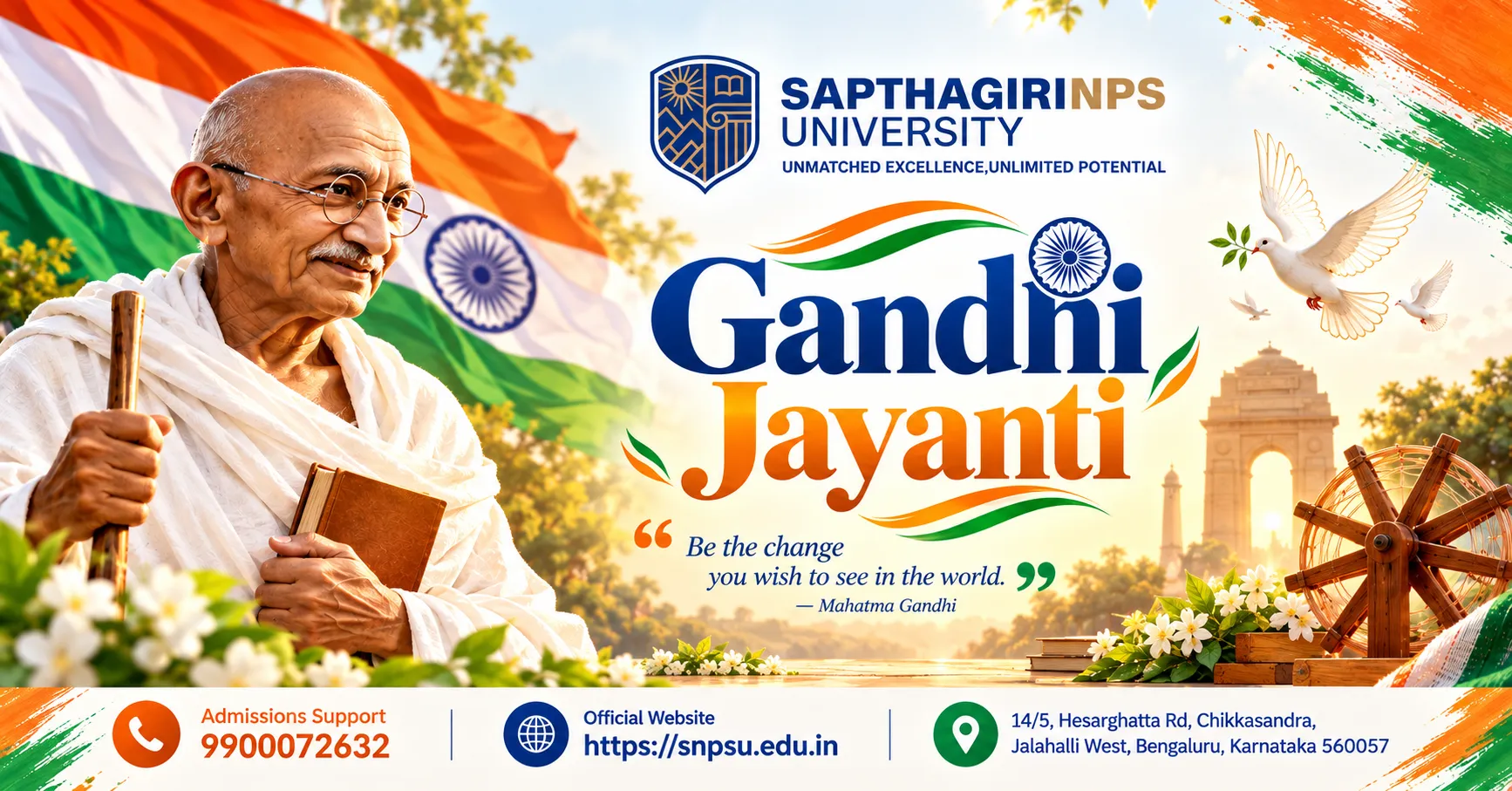
Gandhi Jayanti – History, Importance, Significance and Teachings
Gandhi Jayanti is observed every year on 2 October to commemorate the birth anniversary of Mahatma Gandhi, an important figure in India’s freedom movement and public life. In Gandhi Jayanthi 2026, the occasion falls on Friday, 2 October 2026, and is included in the 2026 holiday calendar. The day provides an opportunity to remember Gandhi’s life, his contribution to India’s freedom struggle and the principles associated with his public philosophy, particularly truth, non-violence, discipline, simplicity and service. For students, Mahatma Gandhi Jayanti is more than a historical observance because it creates an opportunity to understand how values, leadership, responsibility and social awareness can influence individual and community life. A Gandhi Jayanti celebration in an educational environment can connect historical learning with contemporary student experiences through speeches, discussions, cultural activities, cleanliness initiatives, exhibitions, essays and awareness programmes. Understanding the history of Gandhi Jayanti also helps students appreciate why the birth anniversary continues to receive national recognition. The occasion encourages learners to explore the circumstances in which Gandhi worked and the principles that shaped his approach to public action. It also provides a meaningful opportunity to discuss the relevance of ethical behaviour, peaceful communication and responsible citizenship in modern society. For a university community, Gandhi Jayanti can become a platform for learning, reflection and participation, allowing students to connect an important chapter of Indian history with their own academic and professional journeys. The celebration can encourage young people to think about how honesty, perseverance, mutual respect and responsibility can be practised in everyday situations. Gandhi Jayanti therefore carries historical, educational and social significance, making it an appropriate occasion for students to learn from the past while reflecting on their responsibilities in the present and future.
History of Gandhi Jayanti
The history of Gandhi Jayanti is closely connected with the life and legacy of Mohandas Karamchand Gandhi, whose birth anniversary is commemorated on 2 October. The National Portal of India officially identifies 2 October as Mahatma Gandhi’s Birthday, while government resources provide information about his life, philosophy and association with non-violence. Gandhi became an important figure in India’s freedom movement and is remembered for promoting methods of public action associated with truth, non-violence and peaceful resistance. His life and work have become an important part of India’s historical and educational discussions, making his birth anniversary an occasion for remembrance as well as reflection. The importance of the day is not limited to remembering the date of his birth; it also provides an opportunity to understand the historical circumstances in which Gandhi worked and the ideas that shaped his approach to social and national issues. Students studying the History of Gandhi Jayanti can explore how his ideas influenced public participation and how values became an important part of his approach to leadership. Learning about Gandhi’s journey can also encourage students to understand the relationship between personal discipline, public responsibility and social change. Gandhi Jayanti therefore serves as a bridge between historical education and value-based learning, allowing younger generations to engage with an important part of India’s modern history. In an academic setting, the occasion can encourage students to research Gandhi’s life, participate in discussions and examine how historical experiences continue to influence conversations about leadership, peace, responsibility and citizenship.
Why Gandhi Jayanti Is Celebrated
The main purpose of Gandhi Jayanti is to remember Mahatma Gandhi on his birth anniversary and reflect on the values and principles associated with his life. The day is officially recognised in India as Mahatma Gandhi’s Birthday and forms part of the national holiday calendar. The celebration is significant because it provides an opportunity for people, particularly young learners, to look beyond historical dates and understand the broader lessons connected with Gandhi’s life and public work. Gandhi Jayanti significance can be explored through themes such as truth, non-violence, simplicity, self-discipline, service, peaceful communication and responsibility towards society. Educational institutions can use the occasion to encourage students to think about how these values can be reflected in everyday academic and personal life. For example, truthfulness can be connected with academic integrity, discipline with consistent learning, peaceful communication with respectful discussion and service with community participation. A Gandhi Jayanti celebration can therefore become an educational experience rather than simply a formal observance. Students can participate in speeches, essays, quizzes, debates, poster activities, cultural programmes and social-awareness initiatives that help them understand the significance of the occasion. Such activities can also strengthen communication, teamwork, creativity and leadership abilities. The day provides a valuable opportunity to remind students that education includes not only acquiring knowledge but also developing responsibility, character and awareness of the society in which they live.
Why Gandhi Jayanti Matters
| Dimension | What It Represents |
|---|---|
| A Date of Remembrance | 2 October marks the birth anniversary of Mahatma Gandhi and provides a national occasion to remember his life and public legacy. |
| Learning From History | The day encourages students to explore an important period of India’s modern history and understand the ideas associated with Gandhi’s public life. |
| The Practice of Truth | Gandhi’s philosophy gives students an opportunity to reflect on honesty, integrity and truthful conduct in education, relationships and professional life. |
| Peaceful Ways of Resolving Differences | The occasion highlights non-violence and creates scope for discussing respectful communication, patience and constructive approaches to disagreement. |
| Character Beyond Academics | Gandhi Jayanti reminds educational communities that personal values and responsible behaviour can complement academic knowledge. |
| Service-Oriented Thinking | Student activities connected with community service can encourage learners to think about how their abilities can contribute beyond the classroom. |
| Responsible Campus Culture | Ideas of discipline, respect and shared responsibility can be connected with everyday university life, including teamwork and care for common spaces. |
| Youth Participation | Speeches, discussions, exhibitions, essays and cultural programmes give students opportunities to research, communicate ideas and participate actively. |
| Leadership Through Responsibility | The occasion can encourage students to view leadership through accountability, cooperation and the willingness to contribute rather than simply through position. |
| Respectful Communication | Discussions around non-violence can help students consider the value of listening, dialogue and mutual respect when working with different viewpoints. |
| Reflection and Self-Improvement | Gandhi Jayanti provides students with an opportunity to consider personal habits, discipline, integrity and the values they want to carry into their future. |
| From Memory to Meaning | A university celebration can transform a historical observance into a learning experience by connecting Gandhi’s legacy with contemporary student life. |
| National Significance | Gandhi Jayanti is recognised in India’s official holiday calendar; in 2026, it falls on 2 October, Friday. |
Mahatma Gandhi Teachings and Their Relevance
The Mahatma Gandhi teachings most commonly associated with his public philosophy include truth and non-violence, along with ideas of discipline, simplicity, service and responsible conduct. Government sources specifically provide information about Gandhi’s philosophy and non-violence, making these themes central to understanding his historical legacy. For students, these principles can be considered in practical and contemporary ways. Truth can encourage honesty in academic work, professional communication and personal relationships. Non-violence can be understood through peaceful communication, respectful disagreement and constructive approaches to conflict. Discipline can help students maintain consistency in learning and responsibilities, while simplicity can encourage thoughtful choices and awareness of personal priorities. Service can inspire students to contribute positively to their campus and wider community. These values can be discussed through classroom activities, seminars, student programmes and community initiatives. The relevance of Gandhi’s teachings does not require students to view history only through memorisation; instead, they can examine how values can influence behaviour and decision-making in everyday circumstances. For students preparing for professional careers, qualities such as honesty, accountability, patience, teamwork and respect can be valuable across different fields. A meaningful Gandhi Jayanti programme can therefore encourage students to connect historical ideas with modern academic and professional situations. By reflecting on these teachings, learners can develop a broader understanding of how personal conduct, social responsibility and ethical decision-making contribute to a positive community.
Gandhi Jayanti Celebration in a University Environment
A Gandhi Jayanti celebration at a university can bring together history, education, culture and student participation in a meaningful manner. Our university can observe the occasion through activities that encourage students to learn about Gandhi’s life while reflecting on values relevant to academic and professional development. A programme may include an introduction to the historical importance of 2 October, student speeches, presentations, essay activities, poster displays, quizzes, discussions and cultural programmes. Cleanliness and community-awareness activities can also provide students with opportunities to connect the broader idea of service with practical participation. Such programmes can encourage students to work together, share responsibilities and develop communication and organisational skills. Faculty members can guide discussions about Gandhi’s life, his historical role and the relevance of truth and non-violence in contemporary society. Students can also explore how respectful communication and responsible behaviour contribute to a healthy learning environment. The celebration can therefore move beyond a ceremonial gathering and become an opportunity for active learning. Our university can use such occasions to encourage students to understand that historical commemorations can provide lessons for present-day life. When students participate directly in planning and presenting activities, they can develop confidence, teamwork and leadership while learning about an important part of India’s history. A university-based Gandhi Jayanti celebration can consequently combine remembrance with meaningful student engagement.
Importance of Gandhi Jayanti for Students
The importance of Gandhi Jayanti for students can be understood through its connection with history, values, citizenship and personal development. University students are preparing not only for academic qualifications but also for professional and social responsibilities, making discussions about ethical conduct and responsible behaviour particularly relevant. Gandhi Jayanti provides an occasion to consider how qualities such as honesty, discipline, patience, cooperation and respect can influence student life. Academic environments involve teamwork, presentations, projects, discussions and interactions with people who may have different perspectives, and peaceful communication can help students approach such situations constructively. Students can also learn that responsibility involves taking care of shared spaces, respecting others, completing commitments and contributing positively to the community. Activities organised around Gandhi Jayanti can reinforce these ideas while giving students opportunities to participate actively in university life. The occasion can also encourage learners to explore India’s history and understand how individuals and movements contributed to major historical developments. By connecting historical learning with contemporary experiences, students can develop a deeper appreciation of why national commemorations remain meaningful. Gandhi Jayanti can therefore become a learning opportunity that combines historical awareness with personal reflection and social responsibility. For young learners, the occasion can serve as a reminder that professional growth involves more than technical knowledge and that qualities such as integrity, communication, cooperation and responsible conduct can contribute to a well-rounded educational journey.
Gandhi Jayanthi 2026 – A Day of Reflection and Learning
Gandhi Jayanthi 2026 provides an opportunity for students and the wider community to remember Mahatma Gandhi and reflect on the historical and educational significance of his birth anniversary. The 2026 holiday calendar records Mahatma Gandhi Jayanti on 2 October 2026, which falls on a Friday. For students, the occasion can be approached as a day of historical learning, value-based reflection and meaningful participation. Our university can use the occasion to encourage students to understand the history behind Gandhi Jayanti while exploring themes such as truth, non-violence, discipline, service and peaceful cooperation. Students can participate in academic and cultural activities that help them communicate their understanding of the occasion and develop confidence through active involvement. The celebration can also provide an opportunity to discuss how responsible citizenship begins with everyday actions such as respecting others, maintaining shared spaces, communicating thoughtfully and fulfilling personal responsibilities. Gandhi Jayanti can therefore connect national history with student development in a practical and engaging way. Rather than limiting the occasion to a single ceremony, the university community can use it to encourage continued reflection on the importance of ethical behaviour and social responsibility. Gandhi Jayanthi 2026 can thus be observed as a meaningful occasion that honours history while encouraging students to carry forward values that can contribute to a respectful, responsible and collaborative society.
Gandhi Jayanti – History, Importance, Significance and Teachings
1. What is Gandhi Jayanti and why is it celebrated?
Gandhi Jayanti is celebrated every year on 2 October to commemorate the birth anniversary of Mahatma Gandhi, who was born on 2 October 1869 in Porbandar, Gujarat. Gandhi became one of the most prominent leaders of India’s freedom movement and is widely remembered for his commitment to truth, non-violence, peaceful resistance, simplicity and social harmony. The occasion provides an opportunity to remember his contribution to India’s history and to reflect on the values associated with his life and philosophy. Gandhi Jayanti is particularly meaningful for students because it encourages them to understand the importance of honesty, discipline, compassion, equality, peaceful communication and responsibility toward society.
2. When is Gandhi Jayanti celebrated in India?
Gandhi Jayanti is celebrated on 2 October every year and is observed as a national holiday in India. Schools, colleges, universities, government institutions and community organizations conduct various programmes to commemorate the occasion. Educational activities, speeches, discussions, cultural programmes, prayer meetings and community initiatives are commonly associated with the day. Gandhi Jayanti provides an opportunity for younger generations to learn about Gandhi’s contribution to India’s freedom movement and to understand how values such as truth, peace and social responsibility can remain relevant in everyday life.
3. What is the history of Gandhi Jayanti?
Mahatma Gandhi was born on 2 October 1869 in Porbandar, Gujarat. After studying law, he spent several years in South Africa, where his experiences with racial discrimination influenced his approach to social and political activism. After returning to India, Gandhi became an important leader in the freedom movement and promoted methods of non-violent resistance and Satyagraha. His approach encouraged people to participate in the struggle for independence through peaceful collective action. Gandhi was assassinated on 30 January 1948. His birth anniversary continues to be commemorated on 2 October as Gandhi Jayanti, providing an annual occasion to remember his life, contribution and teachings.
4. Why is Gandhi Jayanti important?
Gandhi Jayanti is important because it provides an opportunity to remember Gandhi’s contribution to India’s freedom struggle and to reflect on the principles associated with his philosophy. Truth, non-violence, simplicity, equality, self-discipline and service are among the values commonly discussed in connection with Gandhi’s life. The occasion also encourages students and citizens to think about their responsibilities toward their families, communities and society. Through educational programmes and community activities, Gandhi Jayanti can help create awareness about peaceful cooperation, respect for others and responsible citizenship.
5. What were the main teachings of Mahatma Gandhi?
The teachings associated with Mahatma Gandhi emphasize the importance of truth, non-violence, simplicity, self-discipline, equality and service. Gandhi considered truth an important foundation of personal and public life and believed that individuals should remain honest and responsible in their actions. His philosophy of non-violence encouraged peaceful methods of addressing injustice and conflict. He also promoted a simple way of living and emphasized personal discipline. His views on social equality and service encouraged individuals to work toward the welfare and dignity of others. These ideas continue to be studied as important aspects of his contribution to Indian history and social thought.
6. What does Ahimsa mean in Gandhi’s philosophy?
Ahimsa, commonly translated as non-violence, was one of the central principles associated with Gandhi’s philosophy. It involves avoiding violence and seeking peaceful approaches to disagreements, conflicts and social change. Gandhi connected non-violence with compassion, patience, respect and self-control. His use of non-violent resistance demonstrated how peaceful collective action could be used to challenge injustice. In everyday life, the principle of Ahimsa can encourage people to communicate respectfully, understand different viewpoints and resolve disagreements without aggression or hatred.
7. What is Satyagraha according to Mahatma Gandhi?
Satyagraha is a concept closely associated with Gandhi and is generally understood as a commitment to truth through non-violent resistance. Gandhi developed the method during his activism in South Africa and later applied it during India’s freedom movement. Satyagraha emphasized truth, courage, peaceful action, self-discipline and a willingness to make personal sacrifices for a cause. Rather than relying on violence, the approach encouraged people to resist injustice through peaceful and determined action. Satyagraha therefore became an important part of Gandhi’s philosophy and his approach to social and political change.
8. How is Gandhi Jayanti celebrated in schools and colleges?
Gandhi Jayanti is commonly observed in educational institutions through programmes that help students understand Gandhi’s life, India’s freedom movement and the importance of social responsibility. Schools and colleges may organize speeches, essay-writing activities, debates, cultural programmes, prayer meetings, exhibitions and discussions about Gandhi’s teachings. Cleanliness and community-service activities are also commonly associated with the occasion. These programmes provide students with an opportunity to connect historical learning with values such as honesty, discipline, peaceful communication, cooperation and responsible participation in society.
9. Why is cleanliness associated with Gandhi Jayanti?
Cleanliness has an important place in discussions about Gandhi’s social philosophy. Gandhi frequently emphasized the importance of personal hygiene, sanitation and maintaining clean surroundings. He connected cleanliness with individual responsibility and the welfare of the community. As a result, cleanliness and sanitation activities are commonly organized around Gandhi Jayanti. Such initiatives encourage students and citizens to take responsibility for their surroundings, maintain hygiene and understand the importance of clean public spaces. The activities also provide an opportunity to connect Gandhi’s emphasis on cleanliness with broader ideas of civic responsibility and community service.
10. What can students learn from Mahatma Gandhi’s life and teachings?
Students can learn valuable lessons from studying Gandhi’s life, including the importance of truth, non-violence, discipline, simplicity, perseverance, equality and service. His life provides an opportunity to understand how peaceful collective action and commitment to principles played a significant role in India’s freedom movement. Students can also relate these values to their everyday lives by being honest in their academic work, respecting different opinions, communicating peacefully, helping others and taking responsibility for their communities. Gandhi Jayanti therefore serves as both a historical commemoration and an educational occasion that encourages students to reflect on truth, peace, responsibility, equality and service to society.
Gandhi Jayanti Wishes & Join Our University
Warm Gandhi Jayanti wishes from our university. May the timeless values of truth, peace, non-violence, discipline and compassion inspire every student to learn with purpose, act with responsibility and contribute positively to society. On this meaningful occasion, we remember Mahatma Gandhi and reflect on the importance of integrity, service and responsible citizenship in our everyday lives.
May truth guide your thoughts, peace shape your actions and knowledge empower your journey.
Happy Gandhi Jayanti!
Begin Your Academic Journey With Our University
Join our academic community and take the next step towards building your knowledge, skills and future. Click Here to Apply or contact the Admissions Team at 9900072632 for guidance.
Leave a Comment