

Guru Purnima 2026: History, Significance, Traditions & Importance | Our University
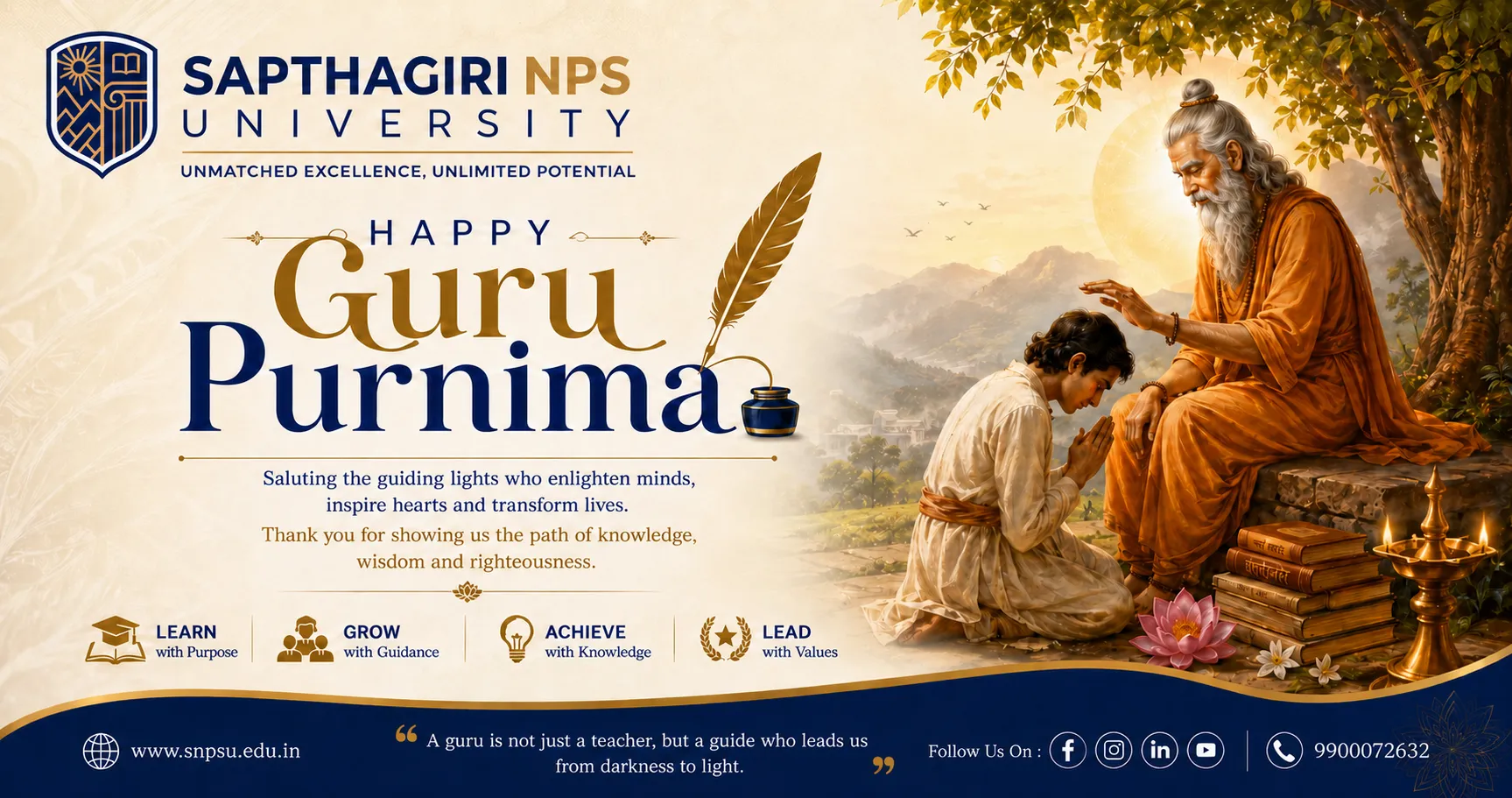
Guru Purnima 2026: Honouring the Eternal Bond Between Guru and Disciple
A Celebration of Knowledge, Wisdom, Gratitude, and Lifelong Learning
Every great civilization has been shaped by the wisdom of its teachers. Long before books, universities, and modern classrooms became centres of learning, knowledge was preserved and passed from one generation to the next through the guidance of dedicated Gurus who devoted their lives to educating others. Their teachings extended beyond academic instruction, nurturing values, discipline, integrity, compassion, leadership, and the pursuit of truth. Guru Purnima is a timeless celebration that honours this extraordinary legacy and expresses heartfelt gratitude to every teacher, mentor, guide, and visionary whose wisdom continues to illuminate the path of learning.
Observed on the sacred full moon day (Purnima) of the Hindu month of Ashadha, Guru Purnima is one of India's most revered cultural and spiritual festivals. Celebrated across educational institutions, spiritual organizations, and communities around the world, this auspicious occasion serves as a reminder that every achievement, every discovery, and every success story begins with the inspiration and guidance of a teacher. It is a day that transcends religious and cultural boundaries, bringing together students, educators, researchers, professionals, and lifelong learners in a shared expression of respect and appreciation for those who dedicate themselves to the noble mission of education.
Known traditionally as Vyasa Purnima, the festival commemorates the birth anniversary of Maharishi Ved Vyasa, one of the greatest scholars in Indian history. Revered as the compiler of the Vedas, the author of the Mahabharata, and the architect of numerous philosophical and spiritual texts, Maharishi Ved Vyasa laid the foundation for preserving India's vast heritage of knowledge. His unparalleled contributions to literature, philosophy, and education continue to inspire generations of scholars, educators, and students, making Guru Purnima a universal celebration of wisdom, learning, and intellectual excellence.
The significance of Guru Purnima extends far beyond its historical and spiritual origins. In today's rapidly evolving world, where knowledge is readily available through digital platforms, artificial intelligence, and advanced technologies, the role of a teacher remains more essential than ever. Information may be accessible within seconds, but wisdom is cultivated through experience, mentorship, critical thinking, and meaningful human interaction. A true Guru does not merely provide answers but inspires curiosity, encourages innovation, develops character, and empowers learners to transform knowledge into purposeful action.
Our university proudly celebrates Guru Purnima as a tribute to the educators, mentors, researchers, and academic leaders whose dedication shapes the future of every student. We believe that education is not confined to classrooms, examinations, or degrees; it is a lifelong journey of intellectual discovery, personal growth, ethical responsibility, and continuous learning. Every faculty member contributes to creating an academic environment where students are encouraged to explore new ideas, challenge conventional thinking, develop innovative solutions, and pursue excellence with confidence and integrity.
Our educational philosophy is founded on the belief that outstanding teachers create extraordinary individuals. Through interdisciplinary learning, research-driven education, industry collaboration, experiential learning opportunities, and value-based academic practices, our university strives to prepare students not only for successful careers but also for responsible leadership in an increasingly interconnected world. We recognize that behind every accomplished engineer, doctor, scientist, entrepreneur, lawyer, artist, educator, researcher, and public servant stands a teacher whose encouragement, patience, and unwavering belief transformed potential into achievement.
Guru Purnima also reminds every learner to pause and acknowledge the countless individuals who have influenced their educational journey. Parents who introduce the first lessons of life, school teachers who build strong academic foundations, university professors who expand intellectual horizons, research supervisors who inspire innovation, industry experts who bridge theory with practical application, and mentors who provide guidance during life's most challenging moments all embody the true spirit of a Guru. Their influence extends beyond textbooks and classrooms, shaping confidence, character, resilience, compassion, and the ability to contribute positively to society.
The timeless Guru–Shishya Parampara, or teacher-disciple tradition, has remained one of the greatest strengths of Indian education for thousands of years. Built upon mutual respect, trust, discipline, dedication, and the continuous pursuit of knowledge, this sacred relationship has nurtured some of history's greatest philosophers, scientists, physicians, mathematicians, poets, artists, and leaders. Although educational methodologies have evolved significantly over the centuries, the fundamental values that define this tradition continue to inspire modern institutions committed to academic excellence and holistic student development.
In an era where innovation, artificial intelligence, digital transformation, sustainability, and global collaboration are reshaping every profession, lifelong learning has become essential for personal and professional success. Modern education requires more than technical expertise; it demands creativity, adaptability, ethical decision-making, emotional intelligence, leadership, communication skills, and a commitment to continuous self-improvement. Teachers play an indispensable role in cultivating these qualities, preparing students to navigate complex challenges while remaining grounded in integrity and social responsibility.
Guru Purnima is therefore much more than a traditional festival. It is a celebration of gratitude, knowledge, mentorship, and the enduring human connection that transforms education into enlightenment. It reminds us that true success is measured not only by professional accomplishments but also by the values, wisdom, and compassion we acquire through the guidance of exceptional teachers. Every lesson learned, every challenge overcome, and every dream realized carries the invisible influence of a mentor who believed in our potential before we believed in ourselves.
As we commemorate Guru Purnima 2026, our university proudly honours every teacher, professor, mentor, researcher, guide, and academic leader who continues to inspire excellence, foster innovation, and nurture future generations of responsible global citizens. This special occasion provides an opportunity to express sincere gratitude for their unwavering dedication and to reaffirm our shared commitment to learning, discovery, integrity, and service. Together, let us celebrate the transformative power of education and the timeless values that continue to guide humanity toward a brighter, more knowledgeable, and compassionate future.
What is Guru Purnima?
Guru Purnima is one of the most revered and spiritually significant festivals celebrated in India, dedicated to honouring teachers, mentors, scholars, spiritual guides, and every individual who has played a meaningful role in illuminating the path of knowledge. More than a cultural or religious observance, Guru Purnima represents the timeless values of gratitude, humility, respect, wisdom, and lifelong learning. It is a day when students, disciples, educational institutions, and communities come together to acknowledge the profound influence of those who dedicate their lives to educating, mentoring, and inspiring others.
Celebrated on the full moon day (Purnima) of the Hindu month of Ashadha, which usually falls during June or July, Guru Purnima holds immense importance in India's educational, cultural, and spiritual heritage. The brilliance of the full moon is often regarded as a symbol of enlightenment, purity, and complete knowledge, reflecting the role of a Guru who removes the darkness of ignorance and fills the lives of students with the light of wisdom. This symbolism makes Guru Purnima one of the most meaningful occasions for expressing appreciation towards educators whose guidance shapes not only careers but also character, values, and lifelong perspectives.
The word "Guru" originates from the Sanskrit language and carries a profound philosophical meaning. According to traditional interpretation, "Gu" signifies darkness or ignorance, while "Ru" represents the remover of that darkness. A Guru, therefore, is someone who dispels ignorance through knowledge, understanding, and wisdom. While the term was historically associated with spiritual masters and learned scholars, its meaning has evolved to include every individual who inspires learning and personal growth. Today, a Guru may be a school teacher, university professor, research supervisor, mentor, coach, industry expert, parent, or any person whose guidance positively transforms another person's life.
Guru Purnima is traditionally observed as Vyasa Purnima, commemorating the birth anniversary of Maharishi Ved Vyasa, one of the greatest scholars and philosophers in Indian history. Revered as the compiler of the Vedas and the author of the Mahabharata, Maharishi Ved Vyasa made unparalleled contributions to preserving India's intellectual and spiritual heritage. His remarkable work organized centuries of Vedic knowledge into a structured form that could be studied and passed on to future generations. His literary and philosophical contributions continue to influence education, culture, spirituality, and research even today, making him an eternal symbol of scholarship and wisdom.
The significance of Guru Purnima extends beyond a single historical figure. It celebrates the enduring relationship between teacher and student a relationship built on trust, respect, discipline, and a shared commitment to learning. Throughout Indian history, this sacred bond has been known as the Guru–Shishya Parampara, a tradition that has nurtured countless scholars, scientists, philosophers, artists, physicians, mathematicians, and leaders. This educational philosophy emphasizes that true learning is not limited to acquiring information but involves developing wisdom, character, ethics, discipline, and the ability to contribute positively to society.
In contemporary society, Guru Purnima has evolved into a universal celebration of education and mentorship. Educational institutions across the country organize special events to recognize the invaluable contributions of teachers and faculty members. Students express their gratitude through speeches, cultural performances, appreciation messages, and acts of respect, acknowledging the countless hours educators dedicate to teaching, mentoring, counselling, and inspiring future generations. These celebrations strengthen the bond between teachers and students while reinforcing the values of mutual respect, responsibility, and academic excellence.
The relevance of Guru Purnima has become even more significant in the modern era, where technological advancements have transformed the way knowledge is accessed and shared. Digital libraries, online learning platforms, virtual classrooms, and artificial intelligence have made information available at the click of a button. However, while technology provides information, it cannot replace the wisdom, experience, ethical guidance, encouragement, and emotional support that an inspiring teacher provides. A true Guru helps students think critically, solve complex problems, develop confidence, cultivate integrity, and transform information into meaningful knowledge that can be applied responsibly in real life.
Our university believes that the essence of Guru Purnima lies in recognizing education as a lifelong journey rather than a destination. Learning does not conclude with graduation or the completion of a degree; it continues throughout every stage of personal and professional life. Every challenge becomes an opportunity to learn, every experience becomes a lesson, and every mentor becomes a source of inspiration. This philosophy encourages students to remain curious, adaptable, and committed to continuous self-improvement in an ever-changing world.
Guru Purnima also reminds us that teachers influence lives in ways that extend far beyond academic achievement. They inspire confidence in moments of uncertainty, encourage perseverance during challenges, nurture creativity through exploration, and instill ethical values that guide decision-making throughout life. Behind every successful doctor, engineer, scientist, entrepreneur, lawyer, researcher, artist, educator, public servant, and innovator stands a teacher whose guidance laid the foundation for future accomplishments. Their influence often continues long after formal education has ended, shaping careers, relationships, leadership, and contributions to society.
The festival further emphasizes that gratitude is one of the highest expressions of learning. Recognizing the efforts, sacrifices, and dedication of teachers strengthens the educational community and reminds students that success is never achieved alone. It is built upon the knowledge shared, encouragement offered, and opportunities created by mentors who believe in the potential of every learner. Expressing gratitude on Guru Purnima is therefore not merely a tradition but a reflection of respect for the transformative power of education itself.
As Guru Purnima continues to be celebrated across schools, colleges, universities, research institutions, and communities around the world, its timeless message remains unchanged. Knowledge is humanity's greatest asset, teachers are its most dedicated custodians, and education remains the most powerful force for positive transformation. By honouring our Gurus, we celebrate the enduring values of wisdom, humility, compassion, integrity, and lifelong learning that continue to shape individuals, strengthen communities, and build a brighter future for generations to come.
The History of Guru Purnima: A Legacy of Knowledge That Transcends Time
The history of Guru Purnima is deeply interwoven with the cultural, spiritual, and educational heritage of India. Its origins can be traced back thousands of years to the Vedic period, when knowledge was considered the highest form of wealth and teachers occupied the most respected position in society. Unlike modern systems of education, where learning is often confined to classrooms and examinations, ancient India viewed education as a lifelong journey that shaped an individual's intellect, character, values, and purpose. The Guru was regarded not merely as an instructor but as a guide who nurtured every aspect of a disciple's life, preparing them to become responsible, knowledgeable, and compassionate members of society.
During the Vedic age, education flourished through the Guru–Shishya Parampara, one of the oldest and most respected educational traditions in the world. Students, known as Shishyas, lived with their teachers in residential learning centres called Gurukuls, where education extended beyond academic subjects. Under the constant guidance of their Guru, students learned philosophy, mathematics, astronomy, medicine, literature, ethics, agriculture, music, martial arts, governance, environmental stewardship, and spiritual wisdom. Daily life in a Gurukul emphasized discipline, humility, self-reliance, respect for nature, and service to society. This holistic approach ensured that education prepared individuals not only for successful careers but also for responsible citizenship and meaningful lives.
Guru Purnima is traditionally celebrated as Vyasa Purnima, commemorating the birth anniversary of Maharishi Ved Vyasa, one of the most influential scholars and philosophers in Indian civilization. Born to Sage Parashara and Satyavati, Ved Vyasa is revered as one of the greatest intellectual figures in history. At a time when the vast body of Vedic knowledge existed primarily through oral tradition, he undertook the monumental task of compiling, organizing, and preserving this wisdom for future generations. His extraordinary efforts ensured that India's spiritual, philosophical, and cultural heritage would remain accessible for centuries to come.
Maharishi Ved Vyasa is credited with dividing the original Veda into the four distinct Vedas Rigveda, Yajurveda, Samaveda, and Atharvaveda making them easier to study, understand, and preserve. Beyond this remarkable achievement, he authored the Mahabharata, the world's longest epic, which contains the sacred Bhagavad Gita, one of the most influential philosophical texts ever written. He is also traditionally associated with composing the Brahma Sutras, editing the eighteen Mahapuranas, and contributing significantly to the intellectual and spiritual development of Indian civilization. His unparalleled dedication to preserving knowledge earned him the title Adi Guru, or the first great teacher, making Guru Purnima a fitting occasion to honour his enduring legacy.
Over time, the celebration of Guru Purnima evolved beyond commemorating Maharishi Ved Vyasa alone. It became a universal occasion to express gratitude towards every teacher who contributes to the intellectual, moral, and spiritual growth of individuals. The festival symbolizes the timeless belief that knowledge is humanity's greatest treasure and that teachers are the custodians entrusted with preserving and sharing this treasure across generations. This philosophy remains deeply embedded in India's educational traditions and continues to inspire institutions of learning around the world.
Guru Purnima also occupies an important place in Buddhist history. According to Buddhist tradition, after attaining enlightenment beneath the Bodhi Tree at Bodh Gaya, Lord Buddha spent several weeks contemplating the profound truths he had realized. He then travelled to Sarnath, near Varanasi, where he delivered his first sermon to his five former companions. This historic discourse, known as the Dhammacakkappavattana Sutta or the "Setting in Motion the Wheel of Dharma," explained the Four Noble Truths and the Noble Eightfold Path, laying the foundation of Buddhism. This event is believed to have taken place on the day of Guru Purnima, making the festival especially significant for Buddhists worldwide as a celebration of wisdom, compassion, and the transmission of knowledge.
Similarly, Guru Purnima holds special significance in Jainism. Historical traditions state that Lord Mahavira, the twenty-fourth Tirthankara, accepted Gautam Swami as his first and foremost disciple on this auspicious day. Gautam Swami later became one of the greatest exponents of Jain philosophy, carrying forward the teachings of Lord Mahavira and contributing to the spread of Jain principles of non-violence, truth, self-discipline, and spiritual liberation. Consequently, Guru Purnima is also observed by the Jain community as a day of reverence for teachers and spiritual guidance.
Throughout the medieval period, Guru Purnima continued to occupy an important place in India's educational and cultural traditions. Great philosophers, saints, poets, and reformers such as Adi Shankaracharya, Ramanujacharya, Madhvacharya, Sant Kabir, Guru Nanak Dev Ji, Sant Tukaram, and Swami Vivekananda emphasized the indispensable role of the Guru in leading humanity toward knowledge, righteousness, and self-realization. Their teachings reinforced the idea that true education combines intellectual excellence with ethical conduct, compassion, and service to society.
As educational systems evolved over the centuries, the traditional Gurukul gradually transformed into schools, colleges, universities, and research institutions. Although the methods of teaching changed with advancements in science, technology, and communication, the core values of the Guru–Shishya tradition remained unchanged. Respect for teachers, dedication to learning, academic integrity, curiosity, discipline, and lifelong education continue to form the foundation of quality education across the world.
In the twenty-first century, Guru Purnima has assumed even greater significance. The rapid growth of digital technologies, online education, artificial intelligence, and global knowledge networks has revolutionized access to information. Yet, despite these extraordinary advancements, the importance of teachers has not diminished. Technology can deliver facts, automate processes, and provide instant answers, but it cannot replace the wisdom, ethical guidance, mentorship, encouragement, and human connection that define exceptional educators. The role of a Guru today extends beyond teaching subjects; it includes inspiring innovation, fostering critical thinking, developing leadership, nurturing emotional intelligence, and preparing students to navigate an increasingly complex and interconnected world.
Our university proudly embraces the timeless values embodied by Guru Purnima. We recognize that meaningful education is built upon strong relationships between teachers and students, where mentorship, collaboration, curiosity, and mutual respect create an environment in which knowledge flourishes. By honouring the enduring legacy of Maharishi Ved Vyasa and the Guru–Shishya tradition, we reaffirm our commitment to academic excellence, research, innovation, ethical leadership, and holistic student development.
The history of Guru Purnima is therefore not merely a story of an ancient festival; it is the story of civilization itself a celebration of knowledge preserved through generations, of teachers who dedicated their lives to enlightening humanity, and of students who carried that wisdom forward to build stronger societies. Its timeless message continues to inspire millions around the world, reminding us that while methods of education may evolve, the guiding light of a true Guru remains eternal.
Maharishi Ved Vyasa: The Eternal Guru Behind Guru Purnima
No discussion about Guru Purnima is complete without understanding the remarkable life and legacy of Maharishi Ved Vyasa, one of the greatest scholars, philosophers, and literary visionaries in the history of Indian civilization. Revered as the Adi Guru (the First Guru), Maharishi Ved Vyasa occupies a unique position in India's intellectual and spiritual heritage. His extraordinary contributions laid the foundation for preserving ancient knowledge and ensuring that generations to come could benefit from the wisdom of the Vedic tradition.
Guru Purnima is celebrated as Vyasa Purnima because it marks the birth anniversary of Maharishi Ved Vyasa. The festival is dedicated not only to honouring his immense literary achievements but also to recognizing his lifelong commitment to education, scholarship, and the dissemination of knowledge. His work transformed the way sacred knowledge was preserved and transmitted, making him one of the most influential teachers in human history.
During a period when the Vedas were transmitted orally from teacher to disciple, Maharishi Ved Vyasa recognized the importance of organizing this vast body of knowledge into a structured form. Through his vision and dedication, he classified the original Veda into four distinct sections Rigveda, Yajurveda, Samaveda, and Atharvaveda making them easier to study, preserve, and pass on to future generations. This monumental achievement safeguarded India's spiritual and philosophical heritage and established a systematic approach to learning that continues to influence scholars today.
Beyond the Vedas, Maharishi Ved Vyasa authored the Mahabharata, regarded as the world's longest epic. Within this timeless masterpiece lies the Bhagavad Gita, a profound dialogue on duty, ethics, leadership, and self-realization that continues to inspire people across cultures and generations. He is also traditionally credited with composing the Brahma Sutras, editing the eighteen Mahapuranas, and contributing significantly to the philosophical framework of Sanatana Dharma.
What distinguishes Maharishi Ved Vyasa is not merely the volume of his literary work but the enduring relevance of his teachings. His writings explore universal themes such as truth, righteousness, justice, compassion, leadership, education, and the pursuit of knowledge principles that remain relevant in today's rapidly changing world. His legacy reminds us that education is not limited to acquiring information but is a lifelong process of developing wisdom, character, and the ability to serve society with integrity.
Our university recognizes the timeless contributions of Maharishi Ved Vyasa as an inspiration for academic excellence and lifelong learning. His dedication to preserving knowledge encourages educators to teach with purpose and students to learn with curiosity, discipline, and humility. The values he embodied continue to guide institutions of higher education in their mission to cultivate ethical leaders, innovative thinkers, and responsible global citizens.
Major Contributions of Maharishi Ved Vyasa
| Contribution | Historical Significance |
|---|---|
| Compilation of the Four Vedas | Organized the vast body of Vedic knowledge into Rigveda, Yajurveda, Samaveda, and Atharvaveda, ensuring systematic preservation and study. |
| Author of the Mahabharata | Composed one of the world's greatest epics, containing invaluable lessons on ethics, governance, leadership, and human values. |
| Bhagavad Gita | Preserved the timeless dialogue between Lord Krishna and Arjuna, offering guidance on duty, wisdom, and righteous living. |
| Brahma Sutras | Presented a systematic interpretation of Vedantic philosophy that continues to influence scholars worldwide. |
| Eighteen Mahapuranas | Compiled and edited important Puranic literature preserving India's cultural, historical, and spiritual traditions. |
| Guru–Shishya Tradition | Strengthened the teacher-disciple tradition by organizing and transmitting knowledge through disciplined learning. |
| Preservation of Ancient Knowledge | Ensured that centuries of philosophical, scientific, and spiritual wisdom were safeguarded for future generations. |
| Legacy in Education | Inspired countless scholars, teachers, universities, and educational institutions through his lifelong dedication to learning and teaching. |
The life of Maharishi Ved Vyasa serves as a powerful reminder that knowledge becomes truly meaningful only when it is preserved, shared, and used for the welfare of humanity. His legacy continues to inspire teachers to educate with dedication and students to pursue learning with humility, perseverance, and an unwavering commitment to excellence. On Guru Purnima, we pay tribute to this great sage whose contributions continue to illuminate the path of wisdom for generations across the world.
The Guru–Shishya Tradition: The Foundation of India's Educational Heritage
The Guru–Shishya Parampara, or the teacher-disciple tradition, is one of the oldest and most respected educational systems in the world. For thousands of years, this unique model of learning has shaped India's intellectual, cultural, scientific, and spiritual heritage by fostering a deep and meaningful relationship between the Guru (teacher) and the Shishya (student). Unlike modern education, which often focuses primarily on academic achievement, the Guru–Shishya tradition emphasized the holistic development of an individual cultivating knowledge, discipline, ethics, leadership, compassion, and wisdom alongside intellectual excellence.
In ancient India, education was not viewed merely as a means of acquiring information or preparing for a profession. Instead, it was regarded as a lifelong journey of self-discovery, character building, and service to society. Students lived in Gurukuls, residential learning centres where they remained under the direct guidance of their Guru. This immersive environment enabled teachers to mentor students in every aspect of life, extending beyond formal lessons to include moral values, practical skills, decision-making, emotional resilience, and social responsibility. The close interaction between Guru and disciple fostered mutual trust, respect, and a lifelong bond that became the cornerstone of Indian education.
The Guru–Shishya tradition was founded on the belief that education should transform an individual from within. Teachers inspired students to question, explore, observe, and understand rather than simply memorize facts. Learning was personalized according to each student's abilities, interests, and aspirations, allowing knowledge to be transmitted with greater depth and purpose. The Guru was responsible not only for imparting academic knowledge but also for nurturing integrity, humility, discipline, perseverance, and a sense of responsibility toward family, society, and the nation.
Throughout history, this educational philosophy produced some of India's greatest scholars, philosophers, mathematicians, physicians, astronomers, artists, warriors, and leaders. The teachings passed through the Guru–Shishya tradition contributed significantly to advancements in literature, medicine, mathematics, architecture, governance, music, philosophy, and science. Its influence continues to be recognized as one of the defining strengths of India's ancient education system.
Although educational institutions have evolved dramatically over the centuries, the essence of the Guru–Shishya tradition remains highly relevant in modern higher education. Today's classrooms may incorporate digital technologies, smart learning platforms, artificial intelligence, virtual laboratories, and global collaboration, yet the role of an inspiring teacher remains irreplaceable. Technology can provide unlimited access to information, but only a dedicated mentor can cultivate critical thinking, ethical judgment, creativity, emotional intelligence, and the confidence required to transform knowledge into meaningful action.
Our university embraces the enduring values of the Guru–Shishya tradition by fostering a student-centric learning environment where faculty members serve not only as educators but also as mentors, researchers, innovators, and guides. Through personalized mentoring, research opportunities, experiential learning, industry engagement, and continuous academic support, we strive to build meaningful relationships that empower students to achieve excellence both academically and personally. We believe that the strongest educational outcomes emerge when learning is built upon mutual respect, open communication, trust, and shared commitment to lifelong growth.
Core Principles of the Guru–Shishya Tradition
| Principle | Meaning and Relevance |
|---|---|
| Respect (Shraddha) | Students honour and value the knowledge, guidance, and experience of their teachers while maintaining humility throughout the learning journey. |
| Discipline (Anushasan) | Consistent effort, self-control, punctuality, and commitment to learning form the foundation of personal and academic success. |
| Knowledge (Vidya) | Education extends beyond textbooks to include wisdom, ethical values, critical thinking, and practical understanding of life. |
| Mentorship | Teachers guide students academically, professionally, and personally, helping them discover their strengths and realize their full potential. |
| Character Building | The ultimate purpose of education is to develop responsible, ethical, compassionate, and confident individuals who contribute positively to society. |
| Lifelong Learning | Learning is viewed as a continuous journey that extends far beyond graduation and remains essential throughout every stage of life. |
The Guru–Shishya tradition continues to inspire educational institutions across the world because its values are timeless and universal. It reminds us that true education is not measured solely by academic qualifications but by the wisdom, integrity, and compassion that learners carry into their personal and professional lives. Guru Purnima provides an opportunity to celebrate this extraordinary tradition and to express gratitude for the mentors whose guidance continues to illuminate the path toward knowledge, excellence, and responsible leadership.
How Guru Purnima is Celebrated Across India
Guru Purnima is celebrated with immense devotion, gratitude, and enthusiasm across India, reflecting the country's rich cultural, educational, and spiritual heritage. Although the customs and traditions may differ from one region to another, the underlying message remains universal the sincere expression of gratitude towards teachers, mentors, scholars, and spiritual guides whose wisdom illuminates the path of learning and personal growth. It is a day that transcends geographical boundaries, bringing together students, educators, families, and communities in honour of the timeless values of knowledge, humility, respect, and lifelong learning.
In educational institutions, Guru Purnima is observed as an occasion to recognize the invaluable contributions of teachers in shaping future generations. Schools, colleges, and universities organize special assemblies, cultural programmes, inspirational lectures, felicitation ceremonies, and interactive sessions where students express their appreciation through speeches, performances, handwritten messages, and creative presentations. These celebrations strengthen the bond between educators and learners while reinforcing the importance of mentorship, academic excellence, and mutual respect. Many institutions also honour distinguished faculty members for their dedication to teaching, research, innovation, and student development, acknowledging their role in building a stronger academic community.
Spiritual organizations and religious institutions celebrate Guru Purnima with equal reverence. Devotees gather in temples, monasteries, and ashrams to offer prayers, participate in meditation sessions, listen to spiritual discourses, and seek the blessings of their Gurus. Scriptures are recited, devotional hymns are sung, and followers reflect upon the teachings of enlightened masters who have guided humanity toward truth, compassion, and self-realization. For many, the day serves as an opportunity to renew their commitment to personal growth, ethical living, and spiritual discipline under the guidance of their teachers.
Within families, Guru Purnima is also an occasion to acknowledge the first teachers in every person's life parents and elders. Long before formal education begins, children learn values such as kindness, honesty, discipline, respect, and responsibility from their families. Many individuals take this opportunity to express gratitude to parents, grandparents, and elders whose guidance has laid the foundation for their personal and moral development. This broader understanding of the word "Guru" reflects the belief that anyone who imparts wisdom and inspires positive change deserves respect and appreciation.
In recent years, the celebration of Guru Purnima has evolved to embrace modern forms of communication and digital learning. Students who are unable to meet their teachers in person often convey their gratitude through video messages, emails, virtual meetings, social media tributes, and online appreciation events. Educational institutions organize webinars, virtual guest lectures, digital felicitation ceremonies, and alumni interactions, allowing students and teachers from different parts of the world to celebrate together. Technology has expanded the reach of Guru Purnima while preserving its timeless values of gratitude and respect.
Universities and institutions of higher education increasingly use Guru Purnima as an opportunity to emphasize the importance of mentorship in academic and professional success. Faculty members engage students in discussions on leadership, ethics, research, innovation, entrepreneurship, and lifelong learning. Workshops, panel discussions, and interactive sessions encourage students to reflect on the impact of teachers in shaping their aspirations and preparing them to meet the challenges of an ever-changing world. These celebrations reinforce the understanding that education is not limited to earning qualifications but is a continuous process of intellectual and personal growth.
Our university celebrates Guru Purnima as an occasion to honour the dedication, knowledge, and unwavering commitment of our faculty members, mentors, researchers, and academic leaders. The day reflects our belief that every educator contributes significantly to shaping the future of students by inspiring curiosity, encouraging innovation, fostering critical thinking, and nurturing ethical values. Through meaningful interactions, academic excellence, research-oriented learning, and value-based education, our university continues to strengthen the timeless relationship between teachers and students, ensuring that learning remains a transformative and enriching experience.
Beyond ceremonies and celebrations, Guru Purnima encourages every learner to pause and reflect on the individuals who have influenced their journey. It reminds us that success is rarely achieved in isolation. Every accomplishment is supported by teachers who dedicate their time, knowledge, patience, and encouragement to helping others realize their potential. Whether through a classroom lesson, a research project, professional guidance, or words of motivation during challenging times, the impact of a Guru often extends far beyond what can be measured or recognized.
As India continues to emerge as a global leader in education, research, technology, and innovation, Guru Purnima remains a powerful reminder that the nation's greatest strength lies in its tradition of respecting knowledge and honouring those who share it. The festival continues to inspire generations to value education not merely as a means of career advancement but as a lifelong journey of wisdom, service, integrity, and continuous self-improvement. Through this enduring celebration, the timeless spirit of the Guru–Shishya tradition continues to guide learners toward a future built upon knowledge, character, and excellence.
The Relevance of Guru Purnima in Higher Education and Student Development
Guru Purnima is much more than a traditional festival observed once a year; it is a celebration of the enduring values that form the foundation of quality education. In today's rapidly evolving academic environment, where innovation, research, technology, and global collaboration drive progress, the role of educators has become increasingly significant. Universities are no longer limited to imparting theoretical knowledge they are centres of intellectual growth, innovation, leadership, and social transformation. At the heart of this transformation stands the teacher, whose guidance empowers students to discover their potential and prepare for meaningful careers and responsible citizenship.
Higher education is designed not only to equip students with academic knowledge but also to develop critical thinking, analytical reasoning, ethical decision-making, creativity, and leadership skills. These qualities cannot be cultivated through textbooks or technology alone. They emerge through meaningful interactions with teachers who inspire curiosity, encourage independent thinking, challenge conventional ideas, and create opportunities for students to explore new possibilities. Every lecture delivered, research project supervised, laboratory experiment conducted, and mentorship session organized contributes to building confidence and expanding intellectual horizons.
The relationship between teachers and students in higher education extends beyond classroom instruction. Faculty members serve as academic advisors, research mentors, career counsellors, innovators, and role models who guide students through every stage of their educational journey. They encourage learners to ask meaningful questions, embrace challenges, learn from failures, and continuously strive for excellence. This mentorship plays a vital role in preparing students to navigate the complexities of an increasingly competitive and interconnected world.
Modern universities are expected to produce graduates who are not only academically competent but also professionally skilled, socially responsible, and ethically grounded. Employers today seek individuals who possess communication skills, teamwork, leadership qualities, adaptability, emotional intelligence, and problem-solving abilities in addition to technical expertise. Teachers play a crucial role in developing these competencies by creating engaging learning environments, promoting collaborative projects, facilitating industry interactions, and encouraging experiential learning that bridges the gap between theory and practice.
Research and innovation have become defining pillars of higher education, and teachers remain central to this mission. Faculty members inspire students to participate in research activities, explore emerging technologies, publish scholarly work, and contribute innovative solutions to real-world challenges. Through research mentorship, students learn to think systematically, evaluate evidence, solve complex problems, and develop an inquisitive mindset that drives continuous learning. These experiences prepare graduates to become innovators, entrepreneurs, scientists, policymakers, and professionals capable of making meaningful contributions to society.
The emergence of artificial intelligence, automation, digital transformation, and Industry 4.0 has significantly changed the educational landscape. Students now have access to online learning platforms, virtual laboratories, digital libraries, and advanced educational technologies that make knowledge more accessible than ever before. However, while technology has transformed the methods of learning, it has not diminished the importance of teachers. Instead, it has redefined their responsibilities. Educators today guide students in evaluating information critically, applying knowledge ethically, understanding emerging technologies, and using digital tools responsibly. Their mentorship ensures that technological advancement is balanced with human values, ethical reasoning, and social responsibility.
Our university firmly believes that education is a lifelong journey of continuous growth and self-improvement. Guided by dedicated faculty members, students are encouraged to pursue academic excellence while developing integrity, compassion, resilience, creativity, and leadership. Through interdisciplinary learning, industry partnerships, research-driven education, community engagement, and experiential learning opportunities, our university creates an environment where every student is empowered to become a confident professional and a responsible global citizen. Faculty members work closely with students to nurture innovation, inspire excellence, and cultivate the confidence required to succeed in an ever-changing world.
Guru Purnima also reminds students that respect and gratitude are essential qualities of successful learners. Acknowledging the dedication of teachers strengthens the educational community and reinforces the understanding that meaningful achievements are rarely accomplished alone. Every milestone in a student's life is supported by mentors who provide encouragement during moments of uncertainty, constructive guidance during challenges, and unwavering belief during times of self-doubt. These relationships often continue long after graduation, becoming a lifelong source of inspiration and professional guidance.
Beyond academic success, teachers contribute significantly to character formation. They encourage honesty, discipline, empathy, perseverance, teamwork, and ethical leadership qualities that shape responsible individuals capable of making positive contributions to society. Their influence extends into every profession, preparing graduates not only to excel in their chosen careers but also to become compassionate leaders who uphold integrity and serve their communities with dedication.
As we celebrate Guru Purnima, we recognize that the future of education depends upon strong partnerships between teachers and students. When educators inspire with passion and students learn with curiosity and commitment, education becomes a powerful force for innovation, social progress, and national development. Guru Purnima therefore stands as a timeless reminder that while classrooms, technologies, and teaching methodologies may continue to evolve, the guiding influence of a dedicated teacher remains the greatest catalyst for transforming knowledge into wisdom and aspirations into achievements.
Guru Purnima at Our University: Celebrating the Spirit of Learning and Academic Excellence
Guru Purnima is a deeply meaningful occasion for our university, serving as a celebration of the invaluable contribution of teachers, mentors, researchers, and academic leaders who dedicate themselves to shaping the future of every student. It is an opportunity for the entire university community to pause, reflect, and express sincere gratitude to the educators whose knowledge, guidance, and encouragement inspire generations of learners to achieve excellence. More than a ceremonial observance, Guru Purnima represents our institutional commitment to fostering a culture where education is rooted in respect, innovation, integrity, and lifelong learning.
Our university firmly believes that every student's journey begins with the guidance of a dedicated teacher. Behind every academic accomplishment, research breakthrough, entrepreneurial venture, or professional success lies the encouragement of faculty members who invest their time, expertise, and experience in nurturing young minds. Teachers do far more than deliver lectures; they inspire confidence, cultivate curiosity, encourage independent thinking, and motivate students to transform their aspirations into meaningful achievements. Their influence extends far beyond graduation, continuing to guide students throughout their personal and professional lives.
The celebration of Guru Purnima reflects our university's philosophy that education is a collaborative journey built upon trust, mutual respect, and shared responsibility. Students and teachers work together in an environment where ideas are exchanged openly, questions are encouraged, creativity is celebrated, and innovation becomes a natural outcome of continuous learning. This strong academic partnership creates an atmosphere in which every learner is empowered to discover new perspectives, challenge conventional thinking, and develop solutions that contribute positively to society.
One of the defining strengths of our university is its commitment to providing a holistic educational experience. Alongside academic excellence, we emphasize ethical leadership, critical thinking, interdisciplinary learning, research, innovation, entrepreneurship, community engagement, and professional development. Faculty members guide students beyond textbooks by encouraging participation in research projects, industry collaborations, internships, innovation challenges, conferences, seminars, workshops, and community service initiatives. These experiences help students develop practical knowledge, leadership abilities, communication skills, teamwork, and the confidence required to succeed in a rapidly evolving global environment.
Guru Purnima also reminds us that meaningful education extends beyond the transfer of knowledge. A true teacher inspires students to become responsible individuals who value honesty, compassion, discipline, perseverance, and social responsibility. By nurturing these qualities, educators prepare students not only for successful careers but also for meaningful lives dedicated to serving society with integrity and purpose. This holistic approach remains central to our university's vision of developing graduates who are academically accomplished, professionally competent, and ethically grounded.
Research and innovation are integral components of higher education, and our university encourages every student to cultivate a spirit of inquiry and discovery. Faculty mentors actively support students in exploring new ideas, conducting meaningful research, publishing scholarly work, developing innovative solutions, and engaging with emerging technologies. Through this mentorship, students gain the confidence to think independently, solve complex problems, and contribute to scientific, technological, and social advancement. Guru Purnima provides an ideal occasion to recognize the dedication of faculty members who continually inspire innovation through their expertise and guidance.
In today's digital era, education has become more accessible than ever before. Advanced technologies, online learning platforms, artificial intelligence, and digital resources have transformed the educational landscape, creating unprecedented opportunities for learning and collaboration. However, despite these remarkable advancements, the human connection between teacher and student remains irreplaceable. Technology can provide access to information, but teachers provide understanding, wisdom, ethical perspective, motivation, and the confidence to apply knowledge effectively. Our university embraces technological innovation while preserving the timeless values of mentorship that define quality education.
Guru Purnima also strengthens the sense of belonging within our academic community. It reminds students that learning is a lifelong process and that gratitude towards teachers is an essential aspect of personal and intellectual growth. By acknowledging the dedication and commitment of educators, students develop a deeper appreciation for the values of humility, respect, and continuous learning. These values foster stronger relationships within the university community and create an environment where collaboration, excellence, and mutual support flourish.
As we celebrate Guru Purnima, our university proudly honours every teacher, professor, mentor, researcher, and academic guide whose unwavering commitment continues to inspire generations of learners. Their passion for education, dedication to student success, and pursuit of academic excellence form the foundation upon which future leaders, innovators, professionals, and responsible citizens are built. Their influence extends beyond classrooms, leaving a lasting legacy that shapes individuals, strengthens communities, and contributes to the progress of society.
Guru Purnima is therefore not merely a celebration of the past but a reaffirmation of our shared commitment to the future. It inspires every member of our university community to embrace knowledge with humility, pursue excellence with determination, uphold ethical values in every endeavour, and contribute meaningfully to the advancement of society. As we honour our teachers on this auspicious occasion, we also celebrate the transformative power of education and the enduring relationships that continue to illuminate the path of learning for generations to come.
The Timeless Values and Life Lessons of Guru Purnima
Guru Purnima is not only a celebration of teachers but also a celebration of the values that define meaningful education and responsible living. While traditions and ceremonies form an important part of the festival, its true significance lies in the timeless lessons it offers to every learner. These lessons transcend generations, cultures, and professions, reminding us that knowledge is most powerful when accompanied by humility, integrity, gratitude, and a sincere commitment to continuous growth. The festival inspires individuals to reflect upon their personal journey, appreciate the guidance they have received, and strive to become lifelong learners who contribute positively to society.
One of the most profound lessons of Guru Purnima is the importance of gratitude. Every individual's journey is shaped by countless people who offer encouragement, guidance, and wisdom at different stages of life. Parents introduce the first lessons of kindness and responsibility, teachers cultivate academic understanding, mentors provide professional direction, and life experiences become teachers in their own right. Guru Purnima encourages us to acknowledge these contributions with humility and appreciation, recognizing that success is never achieved in isolation. Gratitude strengthens relationships, nurtures respect, and reminds us that every accomplishment is built upon the support and guidance of others.
Another enduring value celebrated through Guru Purnima is humility. True education teaches individuals that learning is an endless process. Regardless of achievements or qualifications, there is always something new to discover, understand, and improve. Humility allows learners to accept constructive feedback, embrace new perspectives, and remain open to continuous growth. It transforms education from a destination into a lifelong pursuit of knowledge and self-improvement. Students who cultivate humility become more adaptable, resilient, and capable of responding to the ever-changing demands of the modern world.
Guru Purnima also emphasizes the importance of discipline as the foundation of achievement. Knowledge alone cannot guarantee success unless it is supported by dedication, perseverance, consistency, and responsible action. Throughout history, remarkable accomplishments in science, medicine, engineering, literature, business, and public service have been made possible through disciplined effort and unwavering commitment. Teachers inspire these qualities by encouraging students to work diligently, manage time effectively, maintain academic integrity, and remain focused on long-term goals despite temporary challenges.
Equally important is the value of respect, which lies at the heart of the Guru–Shishya tradition. Respect creates an environment where learning flourishes through trust, open communication, and mutual understanding. When students value the knowledge and experience of their teachers, they become more receptive to learning and personal development. Similarly, teachers who respect the individuality and aspirations of their students foster confidence, creativity, and independent thinking. This mutual respect strengthens the educational community and creates lasting relationships that often extend well beyond graduation.
The festival further highlights the significance of lifelong learning. In today's rapidly evolving world, technological advancements, scientific discoveries, and global developments continue to reshape every profession. Learning therefore cannot end with the completion of a degree or the attainment of a qualification. Successful individuals remain curious, continuously update their knowledge, develop new skills, and adapt to changing circumstances throughout their lives. Guru Purnima reminds us that education is a continuous journey that enables individuals to remain relevant, innovative, and capable of making meaningful contributions to society.
Another essential lesson associated with Guru Purnima is ethical leadership. Teachers do more than impart academic knowledge; they inspire students to make responsible decisions, uphold honesty, demonstrate compassion, and lead with integrity. In every profession, ethical values determine how knowledge is applied for the benefit of individuals and communities. Leaders who combine competence with integrity earn trust, inspire collaboration, and create lasting positive impact. Guru Purnima encourages every learner to use education not merely for personal success but also for the welfare of society and the advancement of humanity.
The festival also celebrates the transformative power of service. Ancient educational traditions viewed knowledge as a responsibility rather than a privilege. Students were encouraged to use their education to improve the lives of others, strengthen communities, and contribute to national development. This principle remains equally relevant today, where professionals across healthcare, engineering, business, education, research, public administration, and social service have opportunities to address global challenges through innovation, compassion, and responsible leadership. Guru Purnima reminds us that the highest purpose of education is to create positive and lasting change.
Our university embraces these timeless values as the foundation of holistic education. Through academic excellence, research, innovation, ethical leadership, community engagement, and student-centred learning, we strive to develop graduates who are knowledgeable, compassionate, responsible, and prepared to make meaningful contributions in their chosen fields. Beyond acquiring professional expertise, students are encouraged to cultivate integrity, resilience, empathy, collaboration, and a commitment to lifelong learning. These principles continue to guide our educational philosophy and shape every aspect of the learning experience.
As Guru Purnima is celebrated each year, it reminds us that the greatest tribute we can offer our teachers is not limited to words of appreciation or ceremonial observances. The most meaningful expression of gratitude lies in applying the lessons they have taught us, pursuing excellence with humility, serving society with compassion, and continuing the journey of learning with dedication and purpose. By carrying forward these timeless values, every student honours the enduring legacy of the Guru and contributes to building a more knowledgeable, ethical, and progressive society.
Frequently Asked Questions
1. What is Guru Purnima?
Guru Purnima is a sacred festival dedicated to honouring teachers, mentors, scholars, and spiritual guides for their invaluable contributions to education and personal growth.
2. Why is Guru Purnima celebrated?
It is celebrated to express gratitude to Gurus and commemorates the birth anniversary of Maharishi Ved Vyasa, one of India's greatest scholars.
3. Why is Guru Purnima also called Vyasa Purnima?
The festival marks the birth anniversary of Maharishi Ved Vyasa, who compiled the Vedas and authored the Mahabharata.
4. What is the significance of Guru Purnima in education?
Guru Purnima highlights the importance of teachers in shaping knowledge, character, leadership, innovation, and lifelong learning.
5. Who can be considered a Guru?
A Guru can be a teacher, professor, mentor, parent, coach, research guide, industry expert, or anyone who inspires and guides others toward knowledge and personal growth.
6. How is Guru Purnima celebrated in universities?
Universities celebrate the occasion through faculty appreciation programmes, cultural events, seminars, student activities, inspirational lectures, and mentorship initiatives.
7. Why is Guru Purnima relevant in the modern era?
Even in the age of artificial intelligence and digital learning, teachers remain essential for providing wisdom, ethical guidance, critical thinking, and mentorship that technology cannot replace.
8. What message does Guru Purnima convey to students?
The festival encourages students to respect their teachers, remain committed to lifelong learning, uphold integrity, and use knowledge responsibly for the benefit of society.
A Lasting Tribute to Every Guru
The true essence of Guru Purnima lies not only in celebrating a festival but in embracing the values that define meaningful education and purposeful living. It is a reminder that knowledge becomes truly valuable when it is guided by wisdom, strengthened by discipline, and shared with humility. Every teacher leaves an enduring legacy by inspiring minds, nurturing dreams, encouraging innovation, and empowering individuals to realize their fullest potential.
Our university proudly recognizes the invaluable role of educators who dedicate themselves to shaping future generations through quality teaching, research, mentorship, and value-based education. Their commitment extends beyond academic excellence, helping students develop integrity, leadership, compassion, resilience, and a lifelong passion for learning. These enduring relationships between teachers and students continue to build a strong foundation for personal success, professional achievement, and responsible citizenship.
Guru Purnima also inspires every learner to become a torchbearer of knowledge by applying what they have learned with honesty, responsibility, and a spirit of service. The greatest tribute to a Guru is not merely expressed through words of gratitude but through the positive impact created by living with purpose, pursuing excellence, and contributing to the progress of society.
As we commemorate Guru Purnima 2026, let us celebrate the remarkable individuals who dedicate their lives to educating, mentoring, and inspiring others. May this sacred occasion encourage us to cherish the wisdom of our teachers, continue our journey of lifelong learning, uphold the highest standards of character, and carry forward the timeless legacy of the Guru–Shishya tradition for generations to come.
Begin Your Journey on the Auspicious Occasion of Guru Purnima
Guru Purnima symbolizes the beginning of a lifelong journey of knowledge, wisdom, and personal transformation. It is believed that starting an educational journey on this sacred day brings inspiration, purpose, and the blessings of teachers who guide students toward excellence. This auspicious occasion is the perfect time to take the first step toward achieving your academic and career aspirations.
Admissions are now open! Join our university and become part of a vibrant learning community where academic excellence, research, innovation, industry-focused education, and holistic development come together to shape future-ready professionals. With experienced faculty, modern infrastructure, practical learning opportunities, and a student-centric approach, we are committed to helping every learner unlock their true potential.
Whether your dream is to become an engineer, doctor, management professional, scientist, healthcare expert, entrepreneur, researcher, or leader, our university provides the knowledge, guidance, and opportunities to help you achieve your goals.
🪔Guru Purnima Admissions – Take the First Step Towards Excellence
🌐 Official University Website
👉 Click Here to Explore
📝 Apply for Admission
👉 Click Here to Begin Your Application
📧 Connect with the Admissions Office
👉 Click Here to Contact Us
💬 Need Admission Guidance?
📞 Click to Call Our Admissions Team
Our university extends its heartfelt wishes to all teachers, mentors, researchers, students, alumni, and well-wishers for a joyful, meaningful, and inspiring Guru Purnima 2026. May the light of knowledge continue to guide every path, inspire every dream, and illuminate a future filled with wisdom, excellence, and endless possibilities.
Leave a Comment