

Sapthagiri NPS University Examination Process | Complete Student Guide
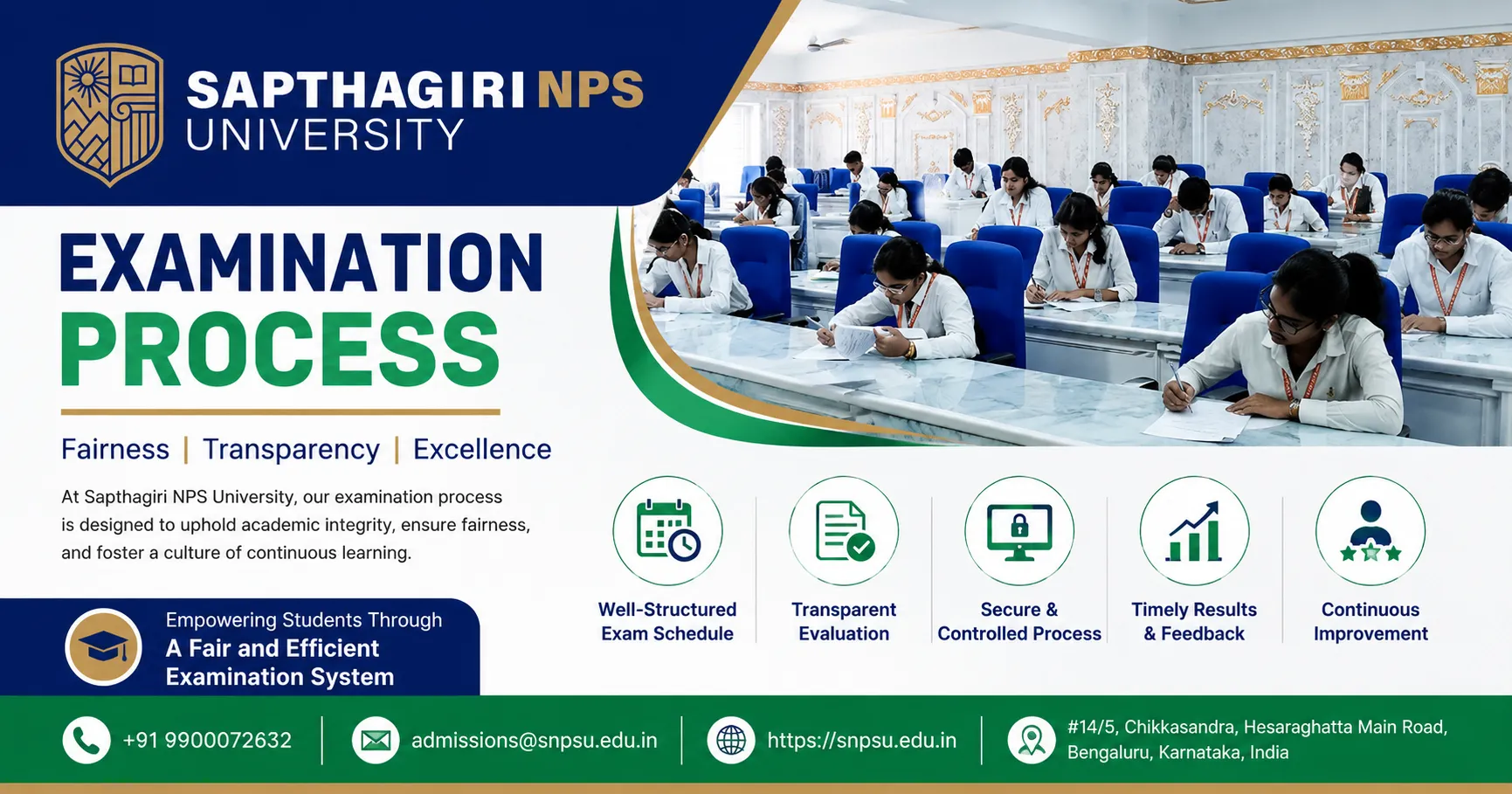
Sapthagiri NPS University Examination Process: A Complete Guide for Students and Parents
Choosing a university involves far more than selecting a programme or comparing facilities. Students and parents also seek confidence in the academic systems that guide learning, measure progress, and recognize achievement. A well-structured examination framework provides transparency, fairness, and opportunities for continuous improvement throughout a student's educational journey.
Our University, academic assessment is designed to encourage consistent learning rather than last-minute preparation. The Sapthagiri NPS University Examination Process reflects our commitment to maintaining academic standards while supporting individual growth. Through carefully planned internal assessments, semester-end examinations, practical evaluations, project work, and continuous faculty guidance, students develop subject knowledge alongside analytical thinking, communication abilities, and professional competence.
Our approach extends beyond awarding grades. Every assessment is intended to strengthen understanding, identify areas for improvement, and prepare students for future academic pursuits and professional responsibilities. By integrating classroom participation, practical learning, research activities, and industry-oriented assignments into the evaluation framework, we create an environment where learning remains active throughout the semester.
This guide explains the examination process followed at Our University while also introducing prospective students to our academic environment, admissions process, learning resources, career development initiatives, campus experience, and student support services.
Understanding the Sapthagiri NPS University Examination Process
Our Sapthagiri NPS University, we believe that examinations should do more than measure academic performance they should inspire continuous learning, critical thinking, practical application, and professional growth. Our examination process is thoughtfully designed to provide students with multiple opportunities to demonstrate their knowledge, skills, creativity, and overall academic development throughout their educational journey.
Rather than relying exclusively on a single final examination, Sapthagiri NPS University follows a comprehensive and continuous evaluation system that encourages students to remain actively engaged with their studies from the beginning to the end of every semester. This balanced approach promotes consistent learning habits, reduces unnecessary examination pressure, and helps students build confidence through regular academic participation.
Our assessment framework is aligned with programme outcomes, course objectives, and industry expectations, ensuring that students not only understand theoretical concepts but also develop practical competencies required for successful careers. Every assessment is carefully planned to evaluate subject knowledge, analytical ability, innovation, communication skills, teamwork, research aptitude, ethical values, and professional readiness.
Need Guidance? Connect with Our Admissions Team
Planning your university education is an important decision, and having the right information can make the process much easier. Whether you have questions about the Sapthagiri NPS University Examination Process, admission eligibility, programme selection, application procedures, scholarships, campus facilities, or career opportunities, our Admissions Team is here to provide personalized assistance.
We encourage prospective students and parents to connect with us for one-to-one counselling and receive accurate guidance before beginning the admission process.
Admissions Contact Details
| Information | Details |
|---|---|
| University | Sapthagiri NPS University |
| Admissions Helpline | +91 9900072632 |
| admissions@snpsu.edu.in | |
| Official Website | https://snpsu.edu.in/ |
| Apply Online | https://admission.snpsu.edu.in/ |
| Campus Address | #14/5, Chikkasandra, Hesaraghatta Main Road, Bengaluru, Karnataka, India |
Our Comprehensive Evaluation Approach
Our Sapthagiri NPS University, we follow a comprehensive and student-centric evaluation system that measures academic achievement, practical knowledge, critical thinking, and professional competencies. Our assessment framework is designed to promote continuous learning and holistic development, ensuring that students are evaluated through multiple methods rather than relying solely on a single final examination. Depending on the programme and course requirements, our evaluation process may include the following components:
Internal Assessment Examinations
We conduct internal assessment examinations throughout the semester to evaluate students' understanding of course concepts. These assessments encourage regular learning, reinforce classroom teaching, and provide opportunities for students to improve their performance before the end-semester examinations.
Continuous Classroom Assessments
Our faculty continuously evaluate students through classroom participation, quizzes, discussions, presentations, and other academic activities. This approach encourages active engagement, consistent learning, and meaningful interaction throughout the semester.
Assignments and Coursework
We encourage students to complete assignments and coursework that strengthen analytical thinking, independent learning, research abilities, and academic writing. These activities help students apply theoretical concepts to practical situations while developing problem-solving skills.
Laboratory Performance Evaluation
For programmes with practical components, we assess students on their laboratory performance, including experimental procedures, technical skills, observation, record maintenance, analytical ability, and safe laboratory practices. This evaluation helps build practical competence and technical confidence.
Practical Examinations
Our practical examinations assess students' ability to apply classroom knowledge in real-world scenarios. These assessments develop technical proficiency, accuracy, problem-solving skills, and professional readiness across various disciplines.
Project Work and Project Presentations
We promote project-based learning that enables students to explore innovative ideas, conduct research, and solve practical challenges. Project evaluations consider planning, execution, technical knowledge, teamwork, creativity, documentation, and presentation skills.
Case Study Analysis
Through case study analysis, we encourage students to examine real-world situations, evaluate possible solutions, and apply theoretical knowledge to practical problems. This method strengthens analytical thinking, decision-making, and industry-oriented learning.
Research-Based Activities
Our academic environment encourages participation in research-based activities that develop curiosity, innovation, critical thinking, and evidence-based learning. These activities help students gain deeper subject knowledge while nurturing a research-oriented mindset.
Seminar Presentations
We organize seminar presentations to help students improve communication, public speaking, presentation, and subject interpretation skills. These sessions encourage confidence while allowing students to share ideas and academic insights with faculty and peers.
Viva Voce Examinations
Our viva voce examinations assess students through direct interaction with faculty members, evaluating conceptual clarity, communication skills, confidence, analytical ability, and overall understanding of the subject.
Technical Demonstrations
Technical demonstrations provide opportunities for students to showcase practical applications of their knowledge through models, software, prototypes, experiments, and discipline-specific technical solutions. These assessments highlight innovation, technical competence, and practical expertise.
Group Discussions and Team-Based Learning Activities
We encourage collaborative learning through group discussions and team-based activities that strengthen leadership, teamwork, communication, interpersonal skills, and collaborative problem-solving while preparing students for professional work environments.
End-Semester Examinations
Our end-semester examinations provide a comprehensive assessment of the knowledge, skills, and competencies acquired throughout the semester. These examinations evaluate conceptual understanding, analytical ability, subject proficiency, and overall academic achievement.
Our Commitment to Fair and Holistic Assessment
Our comprehensive evaluation approach reflects our commitment to academic excellence, transparency, and student success. By combining continuous assessments with practical learning, research, projects, presentations, and end-semester examinations, we create an environment that supports continuous improvement and prepares our students with the knowledge, practical skills, confidence, and professional competencies required to excel in higher education and successful careers.
Why Our Structured Examination System Matters
Our Sapthagiri NPS University, we believe that a well-structured examination system is an essential pillar of quality higher education. Examinations are not simply a means of awarding grades; they are an integral part of the learning journey that helps students evaluate their academic progress, strengthen their knowledge, and develop the skills required for lifelong success. Our examination framework is carefully designed to ensure that every student is assessed fairly, transparently, and comprehensively while encouraging continuous improvement throughout the semester.
A structured examination system creates a clear roadmap for learning by defining academic expectations, assessment criteria, and evaluation standards. Students understand what is expected of them at every stage of their programme, enabling them to prepare systematically and participate actively in their academic activities. This clarity promotes confidence, reduces uncertainty, and encourages students to take greater responsibility for their own learning.
Unlike traditional examination systems that depend entirely on a single final examination, our comprehensive evaluation approach recognizes that learning is a continuous process. By incorporating multiple assessment methods throughout the semester, we provide students with several opportunities to demonstrate their understanding, improve their performance, and receive valuable feedback from faculty members. This continuous engagement helps students build strong academic foundations while reducing the stress associated with one-time high-stakes examinations.
Our structured examination process also encourages students to develop disciplined study habits. Regular internal assessments, assignments, practical sessions, seminars, projects, and classroom activities motivate students to remain consistently engaged with their coursework instead of concentrating their preparation only during examination periods. This habit of continuous learning promotes better retention of knowledge, deeper conceptual understanding, and greater academic confidence.
Another important advantage of our examination system is its focus on holistic student development. Academic excellence extends beyond theoretical knowledge, and our evaluation methods are designed to assess multiple competencies that contribute to professional success. Through a balanced combination of written examinations, practical assessments, project work, research activities, presentations, and viva voce examinations, students develop critical thinking, analytical reasoning, communication skills, creativity, teamwork, leadership, and problem-solving abilities. Our examination framework helps students:
- Measure their academic progress throughout every semester.
- Build confidence through continuous evaluation and constructive feedback.
- Strengthen conceptual understanding across different subjects.
- Improve critical thinking and analytical problem-solving skills.
- Apply theoretical knowledge in practical and real-world situations.
- Enhance communication and presentation abilities.
- Develop research aptitude and innovation.
- Improve technical and professional competencies.
- Strengthen teamwork, collaboration, and leadership qualities.
- Develop effective time management and organizational skills.
- Build discipline, responsibility, and accountability in their academic journey.
- Prepare confidently for higher education, competitive examinations, entrepreneurship, and professional careers.
One of the most valuable aspects of our structured examination system is the opportunity for continuous feedback. Faculty members regularly evaluate students' performance and provide guidance that helps them recognize their strengths while identifying areas that require further improvement. This ongoing interaction creates a supportive academic environment where students can continuously refine their learning strategies and improve their overall performance before the end-semester examinations.
The examination process also enables our faculty to monitor individual academic progress closely. When students require additional academic assistance, personalized mentoring, remedial support, and faculty guidance help address learning challenges at an early stage. This proactive approach ensures that every student receives appropriate support to achieve their academic potential and successfully progress through their programme.
Transparency is another important feature of our examination philosophy. Our assessment procedures are conducted according to established academic regulations and clearly defined evaluation criteria. This commitment to fairness promotes trust, integrity, and accountability while ensuring that every student is evaluated objectively based on their performance and demonstrated learning outcomes.
Our structured examination system also reflects the University's commitment to preparing graduates for an evolving global environment. Modern employers seek professionals who possess not only academic knowledge but also practical expertise, communication skills, analytical thinking, adaptability, and ethical responsibility. By integrating continuous assessments with practical learning, project-based education, research activities, and comprehensive examinations, we help students develop these essential competencies throughout their academic journey.
Ultimately, our examination process supports the broader mission of Sapthagiri NPS University to nurture knowledgeable, skilled, confident, and socially responsible graduates. Every assessment is designed to encourage continuous learning, academic excellence, innovation, and professional growth. Through a fair, transparent, and student-focused evaluation system, we empower our students to realize their full potential, excel in their chosen fields, and contribute meaningfully to society with competence, integrity, and confidence.
Academic Environment Designed for Future-Ready Learning
Our Sapthagiri NPS University, we believe that an effective examination system begins with an engaging and inspiring academic environment. Examinations are most meaningful when they reflect the knowledge, skills, and experiences students gain throughout their learning journey. Therefore, we focus on creating a student-centric ecosystem where classroom learning, practical experiences, innovation, research, and industry exposure work together to prepare students for academic success and future careers.
Our academic environment encourages curiosity, creativity, collaboration, and continuous improvement. Students are motivated to actively participate in lectures, laboratory sessions, workshops, seminars, projects, and research activities that strengthen both conceptual understanding and practical competence. This holistic approach ensures that examinations become a natural outcome of continuous learning rather than isolated academic events.
By integrating modern teaching methodologies with experiential learning opportunities, we help students develop confidence, critical thinking, and professional skills that extend far beyond the classroom. Every academic activity contributes to building the knowledge and competencies required to excel in examinations while preparing graduates to meet the expectations of higher education, research institutions, and diverse industries.
Curriculum with Contemporary Relevance
Our curriculum is thoughtfully designed to provide students with a balanced combination of strong theoretical foundations and practical applications. We recognize that today's professional landscape is constantly evolving due to technological advancements, changing industry requirements, and emerging global opportunities. To ensure that our graduates remain competitive and future-ready, our academic programmes are periodically reviewed and enhanced in alignment with current educational standards and professional expectations.
The curriculum emphasizes outcome-based learning that encourages students to understand concepts deeply rather than relying solely on memorization. Classroom instruction is complemented by practical learning, industry-oriented projects, laboratory experiences, case studies, seminars, and research activities that enable students to apply their knowledge in meaningful ways.
Through this contemporary academic framework, students develop competencies that support both examination success and long-term career growth. Our programmes encourage learners to cultivate:
- Critical thinking and analytical reasoning
- Innovation and creative problem-solving
- Ethical values and responsible decision-making
- Research orientation and scientific inquiry
- Professional communication and presentation skills
- Digital literacy and technological competence
- Interdisciplinary learning and collaborative thinking
- Leadership and teamwork abilities
- Adaptability in dynamic professional environments
- Lifelong learning habits
By integrating these competencies into the curriculum, our examination process evaluates students on their understanding, application of knowledge, analytical abilities, and professional readiness rather than simple memorization of facts. This approach enables students to develop a deeper appreciation of their chosen disciplines while preparing them for successful careers in an increasingly knowledge-driven world.
Faculty Mentorship
Our Sapthagiri NPS University, our faculty members play a vital role in guiding students throughout their academic journey. We believe that effective mentorship extends beyond classroom teaching and contributes significantly to students' academic achievement, personal growth, and professional development.
Our experienced faculty members are committed to creating an interactive and supportive learning environment where students are encouraged to ask questions, explore new ideas, and participate actively in academic discussions. Throughout the semester, faculty provide continuous guidance that helps students strengthen conceptual understanding, improve learning strategies, and prepare confidently for various assessments.
Regular mentoring sessions enable students to discuss academic challenges, clarify subject-related concepts, receive constructive feedback, and identify opportunities for improvement. Faculty members monitor individual academic progress and provide personalized support whenever required, ensuring that students remain motivated and focused on achieving their educational goals.
Beyond examination preparation, our mentors encourage students to participate in research activities, technical competitions, seminars, workshops, innovation projects, internships, and professional development programmes that enhance their overall learning experience. This comprehensive mentorship approach helps students build confidence, improve communication skills, develop leadership qualities, and cultivate a lifelong passion for learning.
By combining academic excellence with personalized faculty guidance, Sapthagiri NPS University creates an educational environment where students are empowered to excel in examinations, pursue higher education, contribute to research and innovation, and succeed in their chosen professions with competence, confidence, and integrity.
Practical Learning
Our Sapthagiri NPS University, we believe that meaningful education extends beyond textbooks and traditional classroom instruction. Practical learning forms an integral part of our academic philosophy, enabling students to transform theoretical knowledge into real-world skills. By participating in hands-on experiences, students gain a deeper understanding of concepts while developing the confidence and competencies required for academic success and professional excellence.
Our programmes are designed to provide experiential learning opportunities that encourage students to explore, experiment, analyse, and innovate. Practical exposure helps bridge the gap between classroom learning and industry expectations, ensuring that students are well prepared to solve real-world challenges with confidence and competence. To support this objective, our academic environment incorporates a variety of practical learning experiences, including:
Laboratory Sessions
Laboratory sessions provide students with valuable hands-on experience by allowing them to apply theoretical concepts in a practical environment. Under the guidance of experienced faculty, students perform experiments, use modern equipment, analyse results, and develop technical competencies. These sessions strengthen conceptual understanding, improve observation and analytical skills, and build the confidence required to solve real-world technical challenges.
Workshops and Skill Development Programmes
Workshops and skill development programmes are designed to enhance students' technical, professional, and interpersonal competencies beyond the regular curriculum. These sessions introduce students to emerging technologies, industry practices, software tools, communication techniques, and career-oriented skills. By participating in workshops, students gain practical exposure that complements classroom learning and improves their overall employability.
Technical Demonstrations
Technical demonstrations help students understand the practical application of theoretical concepts through live demonstrations, prototypes, models, software applications, and engineering solutions. These sessions encourage students to observe complex processes, ask questions, and gain deeper insights into subject-specific concepts while developing their technical knowledge and problem-solving abilities.
Simulation and Application-Based Exercises
Simulation and application-based exercises create realistic learning environments where students can practise applying academic concepts to practical situations. These activities help students develop analytical thinking, decision-making, troubleshooting abilities, and confidence while preparing them to handle real-world professional challenges effectively.
Group Projects and Collaborative Learning Activities
Group projects encourage students to work collaboratively in teams to solve problems, develop innovative solutions, and complete academic assignments. These activities strengthen teamwork, leadership, communication, planning, and project management skills while helping students learn from diverse perspectives and shared experiences.
Field Visits and Educational Tours
Field visits and educational tours provide students with first-hand exposure to industries, research centres, manufacturing facilities, healthcare institutions, and other professional environments relevant to their academic programmes. These experiences help students understand how classroom knowledge is applied in real-world settings while broadening their practical understanding of their chosen discipline.
Industry Interactions and Expert Sessions
Industry interactions and expert sessions connect students with experienced professionals, industry leaders, entrepreneurs, researchers, and subject experts. Through guest lectures, panel discussions, technical talks, and interactive sessions, students gain valuable insights into current industry trends, career opportunities, technological advancements, and professional expectations, helping them prepare for successful careers.
Project-Based Learning
Project-based learning enables students to apply theoretical knowledge by working on practical, innovative, and research-oriented projects. Students identify problems, develop solutions, conduct research, design prototypes, and present their findings under faculty guidance. This approach promotes creativity, independent learning, critical thinking, technical expertise, and innovation while preparing students for industry and higher education.
Research-Oriented Activities
Research-oriented activities encourage students to develop an investigative mindset by exploring new ideas, analysing information, reviewing literature, conducting experiments, and presenting evidence-based findings. Participation in research helps students strengthen analytical reasoning, scientific inquiry, innovation, and academic writing while contributing to lifelong learning and intellectual growth.
Practical Assignments and Technical Exercises
Practical assignments and technical exercises reinforce classroom learning by encouraging students to apply theoretical concepts to real-life problems. These activities may include programming tasks, engineering designs, technical reports, case analyses, software applications, calculations, and discipline-specific exercises. They help students improve technical proficiency, accuracy, problem-solving abilities, and independent learning while preparing them for examinations and professional responsibilities.
These experiences allow students to apply theoretical concepts in practical settings, improving their analytical thinking, technical proficiency, problem-solving abilities, and decision-making skills. Working on real-world applications also enhances creativity, teamwork, communication, and leadership qualities, which are essential for both higher education and professional careers.
Practical learning further strengthens students' understanding of classroom concepts by providing opportunities to observe, analyse, and implement academic principles in realistic environments. Whether conducting laboratory experiments, participating in workshops, developing innovative projects, or engaging with industry professionals, students gain valuable exposure that enriches their overall educational experience.
Our faculty members actively guide students throughout these practical learning activities, encouraging them to ask questions, explore new ideas, and develop innovative solutions. Continuous feedback and mentoring ensure that students maximize the benefits of every practical experience while improving their technical and academic competencies.
This emphasis on experiential learning also supports our comprehensive examination process. Students who regularly participate in practical sessions often develop stronger conceptual understanding, greater confidence, and improved performance in laboratory assessments, practical examinations, project evaluations, presentations, and end-semester examinations.
By integrating practical learning into every stage of the academic journey, Sapthagiri NPS University prepares students not only to perform well in examinations but also to become industry-ready professionals equipped with the knowledge, skills, adaptability, and confidence to succeed in an ever-evolving global environment.
Building Knowledge Through Continuous Assessment
The philosophy behind the Sapthagiri NPS University Examination Process emphasizes continuous academic engagement. Rather than concentrating evaluation into a single event, learning is monitored across multiple academic activities. Continuous assessment encourages students to:
- Participate actively in classes
- Complete assignments on time
- Develop independent learning habits
- Strengthen research skills
- Improve communication abilities
- Collaborate effectively with peers
- Build confidence through regular feedback
This model also reduces examination-related pressure by distributing assessment across the semester.
Learning Resources Supporting Academic Success
Our Sapthagiri NPS University, we believe that academic excellence is achieved through access to quality learning resources that support classroom instruction, independent study, and continuous knowledge development. To help students prepare effectively for examinations and strengthen their understanding of every subject, we provide a comprehensive academic environment equipped with a variety of learning resources.
Our learning ecosystem encourages students to go beyond classroom lectures by exploring additional reference materials, research publications, digital resources, and subject-specific content. These resources promote self-directed learning, critical thinking, research aptitude, and academic confidence while helping students perform successfully in internal assessments, practical evaluations, projects, and end-semester examinations.
By utilizing these resources throughout the semester, students can deepen their conceptual understanding, clarify complex topics, stay informed about recent developments in their disciplines, and develop lifelong learning habits that contribute to academic and professional success.
Library Resources
Our library serves as an important academic resource centre that supports teaching, learning, research, and examination preparation. Designed to provide students and faculty with access to a wide range of educational materials, the library encourages independent learning, intellectual curiosity, and continuous academic growth. Students have access to a diverse collection of learning resources, including:
Printed Textbooks
Printed textbooks form the foundation of academic learning by providing comprehensive coverage of course syllabi. Carefully selected by academic departments, these books help students build a strong understanding of fundamental concepts and support regular classroom learning as well as examination preparation.
Reference Books
Reference books offer detailed explanations, advanced concepts, and additional examples that complement prescribed textbooks. They enable students to gain deeper subject knowledge, clarify complex topics, and strengthen their conceptual understanding for assignments, projects, and examinations.
Academic Journals
Academic journals provide access to scholarly articles, peer-reviewed research, and recent developments across various disciplines. These publications encourage critical thinking, support research activities, and help students stay informed about current trends and innovations in their fields of study.
Research Publications
Research publications expose students to scientific discoveries, industry advancements, and evidence-based studies conducted by researchers and academicians. These resources encourage analytical thinking, research aptitude, and a deeper understanding of contemporary academic and professional issues.
Digital Learning Resources
Digital learning resources provide convenient access to educational materials through online platforms and electronic databases. Students can explore multimedia content, academic references, study materials, and digital resources that support flexible, self-paced learning and examination preparation.
E-Books
E-books offer students easy access to a wide range of academic titles in digital format. Available across various disciplines, they enable students to study anytime and from multiple devices, making learning more accessible, convenient, and efficient.
Periodicals and Magazines
Academic periodicals and educational magazines provide insights into current affairs, industry developments, technological innovations, and emerging trends. These publications help students broaden their knowledge beyond the curriculum while encouraging awareness of real-world applications.
Subject-Specific Collections
Subject-specific collections contain specialized books, manuals, reference materials, and academic resources related to individual disciplines. These curated collections support advanced learning, project work, research activities, and comprehensive examination preparation.
Technical Manuals
Technical manuals provide detailed guidance on equipment, software, laboratory procedures, engineering practices, and technical operations. These resources enhance practical learning by helping students understand industry-standard methods, technical specifications, and professional applications.
Previous Academic References
Previous academic references, including sample question papers, model papers, and academic resources, help students understand examination patterns, question formats, and evaluation methods. These materials support systematic revision and improve confidence before assessments.
Encyclopedias and Reference Works
Encyclopedias and comprehensive reference works provide reliable background information across a wide range of academic subjects. They help students build foundational knowledge, explore unfamiliar topics, and access authentic information for assignments, presentations, and research.
Career and Competitive Examination Resources
Career guidance materials and competitive examination resources help students prepare for higher education, professional certifications, government examinations, and recruitment processes. These resources strengthen aptitude, reasoning, communication, and subject knowledge while supporting long-term career development.
These resources help students gain a deeper understanding of course concepts while supporting assignments, project work, research activities, seminars, and examination preparation. Access to authoritative academic literature enables students to explore topics in greater depth, analyse multiple perspectives, and develop evidence-based knowledge beyond the prescribed curriculum.
Our library also provides a quiet and student-friendly learning environment where students can concentrate on reading, research, revision, and self-study. Whether preparing for internal assessments, laboratory evaluations, project presentations, or end-semester examinations, students can make effective use of the available resources to strengthen their academic performance and expand their knowledge.
By encouraging regular use of library resources, Sapthagiri NPS University fosters a culture of continuous learning, research, innovation, and academic excellence, empowering students to achieve their educational goals and become knowledgeable, confident, and future-ready professionals.
Digital Learning Support
Our Sapthagiri NPS University, we recognize the important role of technology in enhancing teaching, learning, and academic success. Our digital learning ecosystem complements classroom instruction by providing students with flexible, accessible, and engaging educational resources. By integrating technology into the learning process, we encourage students to explore concepts independently, strengthen their understanding, and prepare effectively for various academic assessments.
Digital learning tools enable students to access educational content beyond regular classroom hours, making it easier to revise lessons, complete assignments, collaborate with peers, and stay connected with academic activities. These resources support self-paced learning while promoting digital literacy, critical thinking, and independent study habits that are essential for higher education and professional careers. Our digital learning support may include:
- Digital learning platforms
- Online academic resources
- Presentation tools
- Multimedia learning content
- Recorded academic sessions (where applicable)
- Collaborative learning environments
By utilizing these digital resources, students can reinforce classroom learning, review important concepts, revisit lectures when available, and gain access to additional educational materials that enhance subject understanding. Technology-enabled learning also encourages active participation, interactive learning experiences, and greater academic engagement throughout the semester.
Digital Learning Platforms
Our digital learning platforms provide students with convenient access to academic materials, learning resources, assignments, announcements, and course-related information. These platforms support continuous learning by enabling students to access educational content anytime and from various devices, making learning more flexible and efficient.
Online Academic Resources
Students can utilize online academic resources to explore additional study materials, scholarly references, research content, and educational databases. These resources support classroom instruction while encouraging independent learning, deeper subject exploration, and effective examination preparation.
Presentation Tools
Presentation tools help students prepare and deliver academic presentations, seminars, project demonstrations, and research discussions. By using modern presentation technologies, students improve their communication skills, confidence, creativity, and ability to present complex concepts in a structured and professional manner.
Multimedia Learning Content
Multimedia learning content, including educational videos, animations, graphics, interactive modules, and visual demonstrations, enhances conceptual understanding by presenting complex topics in an engaging and easy-to-understand format. These resources accommodate different learning styles and make academic concepts more accessible.
Recorded Academic Sessions (Where Applicable)
Where applicable, recorded academic sessions provide students with the opportunity to revisit lectures, review important topics, and reinforce classroom learning at their own pace. These recordings support revision, help clarify difficult concepts, and enable students to prepare more effectively for internal assessments and end-semester examinations.
Collaborative Learning Environments
Collaborative learning environments encourage students to work together through group discussions, project collaboration, knowledge sharing, and interactive academic activities. These digital spaces promote teamwork, communication, problem-solving, and peer learning while creating an engaging and supportive educational experience.
Through the integration of modern digital learning technologies, Sapthagiri NPS University empowers students to learn more effectively, remain academically engaged, and prepare confidently for examinations while developing the digital competencies required for lifelong learning and professional success.
Academic Guidance Sessions
Our Sapthagiri NPS University, we believe that continuous academic guidance plays a vital role in helping students achieve their educational goals. Learning becomes more effective when students receive timely support, personalized mentoring, and opportunities to clarify concepts throughout the semester. Our academic guidance initiatives are designed to strengthen subject knowledge, improve examination readiness, and encourage students to become confident, independent learners.
Beyond regular classroom instruction, students are encouraged to participate in a variety of academic support activities that provide additional opportunities for learning, revision, and skill enhancement. These initiatives enable students to reinforce important concepts, address academic challenges, and receive valuable guidance from experienced faculty members. Our academic guidance initiatives may include:
- Revision classes
- Faculty interaction sessions
- Doubt-clearing discussions
- Academic workshops
- Skill-development programmes
- Subject enrichment activities
These academic support programmes help students build a stronger foundation in their subjects while promoting consistent learning and active classroom engagement. Faculty members provide constructive feedback, explain complex concepts, and encourage students to ask questions, participate in discussions, and develop effective study strategies.
Through continuous academic guidance, students gain greater confidence in their abilities, improve their analytical thinking, strengthen conceptual understanding, and prepare more effectively for internal assessments, practical examinations, project evaluations, and end-semester examinations. These initiatives also foster independent learning, time management, and problem-solving skills that contribute to long-term academic success and professional development.
Revision Classes
Revision classes are conducted to help students revisit important concepts covered during the semester. These sessions reinforce classroom learning, clarify key topics, and support systematic preparation for internal assessments and end-semester examinations. Faculty members focus on strengthening conceptual understanding while helping students identify important areas for revision.
Faculty Interaction Sessions
Faculty interaction sessions provide students with opportunities to engage directly with their instructors outside regular classroom teaching. These sessions encourage open communication, academic discussions, and personalized guidance, enabling students to seek clarification, receive feedback, and gain a deeper understanding of their subjects.
Doubt-Clearing Discussions
Doubt-clearing discussions create an interactive learning environment where students can ask questions and resolve academic difficulties. Faculty members provide detailed explanations, simplify complex topics, and guide students toward a better understanding of concepts, helping them build confidence and improve their examination performance.
Academic Workshops
Academic workshops offer focused learning experiences that enhance subject knowledge, practical skills, and analytical thinking. These sessions often include interactive activities, demonstrations, case studies, and problem-solving exercises that complement classroom instruction and promote experiential learning.
Skill-Development Programmes
Skill-development programmes are designed to strengthen technical, communication, analytical, and professional competencies that support both academic achievement and career readiness. These programmes encourage students to develop practical skills, improve confidence, and enhance their overall learning experience.
Subject Enrichment Activities
Subject enrichment activities provide opportunities for students to explore topics beyond the prescribed curriculum through seminars, expert lectures, discussions, research-oriented learning, and academic events. These activities broaden students' perspectives, encourage intellectual curiosity, and promote a deeper appreciation of their chosen disciplines.
Through these comprehensive academic guidance initiatives, Sapthagiri NPS University creates a supportive learning environment where students receive continuous encouragement, expert mentorship, and the academic resources needed to excel in examinations while developing the knowledge, skills, and confidence required for lifelong success.
Academic Integrity and Responsible Learning
Our Sapthagiri NPS University, we believe that academic excellence is built on a strong foundation of integrity, honesty, responsibility, and ethical conduct. While examinations assess students' knowledge and skills, they also reflect the values, discipline, and professionalism that students develop throughout their academic journey. Our commitment to academic integrity ensures that every assessment is conducted in a fair, transparent, and respectful learning environment where merit and genuine effort are recognized.
We encourage every student to approach learning with sincerity, curiosity, and a commitment to producing original work. Upholding academic integrity not only enhances the quality of education but also strengthens students' credibility, self-confidence, and professional character. These values remain important long after graduation, supporting success in higher education, research, entrepreneurship, and professional careers. Students are expected to demonstrate honesty, originality, and ethical behaviour in all academic activities, including:
- Written examinations
- Internal assessments
- Practical and laboratory examinations
- Assignments and coursework
- Project work and project reports
- Research activities and research submissions
- Seminar presentations
- Viva voce examinations
- Technical demonstrations
- Group projects and collaborative learning activities
By maintaining high standards of academic integrity, students contribute to a culture of fairness, mutual respect, and academic excellence. Producing original work, acknowledging sources appropriately, and completing assessments with honesty help preserve the credibility and value of the qualifications earned at the University.
Academic integrity also prepares students for professional environments where ethical decision-making, accountability, transparency, and responsible conduct are essential. Developing these values during higher education enables graduates to become trustworthy professionals who contribute positively to their organizations and society.
Our faculty members play an important role in promoting responsible academic practices throughout the learning process. Students receive continuous guidance on ethical learning, proper academic conduct, effective research practices, appropriate referencing and citation methods, and the importance of creating original work. Faculty mentors also encourage students to develop independent thinking, conduct research responsibly, and respect intellectual property while maintaining the highest standards of academic ethics.
Through continuous awareness, faculty mentorship, and a culture of responsible learning, Sapthagiri NPS University fosters an academic environment where integrity, accountability, and excellence go hand in hand. By embracing these values, our students graduate not only with strong academic knowledge and practical skills but also with the ethical principles and professional responsibility required to succeed with confidence and integrity in a rapidly evolving global environment.
The Role of Examinations in Career Readiness
Our Sapthagiri NPS University, we believe that examinations should prepare students not only for academic success but also for meaningful professional careers. In today's rapidly evolving employment landscape, organizations seek graduates who possess strong subject knowledge along with practical skills, critical thinking, communication abilities, adaptability, and the confidence to solve real-world challenges. Our examination process is designed to support these expectations by evaluating students through a balanced combination of theoretical, practical, and application-based assessments.
Rather than measuring learning solely through traditional written examinations, our comprehensive evaluation system encourages students to demonstrate their knowledge in diverse academic settings. By integrating projects, presentations, laboratory work, practical examinations, seminars, research activities, and collaborative learning into the assessment process, we help students develop the competencies required to succeed in higher education, research, entrepreneurship, and professional careers.
This holistic approach enables students to move beyond memorization and focus on understanding concepts, analysing problems, applying knowledge, and communicating ideas effectively. Throughout their academic journey, students are encouraged to think independently, explore innovative solutions, collaborate with peers, and approach challenges with confidence and professionalism. Our examination process helps students develop essential career-oriented competencies, including the ability to:
- Analyse complex situations using logical and critical thinking.
- Apply theoretical knowledge to practical and industry-related scenarios.
- Solve real-world problems through structured and innovative approaches.
- Present ideas clearly and confidently during seminars, presentations, and project demonstrations.
- Communicate effectively with faculty members, peers, and professionals.
- Work collaboratively in multidisciplinary teams and contribute constructively to group activities.
- Plan, organize, and complete academic tasks within specified timelines.
- Manage multiple responsibilities while developing effective time-management skills.
- Conduct research, evaluate information, and make evidence-based decisions.
- Demonstrate creativity, innovation, and independent thinking in project work.
- Build professional confidence through continuous assessment and constructive feedback.
- Adapt to changing technologies, workplace expectations, and evolving professional environments.
Internal Assessment and Semester Examination System at Our University
A thoughtfully designed examination system encourages students to remain engaged with their studies throughout the academic session. At Our University, assessment is viewed as a continuous academic journey rather than a single event conducted at the end of the semester. The Sapthagiri NPS University Examination Process combines continuous evaluation, practical learning, project-based assessment, and semester-end examinations to create a balanced academic framework.
Every programme follows an assessment methodology that aligns with its curriculum, programme outcomes, and learning objectives. While specific evaluation patterns may differ depending on the discipline and regulatory requirements, the overall objective remains the same—to assess knowledge, application of concepts, analytical thinking, communication abilities, and professional preparedness in a transparent and systematic manner.
Our Faculty members guide students throughout the semester, ensuring that assessments become opportunities for learning, improvement, and academic growth rather than occasions of unnecessary stress.
Continuous Internal Assessment: Encouraging Consistent Learning
Our Sapthagiri NPS University, we believe that meaningful learning is achieved through consistent academic engagement rather than relying solely on a single end-semester examination. Our Continuous Internal Assessment (CIA) approach is designed to encourage students to participate actively in their learning journey throughout the semester, helping them build strong academic foundations, develop practical skills, and continuously improve their performance.
Continuous Internal Assessment provides students with multiple opportunities to demonstrate their knowledge, apply classroom concepts, and receive constructive feedback from faculty members. Instead of concentrating all evaluation at the end of the semester, our assessment process promotes regular learning, allowing students to strengthen their understanding gradually while reducing the pressure often associated with one-time examinations.
Through periodic assessments, students remain actively engaged with their coursework and develop habits that support long-term academic success. Regular evaluation also enables faculty members to monitor student progress, identify areas that require additional attention, and provide timely academic guidance that helps students improve before the final examinations. Our Continuous Internal Assessment approach encourages students to:
- Develop disciplined and consistent study habits.
- Participate actively in classroom learning and academic discussions.
- Receive regular academic feedback from faculty members.
- Strengthen conceptual understanding across different subjects.
- Improve analytical thinking and problem-solving abilities.
- Enhance communication and presentation skills.
- Build confidence through continuous learning and assessment.
- Strengthen practical knowledge through laboratory work and application-based activities.
- Develop independent learning and research skills.
- Identify learning gaps at an early stage and address them effectively.
- Improve time-management and organizational abilities.
- Prepare systematically for end-semester examinations.
Continuous Internal Assessment may include a combination of written tests, quizzes, assignments, laboratory evaluations, practical exercises, project work, seminars, presentations, case studies, research activities, classroom participation, and other programme-specific academic activities. Each assessment contributes to evaluating different aspects of student learning while encouraging active participation throughout the semester.
One of the key advantages of continuous assessment is that it transforms examinations into an ongoing learning experience rather than a single measure of academic performance. Students receive valuable feedback after each assessment, enabling them to recognize their strengths, improve areas requiring additional attention, and adopt more effective study strategies. This continuous cycle of learning, evaluation, and improvement helps students achieve greater academic confidence and stronger overall performance.
The Continuous Internal Assessment system also promotes a deeper understanding of subjects by encouraging students to engage with course material regularly instead of preparing only during examination periods. This consistent approach enhances knowledge retention, strengthens critical thinking, and enables students to apply theoretical concepts more effectively in practical situations.
For programmes that include laboratory work, projects, research activities, and practical learning, continuous assessment provides opportunities to evaluate technical competence, innovation, creativity, teamwork, communication, and professional skills alongside academic knowledge. As a result, students graduate with a balanced combination of theoretical understanding and practical expertise.
Our faculty members play an essential role in the success of the Continuous Internal Assessment process. Through regular mentoring, constructive feedback, academic guidance, and personalized support, they help students overcome learning challenges, improve performance, and remain motivated throughout the semester. This supportive learning environment encourages students to become confident, responsible, and self-directed learners.
By distributing assessment throughout the semester, Sapthagiri NPS University creates a fair, transparent, and student-focused evaluation system that promotes continuous improvement, reduces examination-related stress, and encourages lifelong learning. Our Continuous Internal Assessment approach not only supports academic excellence but also prepares students with the discipline, confidence, and professional competencies required to succeed in higher education and dynamic career environments.
Components of Internal Assessment
Our Sapthagiri NPS University, our Continuous Internal Assessment (CIA) framework is designed to evaluate students through a variety of academic activities that reflect both their theoretical understanding and practical abilities. Rather than depending on a single method of evaluation, internal assessment provides multiple opportunities for students to demonstrate their academic progress throughout the semester.
The specific components of internal assessment may vary depending on the programme, course objectives, and learning outcomes. This flexible approach allows faculty members to assess different aspects of student learning while encouraging consistent academic participation, independent thinking, and continuous improvement. Internal assessment may include one or more of the following academic activities:
- Internal Written Tests
- Classroom Assignments
- Practical and Laboratory Assessments
- Project Work
- Seminar Presentations
- Case Study Analysis
- Research-Based Activities
- Viva Voce
- Classroom Participation
- Technical Demonstrations
- Group Discussions and Collaborative Activities
- Programme-specific Evaluation Components
Each assessment contributes to the overall learning process by helping students strengthen conceptual understanding, improve practical skills, and prepare confidently for end-semester examinations.
Internal Written Tests
Internal written tests are one of the key components of our Continuous Internal Assessment system. Conducted periodically during the semester, these assessments enable faculty members to evaluate students' understanding of the concepts covered in classroom teaching while monitoring their academic progress on a regular basis.
Rather than serving only as examinations, internal written tests function as valuable learning opportunities. They encourage students to study consistently, revise topics regularly, and strengthen their conceptual understanding before the end-semester examinations. By participating in these assessments throughout the semester, students develop greater confidence and become better prepared for comprehensive academic evaluations.
Internal written tests also help faculty identify students who may require additional academic support or guidance. Constructive feedback provided after each assessment enables students to recognize their strengths, address learning gaps, and continuously improve their academic performance. These periodic assessments help students:
- Revise completed modules in a systematic manner.
- Reinforce classroom learning and strengthen conceptual understanding.
- Improve answer-writing techniques and academic presentation.
- Develop analytical thinking and logical reasoning skills.
- Enhance problem-solving abilities across different subjects.
- Build effective time-management skills during examinations.
- Develop disciplined study habits throughout the semester.
- Gain confidence through regular academic evaluation.
- Identify strengths and areas requiring improvement.
- Prepare more effectively for end-semester examinations.
Faculty members evaluate student performance based on clearly defined academic criteria and provide timely feedback to support continuous improvement. This guidance helps students understand their progress, refine their learning strategies, and achieve better academic outcomes.
By integrating internal written tests into the Continuous Internal Assessment process, Sapthagiri NPS University promotes a culture of consistent learning, continuous self-improvement, and academic excellence. These assessments not only measure students' understanding of course content but also help develop the confidence, discipline, and examination skills necessary for success in higher education and future professional careers.
Assignments
Assignments encourage students to explore topics beyond classroom discussions.
They may involve:
- Subject analysis
- Case studies
- Literature reviews
- Technical writing
- Problem-solving exercises
- Data interpretation
- Concept-based learning
Assignments promote independent thinking and encourage students to apply theoretical knowledge in practical situations.
Classroom Presentations
Our Sapthagiri NPS University, classroom presentations form an important component of our continuous learning and internal assessment process. Presentation-based assessments provide students with valuable opportunities to demonstrate their understanding of academic concepts while developing the communication and interpersonal skills that are essential for higher education and professional success.
Presenting before faculty members and peers encourages students to go beyond memorizing information. It requires them to analyse topics, organize ideas logically, interpret concepts accurately, and communicate their knowledge in a clear and structured manner. This process strengthens conceptual understanding while fostering confidence, critical thinking, and independent learning.
Classroom presentations also create an interactive learning environment where students actively participate in discussions, exchange ideas, and gain insights from diverse perspectives. Faculty members provide constructive feedback that helps students improve their presentation techniques, subject knowledge, and overall communication skills.
Through presentation-based assessments, students develop the ability to:
- Organize information in a logical and systematic manner.
- Present academic concepts clearly and confidently.
- Explain complex topics using appropriate examples and visual aids.
- Respond effectively to academic questions and discussions.
- Interpret research findings and present evidence-based conclusions.
- Improve verbal and non-verbal communication skills.
- Strengthen analytical thinking and subject comprehension.
- Build confidence while speaking before an audience.
- Enhance professional presentation and public speaking abilities.
- Develop leadership, teamwork, and interpersonal skills.
Preparing and delivering presentations also encourages students to conduct independent research, evaluate information from reliable sources, and communicate ideas with clarity and professionalism. These experiences help students become more confident learners while improving their ability to express technical and academic concepts effectively.
Beyond supporting academic performance, classroom presentations prepare students for real-world professional environments where effective communication is a highly valued competency. The confidence gained through regular presentations enables students to participate successfully in seminars, project reviews, interviews, group discussions, client interactions, technical meetings, and workplace presentations.
By integrating classroom presentations into our assessment framework, Sapthagiri NPS University nurtures students who are knowledgeable, confident, articulate, and professionally prepared. This holistic approach ensures that graduates possess not only strong academic foundations but also the communication, presentation, and leadership skills required to excel in higher education and successful careers.
Seminars
Our Sapthagiri NPS University, seminars are an integral part of the academic learning experience and contribute significantly to students' intellectual and professional development. Seminar-based learning encourages students to move beyond classroom instruction by exploring specialized topics, emerging technologies, current research, and contemporary developments related to their chosen disciplines.
Through seminars, students are encouraged to independently research academic topics, analyse information from credible sources, organize their findings, and present their ideas in a structured and professional manner. This process promotes active learning, intellectual curiosity, and a deeper understanding of complex concepts while encouraging students to engage with current trends and real-world applications.
Seminars also provide an interactive platform where students participate in meaningful discussions with faculty members and peers. These academic interactions encourage the exchange of ideas, constructive feedback, and collaborative learning, helping students broaden their perspectives and develop greater confidence in expressing their thoughts. Participation in seminars enables students to strengthen a wide range of academic and professional competencies, including:
- Research and information-gathering skills.
- Critical thinking and analytical reasoning.
- Subject-specific knowledge and conceptual understanding.
- Public speaking and presentation skills.
- Professional communication and interpersonal abilities.
- Academic writing and documentation skills.
- Confidence in presenting ideas before an audience.
- Independent learning and intellectual curiosity.
- Logical reasoning and evidence-based discussions.
- Time management and organizational skills.
Preparing for seminars encourages students to review academic literature, analyse research publications, evaluate multiple perspectives, and present well-supported conclusions. This process enhances their ability to interpret information critically while developing a research-oriented approach to learning.
Seminars also prepare students for future academic and professional opportunities where effective communication, presentation skills, and subject expertise are essential. The confidence gained through seminar participation helps students perform successfully in project presentations, viva voce examinations, conferences, interviews, higher education, and workplace interactions.
By incorporating seminars into our comprehensive evaluation process, Sapthagiri NPS University fosters a culture of continuous learning, academic excellence, research, and innovation. These experiences empower students to become confident communicators, analytical thinkers, and future-ready professionals who can contribute meaningfully to their disciplines and society.
Practical Assessments
Laboratory-oriented programmes require students to demonstrate practical competency alongside theoretical understanding.
Practical assessments evaluate:
- Experimental procedures
- Observation skills
- Equipment handling
- Data analysis
- Technical accuracy
- Scientific interpretation
Hands-on learning enables students to connect classroom concepts with practical applications.
Project Evaluation
Our Sapthagiri NPS University, project-based learning is an important component of the academic experience, enabling students to apply theoretical knowledge to practical and real-world challenges. Projects encourage students to think critically, conduct research, develop innovative solutions, and demonstrate the knowledge and skills acquired throughout their programme. By working on academic, technical, and interdisciplinary projects, students gain valuable practical experience while strengthening their problem-solving and decision-making abilities.
Project evaluation is designed to assess not only the final outcome but also the overall learning process. Faculty members evaluate students based on their ability to plan effectively, conduct systematic research, implement appropriate methodologies, and present well-structured solutions. This comprehensive approach encourages students to develop creativity, technical competence, teamwork, and professional responsibility while working on projects that reflect real-world applications. Depending on the programme and project objectives, assessment may consider several important aspects, including:
- Project planning and organization
- Research methodology and information analysis
- Innovation and creativity
- Problem identification and solution development
- Technical implementation and practical application
- Quality of documentation and report preparation
- Data analysis and interpretation
- Presentation and communication skills
- Team collaboration and leadership
- Time management and project completion
- Professional ethics and academic integrity
Throughout the project, faculty mentors provide continuous guidance, helping students refine their ideas, overcome technical challenges, and improve the quality of their work. Regular review meetings and feedback sessions encourage continuous improvement while ensuring that projects remain aligned with academic objectives and programme outcomes.
Project work also promotes independent learning by encouraging students to explore new technologies, evaluate different approaches, conduct literature reviews, and apply classroom concepts to practical situations. These experiences help students develop confidence in handling complex assignments while improving research, analytical thinking, and technical problem-solving skills.
For group projects, students learn to collaborate effectively by sharing responsibilities, communicating ideas, respecting diverse perspectives, and working collectively toward common objectives. These collaborative experiences strengthen interpersonal skills, leadership qualities, adaptability, and teamwork competencies that are highly valued in professional environments.
Project presentations further provide students with opportunities to communicate their ideas confidently before faculty members and peers. Explaining project objectives, methodologies, outcomes, and future scope enhances presentation skills, subject knowledge, and the ability to respond thoughtfully to academic questions and discussions.
In addition to supporting academic learning, well-executed projects often become valuable components of students' professional portfolios. They demonstrate practical experience, innovation, research capabilities, and technical expertise, making them useful during internships, campus recruitment, higher education applications, entrepreneurship initiatives, and employment opportunities.
By integrating comprehensive project evaluation into the academic framework, Sapthagiri NPS University ensures that students graduate with not only strong theoretical knowledge but also the practical experience, innovation, confidence, and professional competencies required to succeed in higher education, research, and dynamic career environments.
Attendance and Academic Participation
Regular classroom participation supports meaningful learning and helps students remain actively involved throughout the semester. Students are encouraged to attend:
- Lectures
- Laboratory sessions
- Tutorials
- Workshops
- Academic discussions
- Seminars
- Skill-development programmes
Consistent attendance enables students to understand course concepts thoroughly while participating in classroom activities that contribute to academic success.
Faculty members also monitor student participation and provide academic guidance whenever additional support is required.
Semester-End Examinations
The Semester-End Examination is an important milestone in the academic journey at Sapthagiri NPS University. As a key component of our comprehensive examination process, these examinations provide students with the opportunity to demonstrate the knowledge, skills, and conceptual understanding they have developed throughout the semester. While continuous internal assessment supports regular learning and academic progress, semester-end examinations offer a comprehensive evaluation of the prescribed curriculum and the learning outcomes achieved by students.
Our semester-end examinations are designed to assess more than the ability to recall information. They evaluate students' understanding of fundamental concepts, analytical reasoning, critical thinking, problem-solving abilities, and their capacity to apply theoretical knowledge to practical and discipline-specific situations. This balanced approach reflects our commitment to outcome-based education and academic excellence.
The examination process is conducted in accordance with the University's academic regulations and examination guidelines, ensuring fairness, transparency, and consistency across all programmes. Examination schedules are planned as part of the academic calendar, allowing students sufficient time to organize their studies and prepare systematically.
To support effective examination preparation, the examination timetable is communicated well in advance. Early notification enables students to develop structured study plans, manage their academic responsibilities efficiently, and approach examinations with confidence. Faculty members also provide continuous academic guidance throughout the semester to help students prepare thoroughly for their assessments. As part of their examination preparation, students are encouraged to:
- Revise each subject systematically according to the examination schedule.
- Review classroom notes, textbooks, and reference materials regularly.
- Complete practical records, laboratory work, and academic documentation on time.
- Revisit assignments, projects, and internal assessment feedback.
- Review faculty guidance and important concepts discussed during classroom sessions.
- Practise solving previous academic exercises, sample questions, and application-based problems.
- Participate actively in revision classes and academic support sessions.
- Clarify subject-related doubts with faculty members before the examinations.
- Develop effective time-management strategies for revision and examination writing.
- Maintain a balanced study routine that supports both academic preparation and personal well-being.
A well-planned preparation strategy helps students strengthen conceptual understanding, improve confidence, and perform more effectively during examinations. Consistent revision throughout the semester, combined with regular participation in classroom learning and internal assessments, enables students to approach semester-end examinations with greater clarity and reduced stress.
Faculty members continue to play an important role during the examination period by offering academic support, revision guidance, and clarification sessions wherever appropriate. Their mentorship helps students consolidate their learning, improve examination techniques, and address any remaining academic concerns before assessments begin.
Beyond evaluating academic achievement, semester-end examinations also encourage students to develop valuable lifelong skills such as discipline, time management, analytical thinking, problem-solving, and independent learning. These competencies contribute not only to examination success but also to higher education, professional careers, research, and lifelong personal growth.
Our Sapthagiri NPS University, semester-end examinations represent the culmination of a semester of continuous learning, practical experiences, research, collaboration, and academic engagement. Through a fair, transparent, and student-focused examination process, we remain committed to supporting every learner in achieving academic excellence while preparing them to become confident, competent, and future-ready professionals.
Question Paper Design
Meaningful assessment requires carefully prepared question papers that evaluate different levels of learning. Question papers are generally designed to assess:
- Fundamental understanding
- Conceptual clarity
- Application of knowledge
- Analytical reasoning
- Problem-solving abilities
- Critical thinking
- Interpretation skills
Rather than emphasizing memorization alone, examinations encourage students to demonstrate comprehensive understanding of the subject.
Practical Examinations
Our Sapthagiri NPS University, practical examinations form an integral part of the assessment process for many professional, technical, and science-based programmes. We believe that academic excellence is achieved when theoretical knowledge is complemented by practical application. Practical examinations provide students with the opportunity to demonstrate their technical competencies, analytical abilities, and problem-solving skills in real-world or simulated learning environments.
Unlike traditional written examinations, practical assessments evaluate how effectively students can apply classroom concepts to perform experiments, solve technical problems, operate equipment, analyse results, and implement discipline-specific methodologies. This experiential approach strengthens conceptual understanding while preparing students for industry, research, and professional practice.
Practical examinations are carefully designed to assess both technical proficiency and conceptual clarity. Students are encouraged to approach each practical task systematically, apply appropriate methods, maintain accuracy, and demonstrate confidence while performing assigned activities. Faculty members observe students throughout the assessment process and evaluate multiple aspects of their performance based on predefined academic criteria. Depending on the programme and course requirements, practical examinations may involve:
- Laboratory experiments
- Clinical demonstrations
- Computer programming and software development
- Engineering design and technical applications
- Scientific observation and data analysis
- Design exercises and model development
- Technical implementation and prototype development
- Equipment handling and instrument operation
- Simulation-based practical exercises
- Project demonstrations and practical problem-solving
Through these activities, students gain valuable hands-on experience while strengthening the practical skills expected in professional environments.
Viva Voce Assessment
Our Sapthagiri NPS University, viva voce assessments are an important component of the examination process for many academic programmes. These oral examinations provide students with the opportunity to demonstrate their conceptual understanding, subject knowledge, communication abilities, and analytical thinking through direct interaction with faculty members. Viva voce examinations complement written and practical assessments by evaluating how effectively students can explain ideas, apply concepts, and respond to academic questions with clarity and confidence.
Unlike written examinations, viva voce assessments encourage students to think critically, organize their thoughts, and communicate their understanding in a structured and professional manner. This interactive assessment helps faculty evaluate not only what students know but also how well they can interpret information, justify their approach, and apply theoretical knowledge to practical situations.
Depending on the programme and course requirements, viva voce examinations may be conducted as part of laboratory assessments, project evaluations, internships, research activities, seminars, or practical examinations. These assessments provide valuable opportunities for students to engage in meaningful academic discussions while demonstrating their depth of knowledge and problem-solving abilities. During a viva voce examination, students may be asked to:
- Explain theoretical concepts and fundamental principles.
- Justify the methodologies used in practical work or projects.
- Interpret experimental results and research findings.
- Discuss project objectives, implementation, and outcomes.
- Demonstrate subject knowledge and conceptual clarity.
- Analyse practical problems and propose appropriate solutions.
- Explain technical procedures and decision-making processes.
- Respond to application-based and scenario-oriented questions.
- Discuss recent developments related to their discipline.
- Answer follow-up questions with confidence and logical reasoning.
Viva voce assessments encourage students to prepare thoroughly, understand concepts in depth, and develop the ability to communicate technical and academic information effectively. Rather than relying on memorization, students are motivated to analyse topics critically, connect theoretical knowledge with practical applications, and present well-reasoned responses supported by evidence and logical thinking.
One of the key benefits of viva voce examinations is the opportunity to strengthen communication and presentation skills. Students learn to express their ideas clearly, organize their responses systematically, maintain professional confidence, and engage in constructive academic discussions. These experiences help reduce hesitation while improving public speaking, interpersonal communication, and professional interaction skills.
Faculty members also use viva voce assessments to provide immediate feedback, helping students recognize their strengths and identify areas where further improvement may be beneficial. This personalized interaction promotes continuous learning and supports the overall academic development of each student.
The skills developed through viva voce examinations extend well beyond the classroom. The confidence gained through regular oral assessments prepares students for interviews, group discussions, project reviews, higher education admissions, research presentations, technical meetings, and professional workplace interactions where effective communication is essential.
Our Sapthagiri NPS University, viva voce assessments are designed not only to evaluate academic knowledge but also to nurture confident communicators, critical thinkers, and future-ready professionals. By integrating oral examinations into our comprehensive evaluation framework, we help students develop the communication skills, analytical abilities, and professional confidence required to succeed in higher education, research, and dynamic career environments.
Evaluation Process
Our Sapthagiri NPS University, the evaluation process is designed to uphold the highest standards of fairness, transparency, consistency, and academic integrity. We believe that a well-defined evaluation system plays a vital role in ensuring that every student receives an objective and comprehensive assessment of their academic performance. Our evaluation practices are aligned with the learning objectives of each programme and are intended to measure not only the acquisition of knowledge but also the ability to analyse, interpret, and apply concepts effectively.
Every assessment, whether it is an internal examination, practical assessment, project evaluation, viva voce, or semester-end examination, is conducted according to established academic regulations and evaluation guidelines. This systematic approach ensures that students are assessed using consistent academic standards while maintaining the credibility and quality of the University's examination process.
Answer scripts and assessment components are evaluated by qualified faculty members who possess subject expertise and a thorough understanding of the course outcomes. Faculty members assess student performance objectively by considering the depth of understanding, quality of responses, analytical thinking, and the ability to communicate concepts clearly and accurately. Our evaluation process focuses on several important aspects of student performance, including:
- Accuracy of answers and technical correctness.
- Conceptual understanding of the subject.
- Logical organization and presentation of ideas.
- Analytical and critical thinking abilities.
- Problem-solving approach and application of knowledge.
- Clarity, coherence, and effectiveness of written communication.
- Appropriate use of technical terminology.
- Interpretation of data and evidence-based reasoning.
- Creativity and originality where applicable.
- Overall quality and completeness of responses.
Students are encouraged to present their answers in a structured and well-organized manner that reflects both conceptual clarity and logical reasoning. Wherever applicable, they are expected to support their responses with relevant diagrams, illustrations, flowcharts, calculations, formulas, graphs, tables, examples, and detailed explanations. Presenting answers systematically not only improves readability but also demonstrates a comprehensive understanding of the subject.
For practical examinations, project work, seminars, and viva voce assessments, evaluation extends beyond written responses. Faculty members also assess technical competence, practical application of concepts, communication skills, presentation quality, teamwork, innovation, research orientation, and professional conduct. This comprehensive approach ensures that students are evaluated on multiple dimensions of learning and professional development.
Constructive feedback forms an important part of the evaluation process. Faculty members guide students by highlighting strengths, identifying areas for improvement, and providing academic suggestions that support continuous learning. This ongoing feedback enables students to refine their understanding, improve their academic performance, and prepare more effectively for future assessments.
Our commitment to a transparent and student-focused evaluation process helps create an academic environment where students are encouraged to learn with confidence, integrity, and responsibility. By maintaining high academic standards and objective evaluation practices, Sapthagiri NPS University ensures that every assessment accurately reflects students' knowledge, skills, and learning outcomes while preparing them for higher education, research, and successful professional careers.
Transparent Academic Practices
Our Sapthagiri NPS University, transparency is a fundamental principle of our academic and examination framework. We believe that a clear, well-communicated, and student-centric examination system helps create a fair learning environment where students understand academic expectations, assessment procedures, and evaluation standards. Transparent academic practices not only promote trust and accountability but also enable students to prepare confidently for every stage of their academic journey.
Our University is committed to ensuring that students receive timely and accurate academic information throughout the semester. From the beginning of each academic session, important examination-related information is communicated through appropriate academic channels, allowing students to organize their studies, manage their schedules, and prepare systematically for assessments. To support effective academic planning, students are provided with clear information regarding:
- Examination schedules and important academic dates.
- Internal assessment components and evaluation methods.
- Continuous Internal Assessment (CIA) activities.
- Programme-specific academic regulations and guidelines.
- Examination instructions and examination procedures.
- Practical examination schedules and project evaluations.
- Seminar and viva voce schedules, where applicable.
- Assignment submission timelines.
- Result announcements and academic updates.
Providing timely academic information enables students to plan their learning activities efficiently, complete assignments within deadlines, participate in assessment activities, and prepare thoroughly for internal and semester-end examinations. This structured communication reduces uncertainty and encourages students to remain focused on their academic goals throughout the semester.
Transparency also supports fairness in the evaluation process by helping students understand how different assessment components contribute to their overall academic performance. Clear communication regarding examination procedures and academic expectations promotes responsibility, discipline, and active participation in the learning process.
Faculty members further strengthen transparency by providing guidance on assessment criteria, examination preparation strategies, academic expectations, and course requirements. Through regular interactions, mentoring sessions, and academic support activities, students receive the information and clarification needed to approach their assessments with confidence.
Our commitment to transparent academic practices extends beyond examination schedules and evaluation procedures. We strive to create an open academic environment where students are encouraged to seek clarification, communicate with faculty members, and actively engage in their educational journey. This collaborative approach fosters mutual trust, accountability, and a positive learning experience.
By maintaining transparent academic practices, Sapthagiri NPS University ensures that students remain well-informed, academically prepared, and confident throughout the examination process. This commitment to clarity, fairness, and effective communication supports academic excellence while empowering students to achieve their educational goals with confidence, integrity, and professionalism.
Academic Feedback
Our Sapthagiri NPS University, we believe that assessment becomes truly meaningful when it is supported by timely, constructive, and personalized academic feedback. Examinations and assessments are not intended solely to measure performance; they also serve as valuable opportunities for students to reflect on their learning, recognize their strengths, and identify areas for improvement. Constructive feedback plays a significant role in helping students progress academically while encouraging continuous growth throughout their educational journey.
Our faculty members are committed to guiding students beyond the evaluation process by providing feedback that is clear, supportive, and focused on improvement. Through regular interactions, mentoring, and academic discussions, students receive valuable insights that help them better understand concepts, improve their performance, and prepare more effectively for future assessments.
Constructive academic feedback enables students to:
- Understand mistakes and learn from them.
- Strengthen conceptual understanding across different subjects.
- Improve overall academic performance through continuous improvement.
- Identify and address weak areas at an early stage.
- Enhance answer-writing techniques and presentation skills.
- Improve analytical thinking and logical reasoning.
- Refine practical knowledge and technical competencies.
- Develop effective study habits and learning strategies.
- Build confidence through continuous guidance and support.
- Prepare more systematically for internal and semester-end examinations.
Faculty members provide feedback across various forms of assessment, including internal written tests, assignments, laboratory work, practical examinations, seminars, project evaluations, presentations, and viva voce examinations. This continuous guidance helps students understand academic expectations while encouraging them to adopt better learning approaches and improve their overall performance.
Academic feedback also encourages self-reflection and independent learning. Students learn to evaluate their own progress, identify knowledge gaps, and take proactive steps to strengthen their understanding of complex concepts. This process promotes responsibility, discipline, and a growth-oriented mindset that supports lifelong learning.
In addition to improving examination performance, constructive feedback helps students develop essential professional skills such as critical thinking, problem-solving, communication, organization, and adaptability. By receiving regular guidance from faculty members, students gain the confidence to approach future academic and professional challenges with greater competence and self-assurance.
Our Sapthagiri NPS University, we view feedback as an ongoing partnership between faculty and students. Through continuous academic support, mentoring, and meaningful guidance, we transform every assessment into an opportunity for learning and improvement. This student-centric approach ensures that examinations contribute not only to academic evaluation but also to personal development, professional readiness, and long-term educational success.
By making constructive feedback an integral part of our examination process, Sapthagiri NPS University fosters a culture of continuous learning, academic excellence, and self-improvement, empowering students to achieve their full potential and become confident, knowledgeable, and future-ready professionals.
Supporting Students During Examination Preparation
Our Sapthagiri NPS University, we understand that effective examination preparation requires more than last-minute revision. Success in university examinations is built through consistent learning, careful planning, disciplined study habits, and a positive mindset developed throughout the semester. Our academic environment encourages students to prepare systematically by making use of classroom learning, faculty guidance, library resources, digital learning platforms, and continuous internal assessments.
Faculty members actively support students during the examination period by providing academic guidance, revision sessions, and opportunities to clarify concepts before assessments. Students are encouraged to begin their preparation well in advance, allowing sufficient time to revise each subject thoroughly, strengthen conceptual understanding, and build confidence before examinations.
A well-planned preparation strategy helps students reduce stress, manage their time effectively, and approach examinations with greater confidence. Regular revision, active participation in academic support activities, and continuous practice enable students to perform to the best of their abilities while reinforcing long-term learning. To help students prepare effectively, Sapthagiri NPS University encourages the following study practices:
Create a Study Schedule
Developing a structured study schedule is one of the most effective ways to prepare for university examinations. A well-organized timetable helps students allocate sufficient time to each subject based on its complexity, syllabus coverage, and individual learning needs.
Planning study sessions in advance encourages consistent learning, prevents last-minute pressure, and ensures that every subject receives adequate attention before the examination. A balanced study schedule also allows students to include time for revision, practical preparation, assignments, short breaks, and regular self-assessment.
An effective study timetable helps students:
- Organize daily study sessions efficiently.
- Allocate sufficient time to every subject.
- Prioritize difficult topics and important concepts.
- Maintain consistency throughout the preparation period.
- Balance revision, assignments, and practical work.
- Avoid last-minute stress and unnecessary pressure.
- Improve concentration and productivity.
- Build disciplined study habits and effective time-management skills.
- Complete revision before the examination schedule begins.
- Approach examinations with greater confidence and preparedness.
By following a structured study plan and maintaining regular learning habits, students can improve their conceptual understanding, retain information more effectively, and perform confidently in both internal assessments and semester-end examinations. Our Sapthagiri NPS University, we encourage every student to adopt a systematic approach to examination preparation, helping them achieve academic excellence while developing lifelong learning and organizational skills.
Revise Regularly
Our Sapthagiri NPS University, we encourage students to make regular revision an essential part of their daily learning routine. Consistent revision helps reinforce classroom learning, strengthens conceptual understanding, and improves long-term retention of academic concepts. Rather than relying on intensive study sessions immediately before examinations, students benefit from reviewing topics regularly throughout the semester.
Revisiting classroom discussions, lecture notes, practical observations, and reference materials soon after each class helps students clarify concepts while the information is still fresh. This habit enables students to identify areas that require additional attention, strengthen their understanding of complex topics, and build confidence for future assessments.
Regular revision also supports better performance in internal assessments, practical examinations, projects, seminars, viva voce, and semester-end examinations by encouraging continuous engagement with the curriculum. Students who revise consistently are better equipped to connect theoretical concepts with practical applications and retain information for longer periods.
We encourage students to review classroom notes shortly after every lecture, revisit important concepts at regular intervals, and make use of textbooks, library resources, digital learning materials, and faculty guidance to reinforce their understanding. Preparing concise notes, summarizing key concepts, practising numerical problems where applicable, and revising diagrams, formulas, and definitions can further enhance learning efficiency.
Regular revision helps students:
- Strengthen conceptual understanding.
- Improve long-term retention of academic concepts.
- Reinforce classroom learning through continuous practice.
- Identify and address learning gaps at an early stage.
- Improve analytical thinking and problem-solving abilities.
- Build confidence before internal and semester-end examinations.
- Reduce last-minute examination stress.
- Develop disciplined study habits and effective time management.
- Prepare systematically for assignments, practical assessments, and projects.
- Achieve consistent academic progress throughout the semester.
By making revision a regular habit, students can transform examination preparation into a continuous learning process rather than a short-term activity before assessments. Our Sapthagiri NPS University, we believe that consistent revision not only improves examination performance but also helps students develop the confidence, knowledge, and lifelong learning skills essential for academic excellence and professional success.
Practice Writing Answers
Writing complete answers improves:
- Time management
- Presentation quality
- Accuracy
- Confidence
Regular writing practice also familiarizes students with examination expectations.
Participate in Faculty Interaction Sessions
Our Sapthagiri NPS University, we encourage students to actively participate in faculty interaction sessions as an important part of their academic journey. Regular interaction with faculty members creates a supportive learning environment where students can seek guidance, clarify concepts, and strengthen their understanding of course material. These sessions provide valuable opportunities to address academic challenges before they become obstacles to learning.
Students are encouraged to make effective use of faculty interaction sessions throughout the semester rather than waiting until the examination period. Asking questions, discussing difficult topics, and seeking clarification on classroom concepts help students build a stronger academic foundation while improving their confidence in the subject.
Faculty members provide personalized guidance based on individual learning needs, helping students understand complex concepts, improve study strategies, and prepare more effectively for internal assessments, practical examinations, projects, and semester-end examinations. These discussions also encourage active participation, critical thinking, and independent learning, enabling students to become more confident and self-directed learners.
Participating in faculty interaction sessions helps students to:
- Clarify academic doubts and strengthen conceptual understanding.
- Gain a deeper understanding of complex topics.
- Receive personalized academic guidance and constructive feedback.
- Improve problem-solving and analytical thinking skills.
- Enhance examination preparation through expert support.
- Strengthen confidence in classroom learning and assessments.
- Develop effective study techniques and learning strategies.
- Identify and overcome learning challenges at an early stage.
- Improve academic performance through continuous mentoring.
- Build meaningful academic relationships with faculty members.
Regular communication with faculty enables students to stay engaged with their studies, address academic concerns promptly, and prepare systematically for examinations. Clarifying doubts at an early stage reduces confusion, improves confidence, and supports better performance across all assessment components.
Our Sapthagiri NPS University, faculty mentorship is an integral part of the learning experience. By encouraging open communication and continuous academic support, we help students maximize their potential, achieve academic excellence, and prepare confidently for higher education and successful professional careers.
Focus on Conceptual Understanding
Understanding principles is more valuable than memorizing information. Students who understand concepts generally perform more confidently across written examinations, projects, presentations, and professional interviews
Academic Integrity During Examinations
Integrity is central to the values of Our Academic Community.
Students are expected to demonstrate honesty throughout every stage of the Sapthagiri NPS University Examination Process.
Responsible academic conduct includes:
- Producing original work
- Following examination regulations
- Respecting examination procedures
- Maintaining ethical behaviour
- Avoiding unfair practices
Academic integrity strengthens the value of every qualification earned at Our University while preparing graduates for responsible professional careers.
Digital Support for Examination Management
Technology plays an important role in enhancing academic administration and ensuring smooth examination-related processes at Sapthagiri NPS University. Depending on programme requirements and institutional practices, students may have access to various digital academic services that provide timely information, improve accessibility, and support effective communication throughout the academic journey.
| Digital Academic Service | Purpose and Student Benefits |
|---|---|
| Examination Notifications | Provides timely updates regarding examination schedules, important announcements, and examination-related information to help students prepare effectively. |
| Academic Calendars | Offers a structured overview of the academic year, including semester commencement, assessment schedules, holidays, examination periods, and other important academic dates. |
| Timetable Updates | Enables students to access the latest examination and class timetable information, helping them plan their study schedules efficiently. |
| Result Announcements | Facilitates timely communication of examination results, allowing students to review their academic performance and plan their next academic activities. |
| Student Information Services | Provides access to essential academic information such as programme details, examination-related updates, student records, and other academic services where applicable. |
| Academic Communication | Supports effective communication between students, faculty members, and academic departments by sharing important notices, examination instructions, and academic updates in a timely manner. |
Examination Preparation Through Mentoring
Academic success is supported through continuous mentoring rather than isolated classroom instruction.
Our Faculty members encourage students to develop:
- Critical thinking
- Independent learning
- Academic discipline
- Professional ethics
- Research orientation
- Effective communication
Personalized guidance enables students to approach examinations with greater confidence while strengthening their long-term academic development.
Preparing for Academic Achievement
Our Sapthagiri NPS University, we believe that academic achievement is built through continuous learning, practical experiences, and the holistic development of every student. While examinations remain an important component of higher education, they represent only one aspect of a comprehensive educational journey. Our academic philosophy emphasizes developing knowledgeable, skilled, ethical, and confident graduates who are prepared to excel in higher education, professional careers, entrepreneurship, and lifelong learning.
Every assessment conducted at the University is designed with a clear purpose—to strengthen conceptual understanding, encourage critical thinking, promote innovation, and develop practical competencies that extend beyond classroom instruction. Internal assessments, laboratory work, projects, seminars, presentations, practical examinations, and semester-end evaluations collectively contribute to building a strong academic foundation while nurturing essential professional skills.
Throughout their academic journey, students are encouraged to participate actively in classroom learning, research activities, collaborative projects, workshops, and skill-development initiatives. These experiences help them develop analytical thinking, communication abilities, leadership qualities, problem-solving skills, teamwork, adaptability, and professional ethics—qualities that are highly valued in today's global workforce.
Our comprehensive examination framework also promotes continuous improvement by providing students with regular feedback, faculty mentorship, and multiple opportunities to demonstrate their learning. This balanced approach encourages disciplined study habits, independent learning, and confidence while reducing the pressure associated with a single high-stakes examination.
Our Sapthagiri NPS University, we are committed to creating an educational environment where academic excellence is complemented by practical exposure, innovation, research, and professional development. Every examination, project, presentation, laboratory session, and academic activity contributes to preparing graduates who are intellectually capable, socially responsible, technologically proficient, and ready to meet the evolving demands of modern industries and society.
Our examination process is therefore not simply an evaluation system—it is an integral part of a broader educational ecosystem that empowers students to realize their full potential and achieve lasting success in their chosen careers.
Advanced Infrastructure Supporting Student Success
Our Sapthagiri NPS University, we believe that an exceptional learning experience is created by combining academic excellence with world-class infrastructure and a student-focused environment. A vibrant campus extends learning beyond classrooms by providing students with modern facilities, advanced technology, practical resources, and collaborative spaces that encourage innovation, creativity, and lifelong learning.
Our educational philosophy recognizes that students perform at their highest potential when they have access to the right academic ecosystem. While the Sapthagiri NPS University Examination Process provides a structured and transparent framework for evaluating academic achievement, it is our comprehensive learning environment that enables students to develop the knowledge, confidence, technical expertise, and professional competencies required for long-term success.
Every aspect of our campus has been thoughtfully designed to support holistic student development. From technology-enabled classrooms and advanced laboratories to libraries, digital learning resources, innovation spaces, and collaborative learning environments, our infrastructure encourages students to explore ideas, conduct research, solve practical problems, and actively participate in their educational journey.
Our modern campus promotes curiosity, critical thinking, teamwork, innovation, and experiential learning, creating an atmosphere where students are inspired to achieve academic excellence while preparing for future careers.
Smart Classrooms for Interactive Learning
Our Sapthagiri NPS University, our smart classrooms are designed to create an engaging, interactive, and technology-enabled learning environment that enhances both teaching and learning. We recognize that today's learners benefit from instructional methods that combine academic expertise with digital technologies, enabling concepts to be presented in a more dynamic, visual, and practical manner.
Our classrooms support an interactive teaching approach where students actively participate in discussions, collaborative activities, problem-solving exercises, and application-based learning experiences. Rather than relying solely on conventional lectures, faculty members integrate modern educational technologies to make learning more engaging, meaningful, and easier to understand.
Our smart classrooms support effective learning through:
- Multimedia-enabled teaching
- Digital presentations
- Interactive classroom discussions
- Case-based learning
- Collaborative learning activities
- Real-time demonstrations
- Audio-visual learning support
- Technology-enabled instructional methods
- Concept visualization through digital resources
- Interactive academic engagement
The integration of technology into classroom instruction enables faculty members to explain complex concepts using visual presentations, multimedia content, diagrams, simulations, and practical examples. These teaching methods help students understand theoretical concepts more effectively while encouraging active participation and classroom interaction.
Interactive discussions and collaborative learning activities provide students with opportunities to ask questions, analyse real-world scenarios, exchange ideas, and develop critical thinking skills. This student-centred approach promotes deeper conceptual understanding while strengthening communication, teamwork, and problem-solving abilities.
Case-based learning further enhances the educational experience by allowing students to apply academic knowledge to practical situations. Through discussion and analysis of real-world examples, students develop decision-making skills, analytical reasoning, and the ability to connect theoretical concepts with professional practice.
Audio-visual learning support also plays an important role in improving knowledge retention. Visual demonstrations, multimedia presentations, and interactive instructional content make complex topics easier to understand and remember, helping students build stronger conceptual foundations throughout the semester.
The benefits of our smart classrooms extend beyond classroom instruction. Students who actively engage in technology-enabled learning often demonstrate improved comprehension, greater classroom participation, enhanced confidence, and stronger academic performance across internal assessments, practical evaluations, project work, presentations, and semester-end examinations.
By integrating modern educational technologies with experienced faculty guidance, Sapthagiri NPS University creates an enriching learning environment where students become active participants in the educational process rather than passive learners. This innovative approach supports continuous academic growth, enhances examination preparedness, and equips students with the digital literacy, communication skills, and professional competencies required to succeed in higher education and today's technology-driven workplace.
Advanced Laboratories for Practical Learning
Our Sapthagiri NPS University, practical learning is an essential part of the educational experience. We believe that students gain a deeper understanding of academic concepts when they have opportunities to apply theoretical knowledge through hands-on learning. Our advanced laboratories provide an environment where students can experiment, observe, analyse, and develop practical skills that complement classroom instruction.
Designed to support outcome-based education, our laboratories encourage experiential learning, technical competence, innovation, and problem-solving. Students work with modern equipment, discipline-specific tools, and practical applications under the guidance of experienced faculty members, enabling them to connect theoretical concepts with real-world scenarios.
Depending on the academic programme, students gain practical exposure through well-equipped laboratories that support:
- Scientific experimentation
- Engineering applications
- Computer programming
- Healthcare education
- Technology development
- Business simulations
- Research activities
Laboratory sessions encourage students to investigate concepts independently while developing analytical thinking, observation skills, technical accuracy, and confidence in applying academic knowledge. Faculty members guide students through experiments, practical demonstrations, and technical exercises that reinforce classroom learning while promoting innovation and critical thinking.
Hands-on learning also plays a vital role in preparing students for practical examinations, laboratory assessments, project work, internships, research activities, and future employment. By participating in regular laboratory sessions, students develop practical competencies, professional confidence, and industry-relevant skills that contribute to academic success and career readiness.
Library Resources that Encourage Independent Learning
The library at Sapthagiri NPS University serves as an important centre for academic learning, research, and intellectual development. We believe that independent reading and continuous exploration of knowledge are essential components of higher education. Our library provides students and faculty with access to a wide range of academic resources that support classroom learning while encouraging self-directed study and research.
Students can utilize our library resources for examination preparation, project work, assignments, seminars, research activities, professional development, and lifelong learning.
Our library collection includes:
- Academic textbooks
- Reference books
- National and international journals
- Research publications
- Digital learning resources
- E-books
- Professional magazines
- Subject-specific collections
These resources enable students to strengthen conceptual understanding, explore advanced topics, review current research, and stay informed about developments within their respective disciplines. Access to scholarly publications and reference materials also supports evidence-based learning, critical thinking, and academic excellence.
Beyond supporting examinations, the library encourages students to cultivate the habit of independent reading, broaden their academic perspectives, enhance research capabilities, and develop the intellectual curiosity required for higher education and professional success.
Digital Learning Resources
Our Sapthagiri NPS University, technology plays an important role in enhancing the teaching and learning experience. We embrace digital learning solutions that provide students with flexible access to academic resources while supporting continuous learning beyond the classroom.
Digital learning resources complement traditional teaching by enabling students to review concepts, access educational content, collaborate with peers, and prepare systematically for assessments. These resources encourage self-paced learning while improving digital literacy and academic engagement.
Depending on programme requirements and institutional practices, digital learning resources may include:
- Learning management platforms
- Online academic content
- Digital reference materials
- Recorded academic resources (where applicable)
- Electronic study materials
- Presentation tools
- Collaborative learning platforms
These digital resources help students organize their study schedules, revisit classroom topics, access learning materials from multiple locations, and strengthen conceptual understanding throughout the semester. Technology-enabled learning supports effective preparation for internal assessments, practical evaluations, projects, and the Sapthagiri NPS University Examination Process while encouraging continuous academic growth.
Research and Innovation Ecosystem
Our Sapthagiri NPS University, we believe that higher education should inspire curiosity, innovation, and the pursuit of new knowledge. Research plays a vital role in helping students develop critical thinking, analytical reasoning, creativity, and problem-solving abilities while preparing them to address real-world challenges through scientific inquiry and innovative solutions.
Our research-oriented academic environment encourages students to move beyond textbook learning by exploring emerging ideas, conducting investigations, and participating in projects that contribute to academic and professional development. Faculty mentors guide students throughout the research process, helping them develop systematic approaches to inquiry, experimentation, and evidence-based analysis.
Students are encouraged to actively participate in a variety of research and innovation initiatives, including:
- Exploring innovative ideas and emerging technologies
- Participating in research initiatives
- Developing analytical and critical thinking skills
- Conducting literature reviews
- Working on interdisciplinary projects
- Presenting research findings
- Collaborating with faculty mentors
Participation in research activities enables students to strengthen conceptual understanding, improve academic writing, develop technical expertise, and enhance their ability to analyse complex problems. These experiences also foster creativity, innovation, independent learning, and intellectual curiosity—qualities that are highly valued in higher education and professional environments.
The University's research ecosystem prepares students for postgraduate studies, research careers, industry-sponsored projects, entrepreneurship, and leadership roles by encouraging continuous exploration, innovation, and knowledge creation. Through research-driven learning, Sapthagiri NPS University empowers students to become confident scholars, innovators, and future-ready professionals capable of making meaningful contributions to society and their chosen fields.
Innovation and Entrepreneurship Initiatives
Our Sapthagiri NPS University, we believe that innovation is driven by curiosity, creativity, and the confidence to transform ideas into meaningful solutions. Our academic environment encourages students to think beyond conventional approaches, identify real-world challenges, and develop innovative solutions that create value for society, industry, and the economy.
Innovation and entrepreneurship are integrated into the learning experience through project-based learning, interdisciplinary collaboration, research activities, workshops, and industry interactions. Students are encouraged to explore new ideas, experiment with emerging technologies, and develop solutions that address practical problems while strengthening their technical and professional competencies.
Our University promotes an entrepreneurial mindset by encouraging students to participate in activities that nurture:
- Creative thinking
- Product development
- Business planning
- Startup awareness
- Problem-solving
- Team collaboration
- Leadership
These initiatives help students develop confidence in transforming innovative ideas into practical applications. By working on projects, interacting with industry professionals, and participating in entrepreneurship-focused activities, students gain valuable insights into innovation management, business development, strategic planning, and emerging market opportunities.
Exposure to innovation and entrepreneurship enables students to understand how academic knowledge can contribute to technological advancement, sustainable development, economic growth, and positive social impact. These experiences also encourage adaptability, creativity, resilience, and leadership—qualities that are increasingly important in today's dynamic professional environment.
Academic Mentoring and Student Support
Our Sapthagiri NPS University, we recognize that every student's academic journey is unique. Individual learning styles, interests, strengths, and aspirations vary, and meaningful education requires continuous guidance that supports students throughout every stage of their university experience. Our academic mentoring system is designed to provide personalized support that extends beyond classroom teaching, helping students achieve academic excellence while developing confidence, independence, and professional competence.
Our experienced faculty members serve as mentors who encourage students to actively engage with their learning, clarify academic concepts, overcome challenges, and achieve their educational goals. Through regular interactions, mentoring sessions, and constructive feedback, students receive continuous guidance that supports both academic and personal development.
Academic mentoring focuses on several important areas, including:
- Subject guidance
- Examination preparation
- Academic planning
- Research advice
- Project supervision
- Career counselling
- Personal development
Faculty mentors help students strengthen conceptual understanding, improve study strategies, prepare effectively for examinations, and identify opportunities for research, innovation, internships, and professional growth. They also encourage students to develop critical thinking, independent learning, and lifelong learning habits that contribute to long-term success.
Regular mentoring sessions create an open and supportive learning environment where students can seek advice, discuss academic concerns, receive constructive feedback, and gain confidence throughout their educational journey. This personalized approach enables students to maximize their potential while developing the knowledge, skills, and professional attitude required for future success.
Skill Development Beyond the Curriculum
Our Sapthagiri NPS University, we believe that academic excellence is strengthened by the development of professional and life skills that prepare students for evolving workplace expectations. In today's competitive environment, employers seek graduates who possess strong communication abilities, leadership qualities, adaptability, ethical values, and collaborative skills in addition to academic knowledge. Our skill-development initiatives complement the curriculum by providing opportunities for students to enhance both technical and interpersonal competencies through workshops, seminars, training programmes, practical activities, and experiential learning. Students are encouraged to participate in programmes that focus on:
- Communication skills
- Leadership development
- Teamwork and collaboration
- Critical thinking
- Time management
- Professional ethics
- Digital competencies
- Presentation techniques
These initiatives help students become confident communicators, effective team members, responsible professionals, and adaptable leaders. Skill development also improves classroom participation, project execution, seminar presentations, and overall academic performance while preparing students for internships, campus recruitment, higher education, and entrepreneurial opportunities. By combining academic learning with professional skill development, Sapthagiri NPS University prepares graduates who are equipped to meet the demands of modern workplaces with confidence, competence, and integrity.
Placement Support and Career Development Opportunities
Our Sapthagiri NPS University, career readiness is an integral part of the student experience. We understand that students and parents view higher education as an investment in future success, and therefore we are committed to helping students develop the knowledge, practical skills, and professional confidence required to build rewarding careers.
Our comprehensive Placement and Career Development ecosystem is designed to support students throughout their academic journey rather than only during the final year of study. Career preparation begins early and progresses systematically through structured training programmes, industry engagement, professional mentoring, and skill-development initiatives that enhance employability and workplace readiness.
The University's dedicated Career Development Team works closely with students by providing continuous guidance, career planning support, and opportunities to strengthen professional competencies. Students receive assistance in identifying career goals, preparing for recruitment processes, improving communication skills, and developing the confidence required for successful professional interactions.
Career development initiatives may include:
- Career guidance and counselling
- Employability skill development
- Resume and profile building
- Aptitude and reasoning preparation
- Communication and soft skills training
- Mock interviews and interview preparation
- Group discussion practice
- Industry interaction sessions
- Internship guidance
- Placement readiness programmes
- Professional networking opportunities
- Career planning workshops
These structured initiatives help students develop the competencies required by employers across diverse industries. Through continuous training, practical exposure, and faculty mentorship, students build confidence, strengthen their professional profiles, and prepare effectively for internships, campus recruitment, higher education opportunities, entrepreneurship, and long-term career success.
Our Sapthagiri NPS University, our commitment extends beyond academic excellence. By integrating career development, innovation, mentorship, practical learning, and professional skill enhancement into the educational experience, we empower students to graduate as knowledgeable, confident, ethical, and future-ready professionals prepared to thrive in an increasingly competitive global environment.
Career Readiness Programmes
Our Sapthagiri NPS University, career preparation begins well before graduation. We believe that academic excellence should be complemented by professional competencies that enable students to confidently transition from the classroom to the workplace. Our career readiness initiatives are designed to strengthen employability skills, build professional confidence, and prepare students for recruitment processes across diverse industries.
Students are encouraged to participate in structured career development programmes that focus on enhancing both technical and interpersonal skills required in today's competitive employment landscape. Through regular training sessions, workshops, mentoring, and practical activities, students gain valuable exposure to workplace expectations and professional practices.
Career readiness programmes may include:
- Professional communication
- Aptitude development
- Logical reasoning
- Quantitative ability
- Personality development
- Workplace etiquette
- Team collaboration
- Leadership enhancement
These initiatives help students improve analytical thinking, communication abilities, confidence, professionalism, and decision-making skills while preparing them for internships, campus placements, higher education, and long-term career success.
Resume Building Workshops
A well-structured resume serves as a student's first introduction to potential employers and plays an important role during internship and placement opportunities. Our Sapthagiri NPS University, resume-building workshops help students create professional resumes that effectively showcase their academic achievements, technical competencies, practical experiences, and career aspirations.
Faculty members and career development professionals guide students in preparing resumes that are clear, organized, and aligned with current industry expectations. Students receive practical guidance on presenting their strengths professionally while highlighting experiences that demonstrate their readiness for employment.
Resume-building sessions help students learn how to:
- Highlight academic achievements effectively.
- Present internship and project experiences professionally.
- Showcase technical knowledge and practical skills.
- Demonstrate extracurricular and leadership involvement.
- Organize professional profiles in a structured format.
- Present certifications, achievements, and accomplishments appropriately.
- Tailor resumes for different career opportunities.
Developing a professional resume enhances students' confidence and strengthens their readiness for internships, campus recruitment, and future employment opportunities.
Mock Interviews
Interview preparation is an essential part of career development. Our Sapthagiri NPS University, mock interview sessions provide students with opportunities to experience professional interview environments before participating in actual recruitment processes.
These simulated interviews help students improve communication, strengthen confidence, refine professional behaviour, and become familiar with various interview formats commonly used by employers.
Mock interview sessions allow students to:
- Practice professional communication skills.
- Improve body language and professional etiquette.
- Build confidence during interviews.
- Respond effectively to technical questions.
- Handle behavioural and situational interview scenarios.
- Improve listening and interpersonal communication skills.
- Develop structured and confident responses.
Constructive feedback from faculty members and career mentors enables students to identify strengths, improve areas requiring additional attention, and refine their interview techniques before participating in campus recruitment or internship selection processes.
Internship Opportunities
Internships provide valuable opportunities for students to bridge the gap between academic learning and professional practice. Our Sapthagiri NPS University, practical industry exposure helps students understand workplace environments, apply classroom knowledge, and develop professional competencies through real-world experiences.
Internships enable students to gain practical insights into their chosen disciplines while working alongside industry professionals and learning about organizational practices, professional responsibilities, and workplace expectations.
Through internship experiences, students can:
- Understand professional work environments.
- Apply theoretical knowledge to practical situations.
- Build professional networks and industry connections.
- Improve technical and workplace skills.
- Develop confidence through practical experience.
- Explore career interests and professional opportunities.
- Strengthen problem-solving and communication abilities.
Internships also enrich students' resumes by demonstrating practical experience, initiative, and industry exposure, thereby improving their employability and career readiness.
Industry Interaction
Our Sapthagiri NPS University, industry engagement forms an important part of the learning experience. Regular interactions with industry experts help students understand emerging technologies, professional expectations, evolving career opportunities, and current industry practices.
Students benefit from opportunities to engage with professionals through activities such as:
- Guest lectures
- Industry seminars
- Expert interaction sessions
- Technical workshops
- Professional conferences
- Industrial visits
These experiences bridge the gap between academic learning and industry requirements by providing valuable practical insights, professional guidance, and exposure to real-world challenges. Industry interactions also encourage lifelong learning while helping students develop informed career aspirations.
Student Life at Sapthagiri NPS University
Student life at Sapthagiri NPS University extends far beyond academics. We believe that higher education should nurture intellectual growth, creativity, leadership, cultural appreciation, social responsibility, and personal well-being. Our vibrant campus environment provides students with opportunities to build meaningful friendships, discover new interests, develop leadership qualities, and participate in activities that enrich their university experience.
The University's student life ecosystem encourages active participation in academic, cultural, social, technical, and recreational activities, helping students achieve a healthy balance between classroom learning and extracurricular engagement.
Student Clubs
Student clubs provide an excellent platform for exploring interests, developing new skills, and collaborating with peers who share similar passions. Participation in club activities enhances creativity, communication, teamwork, leadership, and organizational abilities while contributing to students' overall personality development. Students may participate in clubs related to:
- Literature
- Technology
- Innovation
- Arts
- Culture
- Sports
- Social service
- Entrepreneurship
These clubs encourage creativity, collaborative learning, innovation, and leadership while creating opportunities for personal growth and community engagement.
Cultural Programmes
Cultural programmes celebrate the diversity, creativity, and talents of our student community. Throughout the academic year, students have opportunities to participate in cultural events that promote artistic expression, teamwork, and appreciation of India's rich cultural heritage. Campus cultural activities may include:
- Music performances
- Dance programmes
- Theatre and dramatic presentations
- Literary competitions
- Cultural festivals
- Talent showcases
Participation in cultural programmes helps students develop communication, creativity, confidence, event management, and leadership skills while creating memorable campus experiences and fostering a vibrant university community.
Sports and Wellness
Our Sapthagiri NPS University, we believe that physical well-being is closely connected to academic achievement and overall personal development. Sports and recreational activities encourage students to maintain a healthy lifestyle while developing discipline, resilience, teamwork, and leadership. Students are encouraged to participate in various sports and wellness initiatives that promote:
Physical Fitness
Our Sapthagiri NPS University, we encourage students to maintain physical fitness as an essential part of a healthy and balanced lifestyle. Regular participation in sports and recreational activities helps improve endurance, strength, flexibility, and overall well-being while supporting better concentration and academic performance.
Team Spirit and Collaboration
Sports and group activities provide valuable opportunities for students to develop teamwork and collaboration. Working together toward shared goals teaches students the importance of mutual respect, cooperation, effective communication, and collective responsibility—qualities that are equally valuable in academic and professional environments.
Discipline and Perseverance
Participation in sports instills discipline, dedication, and perseverance. Students learn the importance of consistent practice, commitment, self-motivation, and resilience while working toward individual and team objectives. These qualities contribute positively to both academic success and personal growth.
Mental Well-Being
Physical activity plays an important role in supporting mental health and emotional well-being. Regular participation in sports and recreational programmes helps students manage stress, improve focus, maintain a positive mindset, and achieve a healthy balance between academic responsibilities and personal life.
Leadership Development
Sports provide students with opportunities to develop leadership qualities by encouraging responsibility, decision-making, teamwork, and effective communication. Whether leading a team or contributing as an active participant, students strengthen their confidence and interpersonal skills while learning to motivate and support others.
Healthy Lifestyle Practices
Our University encourages students to adopt healthy lifestyle practices that contribute to long-term physical, mental, and emotional well-being. Regular exercise, active participation in sports, balanced daily routines, and wellness-oriented activities help students develop healthy habits that support academic achievement, personal development, and lifelong well-being.
Participation in sports helps students improve concentration, manage stress, build confidence, and develop the determination needed to succeed both academically and professionally. Through a balanced approach to education that integrates academics, wellness, cultural engagement, and professional development, Sapthagiri NPS University prepares students to become well-rounded, confident, and future-ready graduates.
Leadership Opportunities
University life provides numerous opportunities for students to develop leadership capabilities through:
- Student committees
- Academic events
- Community outreach
- Organizing programmes
- Volunteering initiatives
- Institutional activities
Preparing Students for Future Careers
The combination of strong academics, practical learning, modern infrastructure, research opportunities, industry exposure, and career guidance ensures that students graduate with a well-rounded educational experience.
The Sapthagiri NPS University Examination Process complements these initiatives by evaluating not only theoretical understanding but also practical competence, communication abilities, analytical thinking, and professional readiness.
Every classroom session, laboratory experiment, research activity, internship, project, and campus experience contributes to shaping graduates who are prepared to pursue higher studies, employment opportunities, entrepreneurial ventures, and meaningful contributions to society.
In the next section, we will explore the Sapthagiri NPS University Admission Process, available programmes, eligibility requirements, application procedure, required documents, counselling process, along with detailed FAQs, SEO resources, internal links, and the concluding admissions guide.
Continuing the Student Journey
Beyond academics and examinations, Sapthagiri NPS University offers an enriching learning environment supported by modern infrastructure, advanced laboratories, technology-enabled classrooms, research and innovation opportunities, industry engagement, skill-development initiatives, career guidance, placement preparation, vibrant student life, and holistic development programmes. Together, these elements create a comprehensive educational experience that equips students with the knowledge, practical skills, confidence, and professional competencies required to become future-ready graduates and lifelong learners.
Take Admission Today and Begin Your Journey Towards Success
Admissions are now open at Sapthagiri NPS University . If you aspire to build a successful career through quality education, industry-oriented learning, experienced faculty, and modern infrastructure, now is the ideal time to secure your seat. The university's admission process includes online application, eligibility verification, document submission, and confirmation of admission after selection.
Contact the Admissions Team
📞 Phone: +91 9900072632
🌐 Website: https://snpsu.edu.in
📝 Apply Online: Admissions Portal
Visit Our Campus
📍 Sapthagiri NPS University
#14/5, Chikkasandra,
Hesaraghatta Main Road,
Bengaluru, Karnataka – 560057, India
Take admission today and take the first step towards a future filled with knowledge, innovation, and career opportunities at Sapthagiri NPS University.
Leave a Comment