

Sapthagiri NPS University Experienced Faculty – Academic Expertise, Mentoring, Research and Student Development
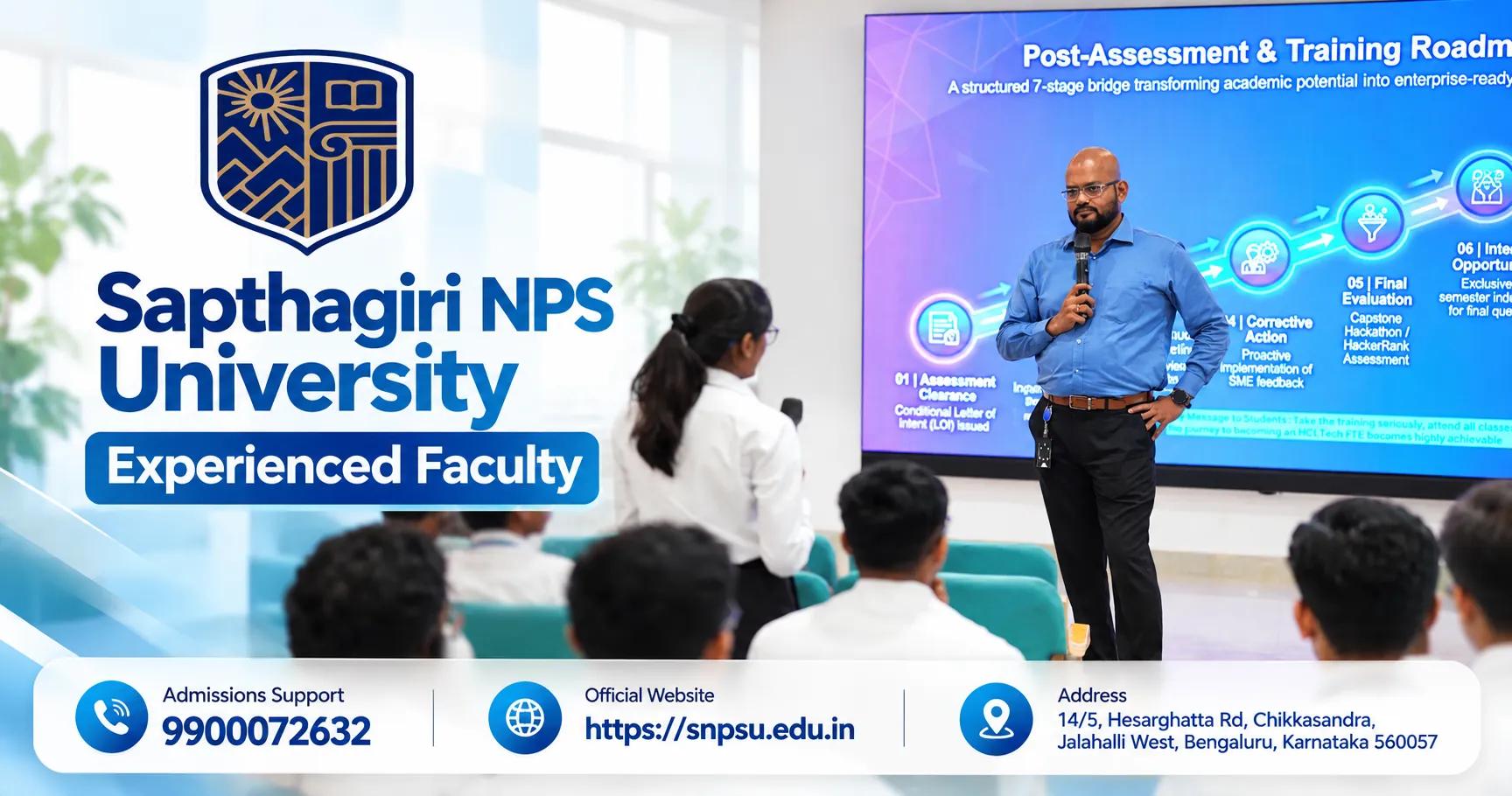
Sapthagiri NPS University Experienced Faculty – Academic Expertise, Mentoring, Research and Student Development
An Academic Environment Shaped by Experience and Expertise
The sapthagiri nps university experienced faculty represents an important foundation of the academic environment at our university, where teaching, mentoring, practical learning, research, innovation and student development are brought together to create a purposeful higher-education experience. Experienced educators contribute more than subject information because they can bring academic maturity, classroom understanding, professional perspective, analytical depth and a strong awareness of the different challenges students may encounter during their educational journey. Our university identifies expert teachers as a major pillar of academic excellence and describes its educators as highly qualified, experienced and passionate professionals who serve not only as instructors but also as mentors who guide learners and foster intellectual curiosity. This approach creates an academic culture where students are encouraged to understand concepts deeply, participate in discussions, explore questions, develop independent perspectives and connect learning with practical situations. Experienced faculty can help learners approach subjects systematically while providing constructive feedback that supports continuous improvement. Their role can also extend into project guidance, research discussions, practical activities, skill development and career-oriented preparation. Our university's broader academic environment combines multidisciplinary education, innovation, research and industry-integrated learning, creating additional contexts in which faculty expertise can enrich student learning. A strong faculty community can therefore influence not only academic performance but also confidence, discipline, communication, curiosity and professional awareness. When students interact with educators who combine knowledge with mentoring capability, the classroom can become a space for inquiry rather than simple information delivery. The experienced faculty environment consequently supports a learning journey where students are encouraged to become responsible learners who can think critically, apply concepts thoughtfully and develop a stronger sense of academic and professional direction.
Faculty Expertise as a Pillar of Academic Excellence
The sapthagiri nps university experienced faculty ecosystem reflects the importance of educator expertise in establishing a rigorous and intellectually engaging academic environment. Experienced faculty members can contribute to academic quality by presenting concepts with greater clarity, placing subjects within meaningful contexts and helping students understand the reasoning behind theories, methods and applications. Our university emphasises engaging, interactive and intellectually stimulating learning experiences in which faculty members combine academic knowledge with practical perspectives. This approach is particularly valuable when students encounter complex subjects that require interpretation, comparison, analytical reasoning or practical application rather than straightforward memorisation. Faculty members can encourage students to question assumptions, examine evidence, discuss alternative approaches and develop well-reasoned conclusions. Such interaction helps students become more active participants in their education and can gradually strengthen their academic independence. Experienced educators can also recognise that learners may possess different strengths, interests and learning requirements, making thoughtful academic guidance especially important. Our university's emphasis on personalised mentoring further supports this environment by giving students opportunities to discuss progress, academic challenges, projects and future goals. The role of an experienced teacher is therefore closely connected with academic development, because students benefit from structured explanations, relevant examples, meaningful feedback and informed guidance throughout their programme. The sapthagiri nps university experienced faculty environment can consequently contribute to stronger conceptual foundations, improved academic confidence and a deeper appreciation of learning as an ongoing process of inquiry, reflection and application.
Subject Knowledge With a Practical Perspective
The sapthagiri nps university experienced faculty approach supports learning by connecting subject knowledge with practical perspectives and real-world applications wherever appropriate within the programme structure. Admissions are Open – Click Here to Apply and begin your academic journey with our university. A strong academic foundation is important, but students also need opportunities to understand how concepts can be used to analyse situations, develop solutions, complete projects and approach unfamiliar challenges. Our university promotes practical learning through project-based activities, laboratories, technical learning environments and industry-oriented experiences across relevant academic areas. Experienced educators can help students make the transition from theoretical understanding to practical application by explaining how principles operate within actual academic or professional contexts. This may involve guiding a student through a project, helping analyse an experimental result, discussing the implications of a case, reviewing an approach to a technical problem or encouraging a learner to reconsider an assumption. Such guidance becomes more valuable when educators understand both the subject and the learning process required to master it. Practical exposure can also strengthen problem-solving because students learn to deal with situations in which the answer is not immediately obvious. Faculty members can encourage learners to approach these challenges systematically, document their work carefully and learn from mistakes rather than avoiding difficult tasks. This creates a culture in which academic learning is connected with experimentation, application and reflection. The experienced faculty environment therefore supports students in developing the ability to translate concepts into meaningful academic outputs while strengthening professional qualities such as precision, responsibility, communication and analytical thinking.
Mentoring Beyond Conventional Classroom Teaching
The sapthagiri nps university experienced faculty contributes to a mentoring-oriented academic environment in which students can receive guidance beyond routine classroom instruction. University students often need support with academic planning, project development, research interests, skill-building, internships, professional preparation and decisions about their broader educational direction. Our university's mentoring framework emphasises regular academic interaction, constructive feedback and support that encourages learners to become increasingly organised, confident and responsible for their own development. Experienced faculty can play an important role in these interactions because their academic maturity can help students interpret challenges from a broader perspective and consider appropriate options before making decisions. Mentoring can involve conversations about study habits, subject understanding, project progress, research opportunities and career preparation, depending on the student's needs and academic stage. A mentor can also encourage a learner to reflect on feedback and develop a realistic improvement plan rather than simply correcting an immediate problem. This can gradually build self-awareness and independent decision-making. Mentoring may be especially valuable when students transition between academic stages because their responsibilities can become more complex and require greater initiative. Faculty interaction can also help students become familiar with available academic resources and encourage them to participate meaningfully in wider university opportunities. The mentoring dimension of the experienced faculty environment therefore supports both immediate academic needs and longer-term personal development, helping learners build confidence while still having access to informed guidance whenever important decisions or challenges arise.
Personalised Academic Guidance and Student Support
The sapthagiri nps university experienced faculty environment can support a more personalised academic experience by recognising that students do not necessarily learn at the same pace or face the same academic challenges.Admissions are Open – Apply Now and take the first step towards building your academic future with our university. Some learners may require additional clarification in a particular subject, while others may need guidance in organising projects, selecting research directions, improving communication or preparing for professional opportunities. Experienced educators can create opportunities for students to discuss such concerns and identify practical approaches to improvement. Our university highlights personalised academic mentoring as an important aspect of faculty engagement and student support, with guidance extending across areas such as academic planning, project development, research activities, internship preparation and career planning. A personalised interaction can be valuable because it allows faculty members to understand the learner's context and provide feedback that is more relevant than a purely general recommendation. Students can use such interactions to ask questions they may hesitate to raise in larger classroom settings, clarify expectations and become more comfortable discussing areas where they require support. Faculty members can encourage learners to set realistic goals and monitor their own progress while remaining available to provide direction. This approach supports a gradual movement from dependence towards academic independence. Personalised guidance can also strengthen trust and communication between students and educators, contributing to a more supportive learning environment. The experienced faculty framework therefore combines academic expertise with individual attention, helping students receive guidance that addresses both the immediate learning requirement and the wider objective of becoming confident, capable and responsible learners.
Faculty Interaction and Intellectual Curiosity
The sapthagiri nps university experienced faculty contributes to an intellectual environment where students can be encouraged to move beyond passive learning and develop curiosity about how and why things work. Our university emphasises intellectual curiosity as an important dimension of faculty mentoring and academic excellence, with educators encouraging students to ask questions, participate in discussions and develop independent perspectives. Experienced faculty members can stimulate this curiosity by introducing alternative viewpoints, posing analytical questions, discussing contemporary applications and inviting students to examine concepts from multiple angles. Such interaction can transform a conventional classroom into an environment where learning becomes an exchange of ideas rather than a one-directional transfer of information. Students who are encouraged to ask thoughtful questions can become more comfortable with uncertainty and may develop a stronger willingness to investigate topics independently. This is particularly valuable in higher education because many academic and professional challenges cannot be solved through memorised information alone. Faculty members can guide learners towards systematic inquiry while helping them distinguish evidence-based reasoning from unsupported assumptions. Intellectual curiosity can also encourage students to explore topics outside the immediate classroom requirement, leading naturally towards research, innovation and interdisciplinary learning. The experienced faculty environment therefore supports the development of an academic mindset in which students are encouraged to remain curious, analytical and open to new perspectives. Such qualities can contribute to lifelong learning because learners become more willing to continue developing their knowledge even after completing a specific course or academic milestone.
Research Guidance and Academic Inquiry
The sapthagiri nps university experienced faculty plays an important role in developing a research-oriented academic culture because meaningful research requires subject understanding, disciplined inquiry, methodological awareness, ethical responsibility and consistent mentorship. Our university places strong emphasis on research and innovation and encourages faculty and students to pursue research that can address real-world challenges while developing critical thinking and problem-solving abilities. Experienced educators can introduce learners to research thinking by encouraging them to identify meaningful questions, examine existing knowledge, gather relevant information, analyse evidence and communicate conclusions clearly. Our research framework describes faculty mentorship across stages such as identifying research topics, reviewing existing knowledge, conducting investigations, analysing findings, preparing academic reports and presenting outcomes. This demonstrates how faculty guidance can support research competence progressively rather than treating research as an isolated academic requirement. Students can benefit from faculty support when they are learning how to formulate research questions, structure investigations, interpret findings and maintain academic integrity. Experienced mentors can also encourage learners to develop patience because meaningful research often involves testing ideas, revising methods and learning from unexpected outcomes. Research guidance can strengthen communication as students prepare reports, presentations and discussions around their work. It can also nurture intellectual independence because learners gradually become more capable of designing and evaluating their own investigations. The experienced faculty environment therefore contributes to a research culture where curiosity is converted into structured inquiry and students learn to approach complex problems with greater confidence, discipline and academic responsibility.
Innovation and Problem-Solving Through Faculty Mentorship
The sapthagiri nps university experienced faculty contributes to innovation by encouraging students to approach academic and practical challenges with creativity, persistence and analytical discipline. Innovation is not limited to producing something entirely new; it can also involve identifying a problem, improving an existing process, exploring a different method or developing a more effective solution. Our university's research and innovation ecosystem encourages students to observe challenges, explore emerging trends, develop creative ideas and investigate possible solutions through systematic learning. Experienced faculty can help learners refine ideas by questioning assumptions, identifying practical constraints, reviewing possible approaches and encouraging evidence-based experimentation. This guidance can prevent students from becoming discouraged when an initial idea does not produce the expected outcome, because experimentation naturally involves revision and learning from unsuccessful approaches. Faculty mentors can also encourage learners to document their process, evaluate results objectively and explain the reasoning behind their decisions. Such habits strengthen not only innovation capability but also professional problem-solving. Collaborative academic work can further develop communication and teamwork because students need to exchange ideas, divide responsibilities and integrate different perspectives into a shared outcome. The experienced faculty environment therefore supports a culture where innovation is approached as a disciplined process of observation, experimentation, evaluation and improvement. Students can gradually become more confident in dealing with ambiguous problems and more willing to explore possibilities that require patience, creativity and structured reasoning.
Faculty-Led Project Learning
The sapthagiri nps university experienced faculty can make project-based learning more meaningful by helping students connect academic concepts with structured tasks, practical applications and measurable outcomes. Projects provide learners with opportunities to move from theory towards implementation, but students often require guidance in defining objectives, selecting an appropriate approach, dividing tasks and evaluating the final outcome. Our university's academic approach includes project-based learning, laboratory activities, practical exposure and collaborative experiences in relevant programmes. Experienced faculty can act as academic facilitators who provide direction without removing the student's responsibility for solving the problem. Admissions are Open – Click Here to Apply and begin exploring programmes that can support your academic and professional aspirations. Students can receive guidance on research questions, project methodology, documentation, presentations and interpretation of results while retaining ownership of the work. This approach can strengthen problem-solving because learners must make decisions rather than simply follow predetermined instructions. Faculty feedback can also help students recognise weaknesses in their approach and improve the quality of their output before final evaluation. Group projects provide additional opportunities for developing communication, coordination and responsibility because students must work within shared timelines. Experienced educators can help learners understand the importance of planning and encourage them to manage project work systematically. The project-learning environment therefore becomes a space in which academic knowledge, practical competence and professional behaviour develop together. Through sustained faculty interaction, students can learn how to approach larger tasks with greater clarity, manage uncertainty and communicate their outcomes in a structured and professional manner.
Faculty Support for Practical and Experiential Learning
The sapthagiri nps university experienced faculty supports experiential learning by helping students understand academic concepts through application, observation, practical tasks and reflective learning. Our university provides advanced laboratories, simulation tools, research facilities and practical learning opportunities designed to strengthen the connection between academic knowledge and real-world applications. Experienced faculty members can guide students through practical activities by explaining procedures, clarifying technical principles, discussing observations and encouraging learners to interpret results rather than simply record them. This type of interaction can make practical learning more intellectually meaningful because students understand the relationship between what they do and why they do it. Experiential learning can also develop professional habits such as accuracy, documentation, safe and responsible practice, teamwork and systematic problem-solving.Admissions are Open – Begin Your Application and take the next step towards joining our university. Faculty members can encourage learners to review outcomes critically and identify reasons when a practical result differs from their expectation. This process can strengthen resilience because students learn that mistakes can become opportunities for investigation and improvement. Practical experiences also create opportunities for students to apply theory in unfamiliar situations, which can deepen conceptual understanding. The experienced faculty environment therefore helps learners move beyond abstract knowledge and develop confidence in applying ideas through structured practical experiences. By combining faculty guidance with hands-on learning, our university can support students in developing capabilities that are academically relevant while also contributing to professional readiness and independent problem-solving.
Continuous Professional Development of Faculty
The sapthagiri nps university experienced faculty model recognises that academic expertise should continue to evolve because higher education is influenced by new research, emerging technologies, changing professional expectations and advances in teaching methodology. Our university identifies continuous professional development and innovative pedagogical practices as important features of its faculty community. This emphasis is valuable because experienced educators must remain willing to refine their own knowledge and approaches if they are to provide students with relevant and stimulating learning experiences. Professional development can include participation in academic workshops, seminars, training programmes, research activities, quality-enhancement initiatives and exploration of updated teaching methods. The university's Internal Quality Assurance Cell specifically promotes innovation in teaching, research and governance and supports workshops, seminars and training programmes for quality enhancement. Continuous development among faculty also creates an example for students because learners can see that professional growth does not end when a qualification is completed. Educators who remain curious and receptive to new ideas can model the same lifelong-learning mindset they encourage in their students. The experienced faculty environment therefore combines accumulated knowledge with a willingness to evolve, creating an academic culture where experience and innovation are not treated as opposites. Instead, professional maturity becomes a platform from which new methods, research perspectives and pedagogical approaches can be explored. This can strengthen academic quality and help students experience a learning environment that remains responsive to changing educational and professional contexts.
Interactive Teaching and Meaningful Classroom Engagement
The sapthagiri nps university experienced faculty contributes to interactive teaching by creating classroom environments where students are encouraged to participate, ask questions, analyse ideas and communicate their understanding.Admissions are Open – Click Here to Apply and discover a learning environment designed to support active student participation. Our university's quality framework describes faculty members as educators who combine academic knowledge with practical perspectives and create engaging, interactive and intellectually stimulating learning experiences. Experienced faculty can use discussions, demonstrations, case-based activities, projects, practical exercises, seminars and guided conversations to help learners engage with subjects from different perspectives. Interactive teaching can be especially effective when students are required to explain their reasoning rather than simply provide an answer. Faculty members can ask probing questions, encourage comparisons and invite learners to challenge assumptions respectfully. This can develop communication skills while helping students understand the subject more deeply. Active participation can also improve confidence because students gradually become more comfortable expressing ideas in front of peers and responding to academic feedback. Experienced educators can balance interaction with structure so that classroom discussions remain focused on clear learning objectives. The result can be a classroom culture where students feel encouraged to contribute while also understanding the importance of evidence, reasoning and respectful academic dialogue. The experienced faculty environment therefore supports teaching that is participatory and purposeful, helping learners develop both subject competence and the intellectual habits required for independent learning.
Feedback as a Tool for Academic Improvement
The sapthagiri nps university experienced faculty environment recognises the importance of constructive feedback in helping students understand their progress and improve their academic performance. Feedback becomes meaningful when it goes beyond identifying an error and explains how a learner can improve the underlying approach or understanding. Our university's academic excellence framework highlights regular interaction with faculty, constructive feedback and personalised guidance as important components of student development. Experienced educators can provide feedback on assignments, projects, presentations, practical work and research activities in ways that encourage students to reflect on their own performance. Students can use feedback to recognise areas of strength and identify areas where additional practice or conceptual clarification is required. This can create a continuous improvement cycle in which learners prepare, perform, receive feedback, reflect and make adjustments. Faculty members can also help students distinguish between a temporary difficulty and a deeper conceptual gap that requires additional attention. Such guidance can prevent learners from becoming discouraged by mistakes because they begin to view feedback as part of the learning process rather than simply as a judgement. Constructive feedback can also strengthen self-assessment because students gradually learn how to evaluate their own work more objectively. The experienced faculty environment therefore promotes a culture of reflection and improvement, helping students become more responsive to academic feedback and more capable of taking ownership of their learning progress.
Supporting Academic Confidence and Independent Learning
The sapthagiri nps university experienced faculty contributes to student confidence by creating opportunities for learners to understand their abilities, receive guidance and progressively take greater ownership of academic responsibilities. Confidence in higher education does not come solely from achieving good results; it can also develop through repeated experiences of solving problems, communicating ideas, completing projects, handling feedback and overcoming academic challenges. Our university's faculty and mentoring approach encourages intellectual curiosity, constructive feedback and independent decision-making, helping learners become more confident in their academic abilities. Experienced educators can support this development by providing appropriate guidance without creating unnecessary dependence.Students can gradually move from asking for complete solutions towards seeking guidance that helps them understand how to solve problems independently. Faculty members can also encourage learners to set realistic goals and recognise incremental improvement rather than focusing exclusively on final outcomes. This approach creates a more sustainable form of confidence because students learn to trust their ability to learn, adapt and improve. Independent learning also becomes important as students progress into advanced subjects and increasingly complex projects. Experienced faculty can encourage learners to explore resources, ask better questions and develop their own academic perspectives. The faculty environment therefore supports a transition from guided learning towards greater intellectual independence while ensuring that students continue to have access to appropriate academic mentorship whenever they require it.
Supporting Research Ethics and Academic Integrity
The sapthagiri nps university experienced faculty contributes to an academic culture in which research and learning are expected to be pursued with integrity, accuracy and responsible professional conduct. Our university's research framework emphasises ethical research practices, including academic honesty, responsible data collection, accurate reporting, appropriate referencing, respect for intellectual property and professional integrity. Experienced faculty members are well positioned to explain why these principles matter and how they should be incorporated into everyday academic work. Students can learn that responsible scholarship is not limited to formal research projects but also applies to assignments, presentations, project documentation and collaborative academic work. Faculty guidance can help learners understand the difference between appropriate collaboration and inappropriate copying, the importance of accurate information and the responsibility involved in presenting academic findings. Research ethics can also encourage students to remain transparent about limitations, acknowledge sources correctly and report results honestly even when findings do not match initial expectations. These practices contribute to professional credibility because trust is central to academic and professional relationships. The experienced faculty environment therefore supports the development of ethical habits alongside subject knowledge, helping students understand that academic excellence involves both intellectual capability and responsible conduct. By reinforcing integrity through teaching and mentoring, educators can contribute to a culture in which students value accuracy, originality, accountability and respect for knowledge.
Faculty Guidance for Career Readiness
The sapthagiri nps university experienced faculty can support career readiness by helping students understand how academic learning, practical experience, projects, communication capabilities and professional behaviour can contribute to future opportunities.Admissions are Open – Click Here to Apply and begin preparing for your academic and professional future. Our university identifies expert faculty and mentorship as components of career readiness and also describes its placement and career-support environment as connected with internships, training and professional opportunities. Experienced educators can provide valuable perspective when learners are considering career directions because academic faculty may understand the relationship between programme learning outcomes and professional expectations. Faculty guidance can help students identify areas where they need to strengthen technical knowledge, communication, presentation, analytical reasoning or project experience. It can also encourage learners to treat internships and practical assignments as opportunities to develop professional habits rather than viewing them only as formal requirements. Students may benefit from discussing project ideas, career interests, higher-education aspirations or research directions with educators who understand their academic progress. Faculty mentoring can also encourage learners to build a professional mindset around deadlines, teamwork, responsibility and continuous learning. Career readiness becomes more meaningful when it develops gradually throughout the programme rather than being postponed until the end. The experienced faculty environment therefore contributes to a broader preparation process in which academic learning and professional development reinforce each other, helping students become more prepared to make informed decisions about their next steps.
Faculty Contribution to Communication Skills
The sapthagiri nps university experienced faculty can contribute significantly to the development of student communication because academic learning requires learners to express ideas clearly in discussions, presentations, projects, reports and collaborative work. Experienced educators can encourage students to explain concepts in their own words, defend their reasoning, participate in structured discussions and present project outcomes with greater clarity. Our university's research-based learning framework notes that students develop communication skills through presentations, technical reports, project documentation and academic discussions. Faculty members can provide feedback on clarity, organisation, structure and delivery while helping learners understand that effective communication is closely connected with clear thinking. Students can also become more confident when educators create respectful environments where questions and different viewpoints are welcomed. Communication development is valuable across disciplines because learners need to collaborate, explain ideas, listen to others and adapt their message according to the audience. Experienced faculty can model professional communication through classroom interaction and academic discussions, giving students practical examples of how ideas can be presented thoughtfully. The faculty environment therefore supports communication as a core academic and professional capability rather than as an isolated skill taught separately from subject learning. Over time, students can become more comfortable presenting their ideas, responding to questions and participating in collaborative academic activities with greater confidence.
Faculty Support for Collaborative Learning
The sapthagiri nps university experienced faculty supports collaborative learning by guiding students through activities that require communication, shared responsibility, problem-solving and coordination. Group learning can be an effective way to expose students to different viewpoints, but successful collaboration requires more than simply placing learners into teams. Students need to understand how to divide responsibilities, communicate respectfully, manage disagreements and remain accountable for their contributions. Experienced faculty can provide structure and guidance so that collaborative activities become meaningful learning experiences.Admissions are Open – Explore Programmes and Apply and take the next step towards joining our university. Our university's learning environment encourages collaborative activities, academic discussions, projects, interdisciplinary engagement and student participation, creating multiple contexts in which teamwork can develop. Faculty members can help students reflect on how individual contributions influence collective outcomes and encourage them to value different approaches to a problem. Collaborative learning can also strengthen leadership because students may need to coordinate tasks, manage timelines and communicate decisions. Experienced educators can intervene constructively when teams face difficulties while allowing learners to develop their own solutions wherever appropriate. The result can be a more mature understanding of teamwork in which students appreciate both individual accountability and collective responsibility. The faculty environment therefore helps learners build interpersonal capabilities alongside academic knowledge, preparing them to work effectively in environments where collaboration, communication and shared problem-solving are essential.
Interdisciplinary Thinking and Broader Academic Perspectives
The sapthagiri nps university experienced faculty can contribute to interdisciplinary learning by encouraging students to recognise connections between different areas of knowledge and consider problems from multiple perspectives. Our university describes itself as a multidisciplinary institution with academic offerings across areas including Engineering, Management, Applied Sciences and Medicine, while its academic vision also emphasises innovation, research and industry-integrated learning. In such an environment, faculty interaction can help learners understand that complex challenges may require knowledge from more than one discipline. Experienced educators can encourage students to compare approaches, identify relationships between concepts and consider how methods from one field may inform another. Interdisciplinary thinking can strengthen creativity because learners are exposed to alternative frameworks for understanding a problem. It can also improve communication because students may need to explain discipline-specific ideas to people with different academic backgrounds. Faculty members can support this process through collaborative projects, research activities, seminars, workshops and guided discussions where suitable. The objective is not to weaken disciplinary depth but to broaden the student's intellectual perspective while maintaining strong foundations within the chosen field. The experienced faculty environment therefore supports an educational culture in which students can become more flexible thinkers who appreciate complexity and are better prepared to approach unfamiliar problems with analytical breadth and intellectual openness.
Technology-Enabled Teaching and Modern Learning
The sapthagiri nps university experienced faculty contributes to technology-enabled learning by combining academic expertise with modern educational resources and contemporary approaches to teaching. Our university provides smart classrooms, advanced laboratories, simulation tools, digital library resources and research facilities as part of its academic infrastructure. Experienced educators can make such resources more meaningful when they are integrated thoughtfully into learning objectives rather than being treated as technology for its own sake. Faculty members can use digital resources to present complex information visually, support practical demonstrations, facilitate research, provide access to wider academic material and encourage students to explore information independently. Technology can also enable learners to work with simulations, digital tools and project-based tasks that complement classroom instruction. Experienced faculty guidance remains important because students need to understand how to use technological resources critically and responsibly. The combination of expertise and educational technology can create learning experiences that are more interactive, flexible and application-oriented. Students can learn not only how to access information but also how to evaluate it, interpret it and apply it appropriately. The faculty environment therefore supports a balanced approach in which technology serves academic purpose while educators remain central to interpretation, mentorship, feedback and learning direction.
Faculty and Quality Enhancement
The sapthagiri nps university experienced faculty contributes to quality enhancement through teaching, research, innovation, academic planning and participation in institutional improvement processes. Our university's Internal Quality Assurance Cell identifies continuous improvement and academic excellence as important institutional priorities and promotes a learner-centric environment supporting high-quality teaching, meaningful research and innovation. Experienced faculty members can contribute to these objectives through reflection on teaching practices, participation in academic development activities and engagement with quality-improvement initiatives. Faculty expertise can support quality because educators are often positioned to understand classroom challenges, student learning patterns and areas where academic processes can be strengthened. Workshops, seminars and professional-development activities can also provide opportunities to examine new approaches and exchange ideas. Our university's quality framework specifically identifies workshops, seminars and training programmes as mechanisms for quality enhancement. The faculty environment therefore contributes not only to the immediate classroom experience but also to broader institutional efforts aimed at maintaining and improving academic standards. Continuous quality enhancement requires participation across the academic community, and experienced educators can provide valuable perspective through their knowledge and professional experience. The result is an academic culture where improvement becomes an ongoing responsibility rather than a one-time objective.Admissions are Open – Click Here to Apply and take the next step towards an academic environment committed to continuous improvement.
Faculty Engagement in Student-Centred Learning
The sapthagiri nps university experienced faculty approach is closely aligned with student-centred learning, where educators guide learners while encouraging them to participate actively and take increasing ownership of their academic progress. Our university's academic excellence framework emphasises interactive learning, independent perspectives, constructive feedback and personalised academic guidance. In a student-centred environment, the role of the faculty member is not limited to delivering content but includes facilitating inquiry, clarifying difficult concepts, supporting projects and helping students develop appropriate learning strategies. Experienced faculty can adapt explanations, examples and activities to support different learning requirements while maintaining clear academic standards. Students can be encouraged to ask questions, participate in discussions and explore ideas independently while receiving timely guidance when necessary. Student-centred learning also places emphasis on reflection, allowing learners to consider what they have understood, where they need improvement and how they can become more effective in their own learning. Faculty members can support this reflective process through feedback and mentoring. The experienced faculty environment therefore creates a balance between academic direction and learner autonomy. Students receive the benefit of expert guidance while gradually developing the confidence and responsibility required to manage increasingly complex academic tasks independently.
Academic Guidance During the Early Stages of Study
The sapthagiri nps university experienced faculty can be particularly valuable during the early stages of a student's programme because learners transitioning into higher education may need guidance in adapting to new academic expectations. University study can require greater independence, more complex subject matter, project work and a stronger need for time management than students may have experienced previously. Experienced faculty can help new learners understand how to organise their studies, approach assignments, participate in academic discussions and seek assistance appropriately. Faculty mentors can also encourage students to build effective habits from the beginning rather than waiting until they encounter significant academic difficulty. Early guidance can include understanding academic expectations, reviewing progress, developing study strategies and becoming familiar with available resources. Our university's mentoring approach supports students throughout their academic journey and encourages increasing responsibility for their own learning. This is particularly relevant because strong academic habits established early can influence how learners manage more advanced responsibilities later. Experienced faculty can create reassurance without reducing the student's independence, helping learners understand that asking thoughtful questions and seeking guidance are signs of responsible learning. The faculty environment therefore plays an important role in helping students make a confident transition into university education and develop the foundations required for long-term academic success.
Faculty Support During Advanced Academic Stages
The sapthagiri nps university experienced faculty remains important as students progress into more advanced stages of education because academic responsibilities often become increasingly specialised, independent and professionally oriented. Learners may become more involved in complex projects, research, advanced practical work, presentations, internships and career preparation as they move forward. Experienced educators can provide guidance that becomes more specialised according to the student's academic interests and future objectives. Admissions are Open – Explore Your Programme and Apply and continue your academic journey with our university. Faculty mentors can help students refine project objectives, assess research directions, interpret practical outcomes and think strategically about professional development. At advanced stages, guidance may also involve encouraging students to question existing methods, compare alternatives and develop independent academic viewpoints. Our university's research environment emphasises faculty mentorship across the research process and encourages students to build competence progressively from foundational learning towards advanced investigation. Experienced faculty can therefore help learners make the transition from structured classroom learning towards more independent academic work. This transition requires students to assume greater responsibility for planning and decision-making, while faculty members provide strategic direction and constructive review. The faculty environment consequently supports students not only in completing advanced academic requirements but also in developing the maturity, confidence and intellectual independence needed for higher studies, research and professional life.
Faculty Role in Developing Professional Competence
The sapthagiri nps university experienced faculty contributes to professional competence by helping students understand that academic knowledge is most valuable when combined with communication, discipline, problem-solving, collaboration and responsible decision-making. Experienced educators can model professional behaviour through punctuality, clarity of communication, academic integrity, structured feedback and thoughtful engagement with students. Our university's academic environment connects learning with practical exposure, research, industry interaction and career assistance, providing several contexts in which professional habits can develop.Faculty members can help learners understand why deadlines matter, how collaboration should be managed and why careful documentation and professional communication are important. Project work and practical learning can further reinforce these expectations by requiring students to produce outcomes within defined responsibilities. Experienced educators can also provide feedback on the quality and presentation of student work and encourage continuous refinement. Professional competence is therefore developed gradually through repeated academic experiences rather than through one isolated course. Faculty mentoring can help learners recognise the relationship between classroom behaviour and future workplace expectations. The experienced faculty environment supports this progression by combining subject expertise with guidance on how students can apply knowledge responsibly and communicate effectively. Such development can strengthen employability while also preparing learners for environments where adaptability, teamwork, ethical conduct and continuous learning are essential.
Faculty Mentoring for Research and Higher Studies
The sapthagiri nps university experienced faculty can provide meaningful support to students who wish to pursue advanced academic study or research because experienced mentors can help learners understand the expectations associated with scholarly work. Students interested in higher studies may need guidance in identifying areas of interest, strengthening their academic foundations, developing research competence and learning how to communicate ideas more formally. Our university's research opportunities framework encourages students to participate in research-based learning and describes faculty mentorship as a key component of research excellence. Faculty guidance can help students understand research methodology, evidence evaluation, documentation and academic presentation while encouraging them to become increasingly independent in their investigations. Educators can also help learners recognise which academic areas align with their interests and strengths. Research-based experiences may develop skills that are valuable for postgraduate study, professional research and innovation-oriented careers, including critical thinking, analytical reasoning, academic writing and systematic inquiry. The faculty environment can therefore encourage students to see research as a continuing intellectual process rather than merely a qualification requirement. Mentoring can also help learners become more comfortable with complex questions and incomplete answers, which are common characteristics of advanced study. Through sustained faculty interaction, students can gradually develop the confidence and discipline needed to undertake deeper academic work. The experienced faculty environment thus supports a pathway from classroom learning towards higher-level inquiry and lifelong intellectual development.
Faculty Support for Innovation and Entrepreneurship Mindsets
The sapthagiri nps university experienced faculty can encourage students to develop innovation and entrepreneurship mindsets by helping them identify problems, explore possibilities and evaluate solutions with greater discipline. Entrepreneurship and innovation require more than creativity because ideas must often be tested, refined, communicated and assessed for practical relevance. Our university's innovation ecosystem encourages curiosity, experimentation, critical thinking and problem-solving while promoting faculty mentorship throughout the research and innovation journey. Admissions are Open – Click Here to Apply and take the next step towards an academic journey where ideas can become structured learning experiences. Experienced faculty can challenge learners to think beyond obvious answers and examine whether a proposed idea genuinely addresses a meaningful problem. They can also help students evaluate feasibility, consider alternative approaches and learn from feedback. Innovation-oriented projects can strengthen resilience because students may encounter setbacks that require revision rather than abandonment of the original objective. Faculty guidance can help learners interpret these setbacks constructively and identify what can be learned from them. Entrepreneurship-oriented thinking also requires communication, teamwork and leadership, and these capabilities can develop through collaborative projects and academic activities. The experienced faculty environment therefore supports a mindset in which students become more comfortable exploring possibilities, testing assumptions and taking informed academic risks. Such development can prepare learners to approach professional challenges creatively while retaining the discipline required to evaluate ideas objectively and act responsibly.
Faculty Influence on Leadership Development
The sapthagiri nps university experienced faculty can contribute to leadership development by guiding students through opportunities that require responsibility, initiative, communication and collaboration. Leadership in a university setting can emerge through project teams, student activities, research groups, academic presentations, clubs, innovation initiatives and other forms of participation. Experienced faculty can encourage learners to take responsibility for planning tasks, coordinating peers and communicating outcomes effectively. Faculty members can also help students understand that leadership is not simply about holding a title but about demonstrating reliability, listening to others, making informed decisions and contributing constructively to collective objectives. Our university's student-life environment includes sports, cultural activities, clubs, innovation challenges and leadership activities as part of broader student development. Faculty guidance can help students balance these opportunities with their academic responsibilities so that participation remains purposeful rather than distracting. Leadership development can also occur within the classroom when students are encouraged to present ideas, facilitate discussions or coordinate collaborative assignments. Experienced educators can provide feedback that helps learners understand how their communication and decision-making affect others. Over time, students can develop greater confidence in taking initiative and managing shared responsibilities. The faculty environment therefore contributes to leadership as an applied capability that grows through guided participation and reflection.
Faculty Support for Student Well-Being
The sapthagiri nps university experienced faculty contributes to a supportive academic environment in which student well-being can be considered alongside academic progress. University students may experience periods of uncertainty, demanding coursework, project responsibilities, examination pressure or difficulty adapting to new academic expectations. Faculty members can help create a more supportive atmosphere by remaining approachable, providing timely academic guidance and encouraging students to seek appropriate assistance when challenges arise. Our university's student-support framework includes personal development, well-being, leadership, collaboration and meaningful engagement, while the broader mentoring system encourages communication and reflection. Experienced educators can contribute by helping students break complex responsibilities into manageable steps, clarify academic priorities and develop realistic approaches to challenges. This does not mean that faculty replace specialised support services; rather, educators can serve as an important first point of academic guidance and encouragement. Positive faculty-student relationships can also strengthen a sense of belonging because learners know that their academic concerns can be discussed respectfully. Student well-being is closely connected with academic organisation, confidence and communication, making the faculty role significant in creating conditions where learners can engage more effectively with their education. The experienced faculty environment therefore complements formal student-support systems by providing continuous human interaction that can encourage students to remain engaged, reflective and responsible throughout their university journey.
Faculty Engagement With Academic Planning
The sapthagiri nps university experienced faculty can help students improve academic planning by guiding them in setting realistic goals, prioritising responsibilities and reviewing progress throughout their programme. University education involves multiple deadlines, assessment periods, projects, practical work and examinations, making effective planning essential for sustained academic performance. Experienced faculty can help learners identify priorities and understand how different academic activities connect with broader learning outcomes. Faculty mentors can encourage students to develop study routines, set project milestones and seek clarification before a challenge becomes difficult to manage. This approach is particularly valuable because academic planning should evolve with the learner. Early-stage students may require more structured guidance, while advanced students can gradually assume greater responsibility for their schedules and decisions. Our university's mentoring framework encourages students to become more organised and independent while benefiting from professional insight and timely guidance.Faculty members can therefore support a transition from externally structured learning towards self-managed academic planning. Such development strengthens not only immediate academic performance but also the planning habits needed in future professional environments. The experienced faculty environment consequently contributes to a culture of responsibility in which students learn to anticipate workloads, manage deadlines and review their own progress more systematically.
Faculty Support for Academic Communication With Students
The sapthagiri nps university experienced faculty plays an important role in maintaining effective academic communication because students benefit when expectations, feedback and guidance are communicated clearly and consistently. Experienced educators can create opportunities for learners to ask questions, discuss academic concerns, clarify project requirements and understand feedback. Our university promotes interactive learning environments and regular faculty-student engagement as important aspects of academic excellence. Effective communication can help students understand not only what they need to complete but also why a particular academic approach is important. Faculty members can explain complex information in accessible language, encourage students to express their perspectives and guide them towards more structured reasoning. Communication is also important when students encounter difficulties because timely discussion can help prevent small misunderstandings from becoming larger academic problems. Experienced faculty can establish a professional yet supportive interaction style that encourages students to communicate responsibly. This can also help learners develop their own communication habits, including listening carefully, asking precise questions and responding constructively to feedback. The faculty environment therefore supports communication as both a teaching tool and a professional competency. Over time, students can become more confident in communicating with educators, peers and future professional colleagues while developing greater clarity in the way they present ideas and discuss challenges.
Faculty Contribution to a Research Culture
The sapthagiri nps university experienced faculty contributes to a research culture in which curiosity, critical thinking, investigation and continuous learning are encouraged as important dimensions of academic development. Our university places research and innovation among its institutional priorities and describes its research centre as a platform for scholarly excellence supported by resources, mentorship and an enabling environment for discovery. Experienced educators can strengthen this culture by encouraging students to think beyond the immediate syllabus and explore questions that may lead to deeper academic investigation. Faculty members can introduce students to research-oriented assignments, project investigations, literature exploration and evidence-based discussions while explaining the principles of responsible scholarship. Research culture becomes stronger when students see that asking questions, testing ideas and examining evidence are normal parts of academic life. Faculty mentorship can provide the structure required to turn curiosity into disciplined inquiry. Students can learn how to formulate questions, gather information, evaluate findings and communicate conclusions, developing abilities that remain useful across disciplines. The research environment also encourages students to view failure or unexpected findings as opportunities for learning and refinement. The experienced faculty community therefore contributes to a culture in which research is integrated with teaching, mentoring and student development. Such a culture can help learners become more intellectually independent and better prepared for higher education, professional research, innovation and complex problem-solving.
Faculty and Industry-Relevant Learning
The sapthagiri nps university experienced faculty can help students connect academic learning with changing professional expectations by integrating practical perspectives, projects, industry-oriented activities and contemporary learning approaches into education where relevant. Our university highlights industry-integrated learning and maintains collaborations and career-oriented initiatives designed to strengthen practical exposure and employability. Experienced educators can contribute to this process because they can help learners interpret how academic concepts relate to professional practices and why certain capabilities matter beyond examinations. Admissions are Open – Apply Now and take the next step towards a professionally focused education. Faculty members can encourage students to develop habits such as structured problem-solving, documentation, communication, teamwork and continuous learning, all of which can support professional readiness. Project-based activities can provide opportunities to simulate professional responsibilities, while internships and industry-linked experiences can offer additional practical exposure where available. Faculty guidance remains important in helping learners reflect on these experiences and connect them with their academic development. Students can discuss project outcomes, professional interests and areas for additional skill-building with educators who understand their programme. The experienced faculty environment therefore helps bridge the distance between formal education and practical expectations without reducing the importance of academic depth. By connecting knowledge with application and professional behaviour, faculty members can help learners understand how their education can support future roles and responsibilities.
Faculty Support for Lifelong Learning
The sapthagiri nps university experienced faculty can inspire lifelong learning by demonstrating that expertise develops through continuous curiosity, professional development, research and reflection rather than ending with the completion of a qualification. Our university emphasises continuous professional development among faculty members and encourages innovative pedagogical practices, while its research framework describes learning as a continuing process of exploration and improvement. Students who observe educators continuing to develop their own knowledge can better understand the value of remaining adaptable throughout a professional career. Experienced faculty can encourage learners to read beyond prescribed material, ask deeper questions, explore emerging developments and remain receptive to new evidence or perspectives. This mindset is particularly important in rapidly evolving academic and professional environments where knowledge and technology continue to change. Faculty mentors can help students understand that professional competence requires periodic learning, reflection and adaptation. Research and project-based work can reinforce this lesson by requiring learners to acquire information that may not have been covered directly in classroom teaching. The experienced faculty environment therefore contributes to a culture in which education is viewed as an ongoing process rather than a finite stage. Students can develop the confidence to continue learning independently and the humility to recognise that expertise requires continuous development. These qualities can support both academic resilience and long-term professional growth.
Faculty Support Across Diverse Academic Disciplines
The sapthagiri nps university experienced faculty represents an academic community working across diverse disciplines within our university, creating opportunities for subject-specific depth while also supporting a broader multidisciplinary learning environment. Our university describes its academic ecosystem as multidisciplinary, with education spanning Engineering, Management, Applied Sciences and Medicine, supported by innovation, research and industry-integrated learning. This diversity requires educators to maintain strong knowledge within their respective areas while also recognising the value of collaboration across disciplines. Experienced faculty can help students develop disciplinary competence while exposing them to broader perspectives through projects, research, seminars, interdisciplinary activities and academic interactions. Admissions are Open – Explore Programmes and Apply and discover the multidisciplinary academic opportunities available through our university. Students can benefit from this environment because complex problems are often better understood when more than one perspective is considered. Faculty collaboration can also create opportunities for learners to encounter different methods of reasoning and application. At the same time, experienced educators can ensure that interdisciplinary exploration does not replace the depth required within a student's core discipline. The faculty environment therefore balances specialisation with intellectual breadth. Students can develop strong academic foundations while becoming more comfortable engaging with ideas beyond their immediate subject area. The experienced faculty community consequently supports a richer educational environment in which students can develop both discipline-specific competence and the adaptability required to understand complex, multidisciplinary challenges.
Faculty Role in Building Academic Discipline
The sapthagiri nps university experienced faculty can contribute to academic discipline by modelling consistency, accountability, clarity and professional conduct through everyday teaching and mentoring interactions. Students develop discipline not only through formal rules but also through repeated experiences of preparing for classes, meeting deadlines, completing projects, responding to feedback and participating responsibly. Experienced educators can reinforce these habits by setting clear expectations and helping learners understand the importance of timely and systematic academic work. Faculty members can encourage students to plan their work in advance, maintain accurate documentation and take responsibility for the quality of their output. Academic discipline also involves intellectual discipline, including checking information, evaluating evidence, presenting arguments clearly and acknowledging limitations. Research guidance and project learning provide practical opportunities for developing these habits. Our university's research framework emphasises responsible data collection, accurate reporting, proper referencing and professional integrity, demonstrating how academic discipline extends beyond punctuality and deadlines. Experienced faculty can therefore help learners understand discipline as a positive professional quality rather than simply a compliance requirement. Students who develop disciplined work habits are more likely to approach complex responsibilities systematically and remain accountable for their decisions. The faculty environment supports this development through consistent expectations, constructive feedback, mentoring and practical academic experiences.
Faculty and Holistic Student Development
The sapthagiri nps university experienced faculty contributes to holistic student development by supporting academic knowledge alongside communication, confidence, leadership, collaboration, creativity and professional awareness. Our university's student-life environment includes sports, cultural fests, clubs, innovation challenges and leadership activities, reflecting a broader understanding of student development beyond classroom achievement. Experienced faculty members can help students balance these opportunities with academic responsibilities and encourage learners to participate in ways that contribute meaningfully to their personal growth. Admissions are Open – Click Here to Apply and take the next step towards a holistic educational experience with our university. Faculty mentoring can provide a space for students to reflect on their interests, strengths and areas for improvement while considering how different experiences contribute to their broader development. For example, a project can strengthen technical skills while simultaneously improving teamwork and communication; a research activity can develop analytical thinking while also encouraging patience and intellectual independence. Faculty members can help learners recognise these connections and approach university opportunities more purposefully. The holistic role of educators is therefore not to control every aspect of student life but to provide guidance that helps learners make informed decisions. Our university's student-support framework also places importance on well-being, leadership, collaboration and meaningful engagement, complementing the academic contribution of faculty members. The experienced faculty environment therefore supports a comprehensive educational experience in which students can grow as knowledgeable learners, responsible individuals and emerging professionals.
Faculty Mentoring for Academic and Professional Decision-Making
The sapthagiri nps university experienced faculty can play an important role when students need to make academic and professional decisions because experienced educators can provide context, perspective and informed guidance without taking away the learner's responsibility to decide. Students may need to choose project directions, explore research interests, consider internships, strengthen specific skills or think about higher studies and career pathways. Our university's mentoring system highlights one-to-one conversations and guidance around academic planning, projects, internships, skill development, career directions and further education. Faculty mentors can help learners compare alternatives, consider practical implications and identify the information required before reaching a decision. Such conversations can also encourage students to reflect on their interests and strengths rather than choosing an option simply because it appears popular or convenient. Experienced educators can provide realistic academic guidance while encouraging students to take ownership of the final decision. The decision-making process itself can become an important learning experience because students develop the ability to analyse options, consider consequences and communicate their reasoning. This capability is valuable in both academic and professional environments. The experienced faculty environment therefore contributes to student maturity by transforming mentorship into an opportunity for thoughtful decision-making, reflection and personal responsibility.
Faculty and Student Research Competence
The sapthagiri nps university experienced faculty can strengthen student research competence by guiding learners through the methods, attitudes and habits required for systematic academic investigation. Research requires more than technical knowledge because students must understand how to formulate meaningful questions, review information critically, select appropriate methods, document work accurately and communicate findings responsibly. Our university's research opportunities framework explicitly describes faculty mentorship across these stages and emphasises the development of research confidence and competence. Admissions are Open – Begin Your Application and build a strong foundation for research-oriented academic development. Experienced educators can help students understand how to distinguish reliable information from unsupported claims and how to organise evidence before reaching conclusions. They can also encourage students to document their processes carefully so that their work can be reviewed and replicated appropriately where relevant. Research competence includes patience and resilience because investigations may require several attempts before producing useful outcomes. Faculty mentoring can help students interpret setbacks constructively and refine their approach rather than abandoning the inquiry prematurely. Presenting research findings can further strengthen communication because learners must explain complex information clearly and defend their reasoning. The experienced faculty environment therefore supports research as both a knowledge-building process and a comprehensive learning experience that develops analytical reasoning, communication, documentation, persistence and academic integrity.
Faculty Role in Creating an Inclusive Learning Environment
The sapthagiri nps university experienced faculty contributes to an academic environment in which students can feel respected, heard and encouraged to participate meaningfully in learning. Our university's institutional identity emphasises integrity, excellence, diversity, community engagement, academic freedom, ethical conduct, collaboration, open dialogue and mutual respect among students, faculty and staff. Experienced educators can support these values through classroom practices that encourage respectful discussion, acknowledge different perspectives and provide appropriate opportunities for participation. An inclusive learning environment does not mean that academic standards are lowered; rather, it can mean that students are encouraged to meet strong standards while receiving appropriate support and opportunities to contribute. Faculty members can establish professional classroom interactions in which disagreement can be expressed constructively and questions can be treated as part of the learning process. This can be particularly beneficial for students who are developing confidence in communicating their ideas. Experienced faculty can also help learners recognise the value of collaboration and respectful academic dialogue when working with peers from different backgrounds or disciplines. The faculty environment therefore contributes to belonging as well as learning. By encouraging participation, mutual respect and intellectual openness, educators can help students engage more confidently with academic challenges and develop interpersonal capabilities that remain important throughout professional life.
Faculty Contribution to Global and Future-Oriented Learning
The sapthagiri nps university experienced faculty can support future-oriented learning by helping students understand how academic knowledge, emerging technologies, research, innovation and professional expectations are evolving. Our university's broader vision emphasises research, innovation, industry-integrated learning and global perspectives, while its academic infrastructure and collaborations support exposure to contemporary learning environments. Experienced educators can provide context around emerging developments and encourage students to remain attentive to changes within their disciplines. Faculty members can also encourage students to develop adaptable capabilities rather than relying solely on knowledge that may become outdated over time. Research-oriented learning, practical projects, interdisciplinary activities and technology-enabled education can provide contexts in which learners practise adapting to new information and approaches. Faculty mentorship remains important because exposure to new technology or emerging ideas becomes valuable only when students learn how to evaluate and apply them responsibly. Experienced educators can help learners distinguish meaningful developments from temporary trends and approach innovation with analytical discipline. The future-oriented faculty environment therefore encourages students to become adaptable learners who are prepared to continue acquiring knowledge as their professional environment changes. This orientation can strengthen long-term academic resilience and support graduates as they navigate further education, evolving technologies and changing professional expectations.
Faculty and Academic Quality Culture
The sapthagiri nps university experienced faculty forms a significant part of the university's quality culture because academic standards depend on the effectiveness of teaching, mentoring, research, assessment and continuous improvement. Our university's Internal Quality Assurance Cell describes its purpose as maintaining high standards in academic and administrative performance and establishing a strong internal quality-assurance system that promotes continuous improvement and academic excellence. Experienced faculty can contribute to this culture through thoughtful teaching, reflection, research engagement, participation in academic development and commitment to learner-centred practices. Quality in education is not created by one factor alone; it emerges from the interaction of curriculum, faculty expertise, infrastructure, academic processes, student support and institutional review. Experienced educators contribute to this ecosystem by bringing professional judgement and accumulated teaching experience to the daily learning process. They can also identify areas where students face challenges and contribute ideas for improving academic practices. The quality framework encourages innovation in teaching, research and governance, reinforcing the idea that improvement should remain ongoing.The faculty environment therefore has an important role in translating institutional quality objectives into meaningful classroom and mentoring experiences. Students ultimately experience academic quality through the clarity of teaching, usefulness of feedback, accessibility of guidance and opportunities available for deeper learning. The experienced faculty community is therefore integral to creating a culture in which quality is continuously developed and strengthened.
Faculty Mentoring and Career Confidence
The sapthagiri nps university experienced faculty can contribute to career confidence by helping students recognise how their academic experiences can be translated into professional capabilities. Students may understand their subjects well but still need guidance on how to communicate strengths, describe project experience, identify areas for improvement and approach career decisions strategically. Our university's career-support ecosystem includes internships, training and placement assistance, while its expert faculty and mentorship framework is positioned as contributing to career readiness. Experienced faculty can complement these systems by helping learners reflect on their academic performance, practical experiences, research interests and skill-development activities. A mentor can encourage students to identify which capabilities they have developed and which areas should become priorities for further growth. Faculty guidance can also help learners approach professional preparation as a gradual process rather than something that begins only when opportunities become immediately available. Projects, presentations and research activities can be reviewed from a professional perspective, allowing students to understand how such experiences demonstrate capabilities such as problem-solving, communication, teamwork and initiative. Career confidence can therefore emerge from a combination of knowledge, practical experience, reflection and informed guidance. The experienced faculty environment supports this process by helping students interpret their academic journey in relation to future opportunities while encouraging them to take responsibility for their own professional development.
Faculty Influence on Critical Thinking
The sapthagiri nps university experienced faculty can strengthen critical thinking by encouraging students to examine information carefully, compare alternatives, question assumptions and support conclusions with appropriate reasoning. Our university's academic and research frameworks emphasise critical thinking, problem-solving and a culture of inquiry as important dimensions of educational development. Experienced educators can cultivate these abilities through open-ended questions, discussions, project work, research assignments, practical investigations and analytical exercises. Admissions are Open – Apply Now and begin your academic journey in an environment that values analytical learning. Critical thinking becomes stronger when students are encouraged to explain why they believe something rather than simply state what they believe. Faculty members can help learners distinguish evidence from opinion and consider the limitations of an argument before accepting it. This is valuable across disciplines because professional and academic problems often involve incomplete information and competing possibilities. Experienced educators can model analytical thinking through the way they structure explanations, evaluate evidence and respond to different viewpoints. Students can then practise these habits in assignments, projects and discussions. The faculty environment therefore supports the development of learners who are more comfortable examining complexity and less dependent on memorised answers. Critical thinking can also strengthen decision-making because students become more capable of considering consequences and evaluating options. Through sustained faculty guidance, the experienced faculty environment can help learners develop intellectual habits that are relevant to academic success, research, professional problem-solving and lifelong learning.
Faculty Contribution to Student Motivation
The sapthagiri nps university experienced faculty can influence student motivation by helping learners understand the purpose behind their academic activities and recognise progress even when challenges arise. Motivation can become stronger when students see a connection between what they are learning, what they are capable of achieving and the opportunities available through continued development. Experienced educators can provide encouragement, clarify expectations and help students divide large academic responsibilities into achievable stages.Our university's mentoring approach emphasises regular academic interaction, reflection and support, which can contribute to a stronger sense of direction among learners. Faculty members can also motivate students by encouraging them to explore interests rather than limiting learning to examination requirements. Research, innovation, projects and practical activities can create opportunities for learners to experience the satisfaction of solving problems and developing something through sustained effort. When faculty members provide constructive recognition and specific feedback, students can better understand how their effort contributes to improvement. This can support intrinsic motivation by helping learners become interested in learning itself rather than depending entirely on external rewards. Experienced educators can also model persistence by showing that advanced knowledge requires curiosity, patience and continuous refinement. The faculty environment therefore contributes to motivation through guidance, encouragement, meaningful academic experiences and opportunities for students to see themselves as capable learners who can continue improving through purposeful effort.
Faculty Support for Professional Communication and Presentation
The sapthagiri nps university experienced faculty can help students develop professional presentation capabilities by creating opportunities to explain projects, research findings, academic concepts and practical outcomes in structured formats. Presentation skills require more than speaking clearly because students must organise information, identify key points, understand their audience and communicate with appropriate confidence. Our university's research-based learning framework identifies presentations, technical reports and academic discussions as opportunities through which students can strengthen communication skills. Experienced faculty can review student presentations and provide guidance on clarity, organisation, evidence, visual communication and response to questions. Such feedback helps learners understand how academic content can be transformed into an effective presentation rather than simply transferred from notes to slides. Presentations can also strengthen confidence because students must communicate ideas in front of others and respond thoughtfully when questioned. Faculty members can create a supportive environment in which students feel comfortable practising, receiving feedback and improving. These experiences can be valuable for academic conferences, project evaluations, interviews and professional meetings. The experienced faculty environment therefore contributes to presentation skill as an integrated part of academic learning and professional preparation. Students gradually learn to communicate complex information with greater precision and confidence, strengthening their ability to represent their ideas and work effectively.
Faculty Role in Developing Academic Resilience
The sapthagiri nps university experienced faculty can help students develop academic resilience by encouraging them to treat challenges, mistakes and setbacks as opportunities for reflection and improvement. Higher education inevitably involves difficult concepts, demanding projects, unexpected results and moments when a learner's initial approach does not produce the desired outcome. Experienced educators can guide students through these experiences by helping them identify the cause of the difficulty and develop a practical strategy for moving forward. Our university's research and innovation environment encourages experimentation, investigation and continuous improvement, while the mentoring framework supports students through academic challenges and decision-making. Faculty members can help learners avoid interpreting a temporary academic difficulty as a permanent limitation. Constructive feedback can redirect attention towards improvement and help students recognise the specific steps required to strengthen performance. Resilience can also develop through projects and research because these activities may involve repeated testing, revision and adaptation. Experienced faculty can encourage persistence while also helping students recognise when a different strategy is required. This combination of encouragement and analytical reflection is important because resilience is not simply continuing to do the same thing; it involves learning from experience and adapting intelligently. The faculty environment therefore supports students in becoming more comfortable with challenges and more willing to engage with difficult academic tasks. Such resilience can remain valuable in professional life, where complex problems often require persistence, flexibility and continuous learning.
Faculty and Student Responsibility
The sapthagiri nps university experienced faculty encourages a balanced relationship between academic guidance and student responsibility, allowing learners to benefit from expert support while gradually becoming more independent. Faculty members can provide explanations, mentoring, feedback and direction, but students must ultimately engage actively with their education, complete responsibilities and make thoughtful decisions. Our university's mentoring system emphasises helping students become increasingly responsible for their own learning while continuing to receive timely guidance and professional insight. Experienced faculty can therefore encourage learners to ask meaningful questions, prepare independently, review feedback and take ownership of their progress. This approach avoids creating a learning culture in which students depend entirely on educators for every academic decision. Instead, faculty members function as mentors and facilitators who help students develop the confidence to manage increasingly complex responsibilities. Student responsibility also includes maintaining academic integrity, meeting deadlines, contributing to group activities and communicating appropriately when support is required. Faculty can reinforce these expectations while creating a respectful environment in which students can learn from mistakes. The experienced faculty framework therefore supports a gradual transition from guided learning to independent academic responsibility. This balance is essential because successful higher education requires both expert guidance and personal initiative. Students who develop this mindset can become more capable of managing future academic, professional and personal responsibilities with greater confidence and accountability.
Faculty Support for Academic and Personal Growth
The sapthagiri nps university experienced faculty contributes to student growth by supporting both academic development and the broader personal capabilities that students need to progress confidently through university life. Our university's student-support environment includes academic guidance, personal development, well-being, leadership, collaboration and meaningful student engagement, creating a context in which faculty mentoring can extend beyond individual subjects. Admissions are Open – Apply Now and take the next step towards a meaningful educational experience with our university. Experienced educators can encourage learners to recognise how different academic and extracurricular experiences contribute to their development. A student who participates in a research project may develop analytical abilities, while another who coordinates a collaborative activity may strengthen leadership and communication. Faculty mentoring can help students reflect on such experiences and understand how they contribute to broader capabilities. Academic growth and personal growth are often connected because greater confidence can improve participation, while improved communication can strengthen academic collaboration. Faculty members can provide encouragement while also maintaining appropriate academic standards and expectations. The university environment therefore becomes one in which students can develop progressively through learning, participation, feedback and reflection. The experienced faculty framework supports this holistic progression by creating regular opportunities for students to engage with knowledgeable educators who can provide academic direction and broader perspective. The result is a more comprehensive learning experience in which students can work towards becoming knowledgeable, confident, responsible and professionally capable individuals.
Faculty Expertise and Future Academic Aspirations
The sapthagiri nps university experienced faculty can help students connect present academic experiences with future aspirations by encouraging them to think strategically about learning, research, skills and professional development. Students entering a programme may initially focus on immediate academic responsibilities, but experienced mentors can help them understand how current choices may influence later opportunities. Faculty members can discuss project opportunities, research interests, academic strengths, skill gaps, internships, higher studies and career directions where appropriate. Such discussions can encourage students to establish realistic goals and identify the actions required to move towards them. Our university's research framework encourages students to develop capabilities relevant to higher education, innovation and professional careers, while the faculty and mentorship framework supports academic and career planning. Experienced educators can therefore serve as academic sounding boards who help learners consider possibilities carefully rather than making decisions without sufficient reflection. Future planning also requires adaptability because interests and opportunities can change as students gain new knowledge. Faculty guidance can help learners remain flexible while maintaining a clear sense of direction. The experienced faculty environment consequently contributes to long-term planning by helping students recognise the relationship between today's learning activities and tomorrow's academic or professional opportunities.
Faculty Contribution to a Culture of Innovation
The sapthagiri nps university experienced faculty contributes to a culture of innovation by encouraging students to question conventional approaches, explore new possibilities and approach problems with both creativity and analytical discipline. Our university's innovation ecosystem emphasises research, curiosity, experimentation, problem-solving and continuous learning while recognising faculty mentorship as an important factor in helping students refine ideas and methodologies. Experienced faculty can guide learners through the stages of innovation by helping them define problems, examine existing approaches, generate alternatives, test concepts and evaluate outcomes. They can also encourage students to document their process and learn from iterations rather than focusing only on the final result. Innovation becomes more meaningful when students understand that creativity must be connected with feasibility, evidence and a clear purpose. Faculty mentors can help learners maintain that balance by asking challenging questions and providing constructive feedback. Collaborative innovation activities can further strengthen teamwork and leadership because students may need to combine different perspectives to develop a stronger solution. The experienced faculty environment therefore supports innovation as a disciplined academic practice rather than a purely spontaneous activity. Students can become more comfortable dealing with uncertainty and more capable of transforming ideas into structured projects. These abilities can support future research, entrepreneurship and professional problem-solving while strengthening intellectual confidence and curiosity.
Faculty and Ethical Professional Values
The sapthagiri nps university experienced faculty can contribute to ethical professional development by modelling integrity, fairness, responsibility, respect and academic honesty throughout teaching, research and student interaction.Admissions are Open – Apply Through the Official Portal and take the next step towards joining our university. Our university's institutional identity places emphasis on integrity, ethical conduct, mutual respect and a collaborative spirit, while its research framework specifically highlights academic honesty, responsible data collection, accurate reporting and professional integrity.Experienced educators can reinforce these values through everyday academic practices, including fair feedback, accurate communication, appropriate acknowledgement of sources and respectful discussion. Students learn professional ethics not only through formal instruction but also by observing how educators conduct themselves. Faculty members can help learners understand that competence without integrity is incomplete because professional credibility depends on trust and responsible behaviour. Ethical conduct is also important in collaborative learning because students must respect shared work, communicate honestly and take accountability for their contributions. In research, integrity becomes even more significant because inaccurate reporting or irresponsible data practices can undermine the value of academic work. Faculty mentorship can therefore provide both instruction and example, helping students internalise ethical principles through repeated practice. The experienced faculty environment supports the development of professionals who are expected not only to be capable but also dependable, respectful and responsible. These values can influence how learners approach future academic and professional relationships.
Faculty Role in Building Confidence Through Participation
The sapthagiri nps university experienced faculty can help students build confidence through meaningful participation in academic discussions, projects, research, presentations and student activities. Confidence often develops gradually when learners experience situations that require them to express ideas, solve problems and accept responsibility. Experienced educators can create opportunities for participation while providing constructive support that helps students understand how they can improve.Our university encourages students to participate actively in academic and wider student experiences, supported by faculty guidance and mentoring. Faculty members can help students move beyond hesitation by asking questions, assigning meaningful responsibilities and encouraging learners to present their reasoning. When students receive respectful feedback after participating, they can become more comfortable with the process of improvement. Confidence also develops through repeated practice, meaning that a supportive academic environment should create multiple opportunities for learners to contribute. Experienced educators can recognise progress and encourage students to take on gradually greater levels of responsibility. This can help learners build a more realistic confidence based on demonstrated capability rather than assumption. The faculty environment therefore supports students as they move from passive observers to active participants and, eventually, independent contributors. Through consistent interaction, learners can become more comfortable expressing ideas, handling questions and accepting constructive criticism. The experienced faculty environment can consequently strengthen academic confidence while preparing students for future professional communication and collaborative responsibilities.
Faculty and the Development of Analytical Problem-Solving
The sapthagiri nps university experienced faculty can strengthen analytical problem-solving by encouraging students to approach challenges systematically rather than immediately searching for a predetermined answer. Our university emphasises critical thinking and problem-solving within its research and academic environment, encouraging learners to observe challenges, analyse information and explore possible solutions.Experienced educators can model this process by showing students how to define a problem, identify relevant information, compare alternatives and evaluate the consequences of different approaches.Project work, laboratory activities and research provide practical contexts in which these skills can be developed. Faculty members can challenge students to explain why they selected a particular method and what evidence supports their conclusion. This encourages learners to think beyond procedure and understand the underlying reasoning. Analytical problem-solving also benefits from reflection because students can review what worked, what did not and what could be done differently next time. Experienced faculty can guide this reflection and help students recognise patterns in their approach. The result is a more disciplined method of dealing with complex academic tasks. The experienced faculty environment therefore supports students in developing problem-solving capabilities that are transferable across subjects and professional contexts. Rather than focusing only on correct answers, faculty guidance can help learners build the ability to understand problems, develop solutions and justify their decisions with evidence and logic.
Faculty Support for a High-Quality Learning Experience
The sapthagiri nps university experienced faculty is central to creating a high-quality learning experience because students interact with educators throughout much of their academic journey. Quality teaching depends on subject expertise, clarity, engagement, feedback, accessibility and the ability to connect learning with meaningful applications. Our university's quality framework emphasises engaging and intellectually stimulating teaching, practical perspectives, personalised mentoring, project-based learning, research activities and academic interaction. Experienced faculty can combine these elements to create a learning process that is structured yet responsive to student needs. Learners can benefit from clear explanations, practical examples, opportunities to ask questions and feedback that guides improvement. The quality of interaction becomes particularly important when students encounter difficult topics because timely academic support can prevent confusion from becoming a persistent barrier. Faculty members can also encourage students to extend their learning through projects, research, seminars and practical experiences. The university's quality-assurance framework further supports continuous improvement and a learner-centric environment. The experienced faculty community therefore contributes directly to the student's perception and experience of academic quality. When expertise, mentorship, practical relevance and continuous improvement are integrated into teaching, learners receive a more comprehensive educational experience. This can support not only examination readiness but also deeper understanding, independent learning, professional competence and long-term academic confidence.
Faculty Mentoring as a Long-Term Student Partnership
The sapthagiri nps university experienced faculty can be viewed as part of a long-term academic partnership in which educators support students through multiple stages of learning rather than only during individual classroom sessions. Students may encounter different needs as they progress, beginning with orientation and foundational learning and later moving towards projects, research, practical application, internships, higher studies and professional preparation. Our university's mentoring framework emphasises continued academic guidance and supports students in becoming increasingly responsible for their own learning. Experienced faculty can provide continuity by understanding a learner's progress and helping connect present challenges with longer-term goals. A mentoring relationship can encourage students to reflect on their development rather than viewing each academic activity in isolation. Faculty members can help learners identify patterns in their performance, make informed decisions and develop strategies for future stages. This relationship can become especially valuable when students are considering research topics, professional pathways or further education. The objective is not to make students dependent on mentors but to help them become increasingly capable of making decisions independently. The experienced faculty environment therefore represents a partnership based on knowledge, guidance, reflection and progressive responsibility. Students can benefit from professional insight while learning to navigate their academic journey with greater maturity. Such a relationship can contribute to confidence, clarity and a stronger sense of direction throughout university life.
Faculty Expertise, Research and Innovation Working Together
The sapthagiri nps university experienced faculty becomes particularly valuable when teaching, research and innovation are viewed as connected dimensions of academic development rather than isolated activities. Classroom instruction can establish foundational knowledge, research can encourage investigation, and innovation can provide opportunities to apply knowledge creatively to practical challenges. Our university's academic vision brings these dimensions together through an emphasis on multidisciplinary education, research, innovation and industry-integrated learning. Experienced educators can act as the connecting element by helping students move from understanding concepts to questioning them, investigating possibilities and developing structured solutions. Faculty members can use classroom discussions to identify student curiosity, project work to encourage application and research mentorship to develop deeper inquiry. Innovation activities can then allow students to experiment with ideas and evaluate outcomes. This progression creates a more integrated learning journey in which different academic experiences reinforce each other. Experienced faculty can provide continuity across these stages while ensuring that students maintain academic rigour and responsible practices. The faculty environment therefore supports a dynamic educational process where knowledge is not merely acquired but explored, tested and transformed into practical understanding. Students can gradually develop the confidence to approach complex challenges using research, analysis and creativity. The experienced faculty community thus contributes to an academic culture that encourages learning to progress naturally from classroom understanding towards inquiry, innovation and meaningful application.
Faculty and the Development of Lifelong Professional Habits
The sapthagiri nps university experienced faculty can help students develop professional habits that remain valuable long after graduation by integrating discipline, communication, reflection, accountability and continuous improvement into everyday academic experiences. Faculty members influence student development not only through what they teach but also through how they structure learning, communicate expectations and respond to academic challenges. Experienced educators can encourage students to meet deadlines, document their work carefully, communicate respectfully, respond to feedback and remain open to learning. These behaviours become particularly visible in projects, research, practical activities and collaborative assignments where responsibility must be shared and outcomes must meet defined expectations. Our university's research framework emphasises professional integrity, systematic investigation, documentation and continuous learning, reinforcing the importance of such habits. Faculty mentors can help students understand how these habits influence academic quality and future professional credibility. Lifelong professional development also requires the ability to recognise when existing knowledge is no longer sufficient and seek new information. Experienced faculty can model this mindset by engaging in continuous professional development and innovation in teaching. The experienced faculty environment therefore provides students with practical examples of how professional maturity can be built through consistency, curiosity and responsible behaviour. These habits can become part of a learner's personal approach to future academic and professional responsibilities.
Choosing a University With Faculty Expertise in Mind
The sapthagiri nps university experienced faculty is an important consideration for students evaluating their higher-education options because the quality of faculty interaction can influence teaching, mentoring, practical exposure, research guidance and the overall learning experience. Students should look beyond programme titles and consider how educators contribute to academic development, student support, practical learning and professional preparation. Our university presents expert faculty and mentorship as important elements of its academic environment and combines these with research, industry-integrated learning, modern infrastructure and co-curricular opportunities. An experienced faculty community can provide the academic direction students need while also encouraging independent thinking and responsible decision-making. Faculty expertise becomes particularly valuable when learners are undertaking projects, research or practical activities because experienced guidance can help them avoid common mistakes and improve the quality of their work. Mentoring also gives students opportunities to discuss their goals and develop clearer academic plans. When selecting a programme, students can therefore consider subject expertise, faculty mentoring, practical learning, research opportunities, communication and the wider student-support environment together. The experienced faculty framework is ultimately about the quality of academic interaction students experience throughout their journey. A knowledgeable and approachable academic community can contribute to confidence, curiosity and stronger preparation for future responsibilities. Choosing a university with a thoughtful faculty environment can therefore be an important part of making a well-informed higher-education decision.
Experienced Faculty Supporting Academic and Professional Growth
The sapthagiri nps university experienced faculty represents a comprehensive academic strength at our university, bringing together subject expertise, teaching experience, mentoring, research guidance, practical learning, innovation, professional development, student support and continuous academic improvement. Our university identifies experienced and passionate educators as important contributors to academic excellence and emphasises their role as mentors who guide students, encourage intellectual curiosity and support learners in reaching their potential. Faculty engagement extends beyond conventional classroom instruction through discussions, projects, practical activities, research, mentoring and academic guidance, creating multiple opportunities for students to develop knowledge as well as transferable capabilities. The university's research ecosystem further demonstrates the value of faculty mentorship in helping learners develop research competence, from identifying questions and reviewing information to analysing findings and communicating outcomes responsibly. Experienced educators can also contribute to communication, leadership, professional discipline, critical thinking, collaboration, ethical awareness and lifelong learning, making faculty interaction an important part of holistic student development. Our university's quality-assurance approach reinforces continuous improvement, learner-centred education and innovation in teaching and research. Through this integrated academic environment, students can benefit from educators who do more than deliver subject content; they can receive guidance that helps them understand, question, apply, evaluate and extend their learning. The sapthagiri nps university experienced faculty therefore reflects an educational ecosystem in which experience is combined with innovation, academic rigour with practical relevance, and expert guidance with increasing student independence. For learners seeking a professional, research-oriented and student-focused academic environment, faculty expertise can become an important part of the overall university experience and a meaningful foundation for long-term academic, personal and professional development.
FAQs – Sapthagiri NPS University Experienced Faculty
1. What makes the Sapthagiri NPS University experienced faculty an important part of the academic environment?
The sapthagiri nps university experienced faculty forms an important foundation of the academic environment at our university, where teaching is supported by subject expertise, mentoring, practical learning, research, innovation and continuous student engagement. Experienced educators bring academic knowledge along with professional maturity, classroom experience and an understanding of how learners develop across different stages of higher education. Our university describes its faculty as highly qualified, experienced and passionate educators who work not only as instructors but also as mentors who guide students, encourage intellectual curiosity and support them in achieving their potential. Experienced faculty members can help learners understand complex concepts in a structured manner, connect theoretical principles with practical applications and develop a more analytical approach towards academic problems. Their contribution can extend into projects, laboratory activities, research, presentations, academic discussions and professional-development initiatives, giving students opportunities to apply what they learn within meaningful contexts. Faculty interaction can also encourage learners to ask questions, examine alternative viewpoints, receive constructive feedback and become more confident in expressing their ideas. The academic environment at our university places importance on research, innovation, practical exposure and industry-oriented learning, creating several opportunities for students to benefit from faculty expertise beyond conventional classroom instruction. Experienced educators can recognise areas where students may require additional clarification and provide appropriate academic direction while encouraging learners to gradually become more independent. This balance between expert guidance and student responsibility can strengthen academic confidence, discipline and self-directed learning. The sapthagiri nps university experienced faculty therefore represents a professional academic community where accumulated knowledge is combined with contemporary learning approaches to create an environment focused on conceptual clarity, practical competence, intellectual growth, research awareness and long-term student development.
2. How does the Sapthagiri NPS University experienced faculty support student mentoring and academic guidance?
The sapthagiri nps university experienced faculty contributes to student mentoring by providing academic guidance that can extend beyond regular classroom teaching and address the changing needs of learners throughout their university journey. Students may require support when understanding challenging subjects, organising coursework, developing projects, selecting research areas, exploring internships, building skills, considering higher education or making career-related decisions. Our university's mentoring approach supports regular academic interaction, constructive feedback and guidance that encourages students to become increasingly organised, confident and responsible for their own learning. Experienced faculty members can provide students with opportunities to discuss academic concerns, review their progress and identify practical approaches for improvement. Mentoring can also help learners recognise their strengths while understanding areas where additional effort, practice or academic assistance may be useful. Faculty members can guide students in setting realistic goals, breaking complex responsibilities into manageable stages and developing effective study strategies. The mentoring relationship can become particularly valuable during project work and research activities because students may need assistance with planning, methodology, documentation, presentation and evaluation. Our university's broader student-support environment also places importance on personal development, well-being, leadership, collaboration and meaningful engagement, allowing faculty mentoring to contribute to development beyond marks and examinations. Experienced educators can encourage students to make informed decisions without creating unnecessary dependence, gradually moving learners towards greater academic independence and confidence. They can also help students understand how current academic choices may influence future opportunities and professional development. Through regular interaction, thoughtful feedback and structured guidance, the sapthagiri nps university experienced faculty can become an important source of academic direction, helping students approach university responsibilities with greater clarity while building decision-making ability, self-awareness, communication skills and long-term confidence.
3. Does the Sapthagiri NPS University experienced faculty support research, innovation and practical learning?
Yes, the sapthagiri nps university experienced faculty supports an academic environment where research, innovation and practical learning can become important components of the student experience. Our university places strong emphasis on research and innovation and encourages students to explore meaningful questions, investigate real-world challenges, develop analytical capabilities and work towards evidence-based solutions. Experienced faculty members play a significant role in this process by providing guidance throughout different stages of research, from identifying areas of interest and formulating questions to reviewing information, selecting methods, analysing findings, preparing academic reports and presenting outcomes. Faculty mentorship can help students understand that research requires curiosity, patience, methodological discipline, responsible academic conduct and a willingness to refine ideas when initial approaches do not produce expected results. Practical learning provides another important dimension because students can apply classroom concepts through projects, laboratories, technical activities, workshops and industry-oriented experiences where relevant to their programmes. Our university's academic environment combines theoretical instruction with practical exposure, allowing learners to understand how knowledge can be translated into applications and solutions. Experienced educators can support students during practical activities by explaining procedures, discussing observations, reviewing project approaches and providing constructive feedback. Innovation can also be encouraged by asking students to identify problems, compare alternatives, experiment with ideas and evaluate outcomes systematically. Such experiences can strengthen critical thinking, creativity, problem-solving and professional confidence while making learning more engaging and relevant. The faculty environment also encourages students to communicate their findings clearly through reports, presentations and academic discussions. As learners participate in research and practical activities, they can gradually become more independent in planning, investigation and decision-making. The sapthagiri nps university experienced faculty therefore serves as an important connection between classroom learning and deeper academic inquiry, helping students develop research awareness, practical competence, innovation capabilities and a mindset of continuous learning.
4. How can the Sapthagiri NPS University experienced faculty help students develop professional and career-ready skills?
The sapthagiri nps university experienced faculty can contribute to career development by helping students understand how academic knowledge can be transformed into practical capabilities, professional behaviour and long-term career readiness. Our university combines experienced faculty and mentoring with practical learning, industry interaction, projects, internships, professional training and career assistance, creating a broader environment in which learners can develop competencies relevant to future professional responsibilities. Experienced educators can guide students in identifying the relationship between their academic subjects and the skills expected in professional environments, including analytical thinking, communication, teamwork, project management, presentation, leadership, ethical conduct and problem-solving. Faculty members can provide constructive feedback on assignments, projects, presentations and practical activities so students can understand not only whether their work is correct but also how it can be improved in terms of quality, structure, clarity and professional presentation. Career guidance can also involve discussions about academic strengths, areas requiring further skill development, higher education possibilities, research interests, internships and emerging opportunities related to a learner's field. Our university's mentoring approach encourages students to think about career development progressively rather than waiting until the final stage of their programme. Experienced faculty can help learners establish realistic development goals and use academic projects, research activities and practical experiences as opportunities to build a professional portfolio. They can also encourage students to develop professional habits such as punctuality, accountability, effective communication, collaboration and continuous learning. These habits can become valuable when students transition into internships, employment, research environments or further education. Faculty members can also help students understand that professional success depends not only on technical knowledge but on the ability to adapt, communicate and continue learning as expectations evolve. The sapthagiri nps university experienced faculty therefore contributes to a comprehensive career-readiness environment in which subject expertise, academic mentoring, practical exposure and professional development work together to help learners become more confident, capable and future-focused professionals.
5. Why should students consider the Sapthagiri NPS University experienced faculty when choosing a programme?
The sapthagiri nps university experienced faculty is an important consideration when students evaluate a higher-education programme because faculty members influence teaching quality, academic guidance, practical exposure, research opportunities, mentoring and the overall learning experience. A programme may have a well-designed curriculum, but students also need an academic environment in which knowledgeable educators can explain concepts clearly, encourage critical thinking, support practical application and provide meaningful feedback throughout the learning journey. Our university highlights experienced faculty and mentorship as important strengths of its academic environment while also providing modern learning infrastructure, laboratories, research facilities, industry-oriented initiatives and opportunities for broader student development. Experienced educators can help learners move beyond textbook knowledge by encouraging them to understand concepts deeply, apply them in projects and practical situations, examine alternative perspectives and communicate their reasoning effectively. Faculty members can also provide guidance when students encounter academic difficulties, helping them identify the specific issue and develop a practical improvement strategy. Research mentorship can encourage students to explore new ideas and develop academic curiosity, while project guidance can help learners strengthen problem-solving, collaboration and presentation capabilities. Admissions are Open – Click Here to Apply and take the next step towards joining our university. Faculty interaction can also contribute to personal development by encouraging confidence, leadership, responsibility, communication and independent decision-making. Students considering a programme can therefore look at the faculty environment together with curriculum, practical learning, research exposure, student support and professional-development opportunities rather than evaluating only the programme title. The presence of experienced educators can provide continuity throughout the academic journey because students may interact with faculty during classroom learning, projects, research activities, mentoring discussions and professional preparation. This creates a more integrated educational experience in which academic knowledge and personal development can progress together. The sapthagiri nps university experienced faculty therefore represents an important academic strength for learners seeking a structured, professional and student-focused environment where experienced educators can contribute to conceptual understanding, practical competence, research awareness, career preparation and holistic development.
Faculty & Academic Contact Details
| Contact Category | Contact Details | Click Here |
|---|---|---|
| Faculty & Academic Enquiries | +91 9900072632 | 👉Click Here for Academic Guidance |
| Email Support | admissions@snpsu.edu.in | 👉 Click Here to Send an Enquiry |
| Campus Address | #14/5, Chikkasandra, Hesarghatta Main Road, Bengaluru, Karnataka – 560057, India | 👉 Click Here for Campus Assistance |
| Online Admission | Official Admission Portal | 👉Click Here to Apply |
| University Website | snpsu.edu.in | 👉Click Here to Visit University Website |
Admissions Are Open – Join Our University Immediately
Admissions are open for students looking to begin their academic journey in a professional and supportive learning environment. Our university provides opportunities to explore academic programmes, experienced faculty guidance, practical learning, research, innovation and student development within a structured educational setting. For admission guidance, programme information and application assistance, students can contact our university at 9900072632 or 080-28372800 / 080-29633636. Take the next step towards your academic and professional goals and begin your application process today.
Leave a Comment