
Sri Krishna Janmashtami Celebration | Sapthagiri NPS University
Sri Krishna Janmashtami: History, Significance, Traditions and Celebration at Our University
Sri Krishna Janmashtami is one of the most celebrated festivals in India and holds an important place in the country's cultural, spiritual and traditional heritage. The festival commemorates the birth of Lord Krishna, who is traditionally regarded as an important divine figure and is associated with numerous stories, teachings, literary works, artistic traditions and philosophical ideas. Sri Krishna Janmashtami is observed with great enthusiasm in different parts of India, with communities following their own regional customs while sharing the common theme of remembering Krishna's birth. The festival is traditionally associated with the eighth day of the Krishna Paksha, or the dark fortnight, of the relevant lunar month, and the exact date changes each year according to the lunar calendar. Midnight has a special significance because Krishna's birth is traditionally believed to have taken place at midnight. Devotees may observe fasting, prayers, devotional singing, temple visits, storytelling and other traditional practices as part of the occasion. Beyond its religious importance, Sri Krishna Janmashtami provides an opportunity to understand India's diverse cultural heritage and the way traditions have been preserved through generations. Krishna's stories have influenced Indian literature, music, dance, painting, sculpture, theatre and folk traditions for centuries. The festival also provides opportunities for young people to explore values such as courage, wisdom, friendship, responsibility, compassion, discipline and perseverance. For students, Sri Krishna Janmashtami can become a meaningful cultural learning experience that connects historical traditions with contemporary life. Through cultural programmes, creative activities, educational sessions and student participation, our university can create an environment where the festival becomes a celebration of heritage, learning, creativity and togetherness.
What is Sri Krishna Janmashtami?
Sri Krishna Janmashtami is traditionally observed to commemorate the birth of Lord Krishna and is celebrated by millions of people across India and by Indian communities in many parts of the world. The term Janmashtami is associated with Krishna's birth and the eighth lunar day on which his birth is traditionally believed to have occurred. Krishna is regarded in many Hindu traditions as an avatar of Lord Vishnu and is represented through several different dimensions of personality and life. He is remembered as a playful child in Gokul, a beloved figure associated with Vrindavan, a friend and companion, a protector, a strategist, a leader, a guide and a spiritual teacher. These different aspects have allowed Krishna's stories to become part of numerous cultural traditions across India. The festival is celebrated differently according to regional customs, with some communities giving greater importance to fasting and midnight prayers while others organize public performances, devotional music, processions and Dahi Handi activities. Temples associated with Krishna may be decorated with flowers, lights and traditional displays, while families and communities may create special arrangements to commemorate the occasion. Sri Krishna Janmashtami also has a strong connection with Indian performing arts because stories from Krishna's life are frequently represented through classical dance, folk dance, theatre and music. Literature has played an equally important role in preserving and spreading Krishna traditions across generations. For students, understanding Sri Krishna Janmashtami provides an opportunity to explore how a traditional festival can contain historical, cultural, artistic and philosophical dimensions. Our university can use the occasion to encourage students to learn about these dimensions through educational programmes, cultural activities, discussions, competitions and creative presentations.
The Ancient History of Sri Krishna Janmashtami
The history of Sri Krishna Janmashtami is closely connected with the long development of Krishna traditions in Indian civilization. Stories about Krishna appear in several important Sanskrit literary and religious works, and these narratives have been preserved through both written texts and oral traditions. The Mahabharata, Harivamsa, Bhagavata Purana and Vishnu Purana are among the important texts associated with Krishna and have contributed to the development of the stories, beliefs and cultural practices connected with him. Over centuries, poets, scholars, saints, storytellers and artists interpreted these narratives in different ways and helped them reach communities across various regions. The growth of devotional traditions played an especially important role in the popularity of Krishna worship and Krishna-centered celebrations. Devotional movements in different parts of India emphasized personal devotion, love, surrender and an emotional relationship with the divine. Krishna consequently became a major subject of devotional poetry and music. Regional languages also played an important role in spreading Krishna stories beyond Sanskrit-speaking scholarly communities. Writers and poets composed works about Krishna in many Indian languages, allowing his stories to become part of regional cultural identities. Temple traditions further contributed to the development of special celebrations associated with Krishna's birth. Over time, Janmashtami became an important annual occasion marked by special prayers, decorations, devotional performances and community participation. The historical development of Sri Krishna Janmashtami therefore represents a long cultural process rather than a tradition belonging to only one period. The festival demonstrates how stories, beliefs, artistic expressions and community practices can be transmitted from one generation to another while also adapting to changing social environments. Understanding this history helps students appreciate why Sri Krishna Janmashtami continues to remain culturally significant in contemporary India.
Sri Krishna Janmashtami Celebration – Contact Information
| Get in Touch | Information |
|---|---|
| Janmashtami Celebration Enquiry | For details about the Sri Krishna Janmashtami celebration, contact our university team. |
| Talk to Our Team | Call: 9900072632 |
| Email Support | admissions@snpsu.edu.in |
| Visit Our Campus | 14/5, Hesarghatta Rd, Chikkasandra, Jalahalli West, Bengaluru, Karnataka – 560057 |
| Enquiry Assistance | Our team is available to assist with your queries and provide further information. |
The Traditional Story of Krishna's Birth
The traditional story of Krishna's birth is the central narrative associated with Sri Krishna Janmashtami and begins in the ancient city of Mathura. According to traditional accounts, Devaki was related to Kamsa, the ruler of Mathura, and Devaki married Vasudeva. The narrative describes a prophecy warning Kamsa that Devaki's eighth child would become responsible for his downfall. Fearful of the prophecy, Kamsa imprisoned Devaki and Vasudeva and kept them under strict supervision. Traditional accounts describe the difficult circumstances surrounding the birth of their children and Kamsa's attempts to prevent the prophecy from being fulfilled. When Krishna was eventually born as the eighth child, the traditional narrative describes his birth as taking place at midnight. This midnight birth forms the central moment remembered during Sri Krishna Janmashtami celebrations. According to the traditional story, Vasudeva carried the newborn Krishna from Mathura towards Gokul to protect him from Kamsa. He is traditionally said to have crossed the Yamuna River during the journey and placed Krishna under the care of Nanda and Yashoda. Krishna's upbringing in Gokul then became the foundation for many of the beloved childhood stories associated with him. The narrative of his birth is often interpreted through themes of hope, courage, protection and the triumph of good over oppression. These themes help explain why the birth story continues to resonate strongly with devotees and cultural communities. During Sri Krishna Janmashtami, the birth narrative is often presented through devotional songs, storytelling, dramatic performances, temple rituals and artistic representations, allowing each generation to engage with the traditional story in its own way.
Importance of Sri Krishna Janmashtami
Sri Krishna Janmashtami holds deep cultural, spiritual, historical and social importance. It is not only a celebration of the birth of Lord Krishna but also an occasion to remember the values, teachings and stories associated with his life. The festival encourages people to reflect on courage, wisdom, devotion, friendship, responsibility, compassion and the importance of performing one's duties. It also preserves India's rich traditions through music, dance, storytelling, art, temple customs and community celebrations. For students, Sri Krishna Janmashtami can provide an opportunity to understand Indian heritage while developing creativity, teamwork and cultural awareness.
| Importance of Sri Krishna Janmashtami | Why It Is Important |
|---|---|
| Commemorates Krishna's Birth | Sri Krishna Janmashtami marks the traditional birth of Lord Krishna and provides an opportunity for people to remember and celebrate his life and teachings. |
| Preserves Cultural Heritage | The festival helps preserve traditional stories, customs, music, dance, art, food and cultural practices that have been passed down through generations. |
| Spiritual Significance | The occasion encourages devotion, prayer, reflection and an understanding of spiritual values associated with Krishna. |
| Teaches Courage | Stories from Krishna's life highlight the importance of facing challenges with confidence, determination and courage. |
| Highlights the Importance of Duty | Krishna's teachings, particularly those associated with the Bhagavad Gita, emphasize responsibility and performing one's duties sincerely. |
| Promotes Friendship | Krishna's childhood stories highlight friendship, cooperation, trust and the importance of positive relationships. |
| Encourages Wisdom | Krishna is traditionally portrayed as a guide and counsellor, encouraging people to think carefully and make responsible decisions. |
| Promotes Teamwork | Traditions such as Dahi Handi demonstrate the importance of coordination, cooperation and collective effort. |
| Strengthens Community Bonding | Janmashtami celebrations bring families, students, communities and cultural groups together through shared activities. |
| Encourages Student Participation | Cultural programmes provide students with opportunities to participate in music, dance, art, theatre, storytelling and competitions. |
| Supports Cultural Awareness | Students can learn about the different ways Sri Krishna Janmashtami is celebrated across India's diverse regions. |
| Connects History and Modern Life | The festival allows younger generations to understand historical and traditional narratives while presenting them through contemporary activities. |
| Promotes Creativity | Decorations, artwork, performances, digital content and cultural presentations give students opportunities to express their creativity. |
| Encourages Social Responsibility | Janmashtami can inspire community service, cleanliness activities, charitable initiatives and responsible participation. |
| Promotes Environmental Awareness | Modern celebrations can encourage eco-friendly decorations, reduced waste and sustainable event practices. |
| Strengthens Family Values | Stories involving Krishna, Yashoda, Nanda and his childhood companions highlight affection, care and relationships. |
| Encourages Perseverance | Krishna's traditional life stories contain challenges that can inspire students and communities to remain determined during difficult situations. |
| Supports Holistic Education | For students, cultural celebrations can complement academic learning by developing communication, leadership, teamwork and cultural understanding. |
| Celebrates Indian Diversity | Different regions have unique Janmashtami traditions, demonstrating the richness and diversity of Indian culture. |
| Creates a Spirit of Togetherness | The festival brings people together in an atmosphere of celebration, cultural appreciation, learning and shared participation. |
Mathura and the Heritage of Sri Krishna Janmashtami
Mathura has a particularly important place in the cultural heritage associated with Sri Krishna Janmashtami because it is traditionally identified as the birthplace of Lord Krishna. The city's connection with Krishna has developed through centuries of religious traditions, literature, pilgrimage practices, temple culture and community memory. Mathura is widely associated with important episodes from Krishna's life, and the region surrounding Mathura contains numerous places connected with Krishna traditions. During Sri Krishna Janmashtami, the cultural atmosphere of Mathura becomes particularly significant, with temples and public spaces participating in celebrations connected with Krishna's birth. The association between a geographical location and a cultural narrative demonstrates how festivals can preserve collective memories and strengthen connections between communities and places. Mathura's role in Krishna traditions also provides students with an opportunity to explore the relationship between heritage, pilgrimage, tourism, architecture and cultural identity. The city represents an example of how religious and cultural traditions can influence the development of a region over long periods of time. Learning about Mathura as part of Sri Krishna Janmashtami can therefore extend beyond the traditional birth story and introduce students to broader questions about India's historical and cultural geography. Our university can encourage students to explore such connections through presentations, research projects, cultural exhibitions and educational discussions. By studying the historical importance of Mathura and its relationship with Krishna traditions, students can gain a deeper appreciation of how cultural heritage is preserved through places, stories and community practices.
Krishna's Childhood in Gokul
The childhood of Krishna in Gokul forms one of the most popular parts of the traditional narratives associated with Sri Krishna Janmashtami. After his birth in Mathura, Krishna is traditionally described as being raised by Nanda and Yashoda in Gokul. The stories of his childhood portray him as playful, curious, energetic and deeply connected with the people around him. Stories involving Krishna, Yashoda, Nanda and his friends have been passed down through generations and remain popular among children and adults. The childhood narratives often include stories about Krishna's playful activities, his relationship with other children and his association with butter and curd. These stories have been represented through paintings, songs, dance performances, children's literature, theatre and television. The popularity of these stories demonstrates how cultural narratives can remain accessible by being adapted into different forms of expression. The childhood of Krishna is also associated with themes of friendship, family affection, curiosity and joy. These themes can be particularly meaningful for students because university life also involves developing friendships, building communities and learning through shared experiences. Sri Krishna Janmashtami celebrations can use storytelling and cultural performances to introduce students to these childhood narratives. Students can create short plays, dance presentations, art displays or storytelling sessions based on selected episodes. Such activities can help preserve cultural knowledge while allowing students to express their creativity. Our university can encourage students to approach these stories not only as traditional narratives but also as opportunities to understand the role of storytelling in preserving Indian culture.
Krishna and Yashoda
The relationship between Krishna and Yashoda is one of the most affectionate relationships represented in traditional Krishna stories. Although Krishna was born to Devaki and Vasudeva, he was raised by Yashoda and Nanda, who became central figures in his childhood. Traditional stories describe Yashoda caring for Krishna, guiding him and responding to his playful activities. Their relationship has inspired devotional poetry, songs, paintings, sculptures and dramatic performances throughout Indian cultural history. The stories associated with Yashoda and Krishna are often interpreted as expressions of parental affection, care and emotional connection. They demonstrate how cultural narratives can communicate universal human emotions while remaining connected to a particular historical and religious tradition. During Sri Krishna Janmashtami, representations of Krishna's childhood often include scenes involving Yashoda. These stories are especially popular in family and community celebrations because they present a gentle and affectionate dimension of Krishna's personality. Students can explore this relationship through cultural performances, art competitions and storytelling programmes. A university celebration can also provide an opportunity to discuss how family relationships have been represented in Indian literature and art. By studying the cultural representations of Yashoda and Krishna, students can understand how a traditional story has influenced artistic expression over generations. Such activities can make Sri Krishna Janmashtami an engaging cultural learning experience for the university community.
Krishna and His Childhood Friends
Friendship is another important theme in the stories associated with Krishna's childhood. Traditional narratives describe Krishna spending time with his friends in Gokul and Vrindavan, participating in playful activities and sharing experiences with them. These stories contribute to the popular image of Krishna as a joyful and approachable figure. The emphasis on friendship is particularly relevant for young people because university life is an important stage for developing personal relationships and learning to work with people from different backgrounds. Students meet classmates, teammates, teachers and friends from different regions and cultures, creating opportunities for collaboration and mutual learning. Sri Krishna Janmashtami can therefore be used to highlight the importance of friendship, cooperation, trust and mutual support. Cultural activities based on Krishna's childhood friendships can include theatre, dance, storytelling and artistic displays. Students can also organize discussions about the role of friendship in literature and traditional stories. Such activities can encourage students to reflect on the importance of positive relationships in academic and professional environments. The cultural message of friendship can also support the broader goal of creating a welcoming and cooperative university community. Through shared participation in Sri Krishna Janmashtami activities, students can develop stronger connections with one another while learning about an important theme in Krishna's traditional narratives.
Krishna in Vrindavan
Vrindavan occupies an important place in Krishna traditions and is traditionally associated with several episodes from Krishna's childhood and youth. The region has developed a strong cultural identity around Krishna through temples, devotional traditions, literature, music and performing arts. Stories associated with Krishna and Vrindavan have inspired generations of poets and devotional communities. The cultural importance of Vrindavan demonstrates how religious traditions can influence the development of towns, communities, artistic practices and pilgrimage networks. During Sri Krishna Janmashtami, Vrindavan becomes especially prominent in cultural and devotional celebrations connected with Krishna. Students learning about the festival can explore the historical and cultural relationship between Krishna, Mathura and Vrindavan. They can also examine how pilgrimage destinations become centres for preserving traditional music, dance, literature, architecture and community practices. Our university can encourage students to study these connections through research assignments, presentations and cultural exhibitions. Such learning can help students understand the wider cultural landscape surrounding Sri Krishna Janmashtami. The story of Vrindavan also provides opportunities to explore the influence of nature, pastoral life and rural imagery in Indian artistic traditions. Through such discussions, students can develop a richer understanding of the many cultural dimensions of Krishna's story.
The Significance of Midnight in Sri Krishna Janmashtami
Midnight is one of the most distinctive features of Sri Krishna Janmashtami because Krishna's birth is traditionally believed to have occurred at midnight. Many devotees therefore observe the festival throughout the day and participate in special prayers and celebrations during the late evening and midnight period. The midnight moment represents the central point of many Janmashtami observances. Traditional narratives describe Krishna's birth taking place during a difficult and uncertain period, making his arrival symbolically associated with hope and transformation. The movement from darkness towards hope has contributed to the symbolic importance of the midnight celebration. Temples may conduct special rituals, devotional singing and ceremonies around this time. Families and communities may also gather for prayers and cultural programmes. The midnight tradition demonstrates how a particular moment in a traditional narrative can shape the structure of a festival for generations. For students, this aspect of Sri Krishna Janmashtami can provide an opportunity to understand the relationship between storytelling, symbolism and cultural practice. Our university can explain the historical and cultural significance of the midnight tradition through educational presentations and storytelling sessions. By understanding why midnight is important, students can appreciate the festival beyond its surface-level celebrations and learn about the narratives that form its foundation.
Why Sri Krishna Janmashtami is Celebrated
Sri Krishna Janmashtami is celebrated primarily to commemorate the traditional birth of Lord Krishna, but its significance extends into several cultural and philosophical areas. The festival provides an opportunity for devotees and communities to remember Krishna's life and the teachings traditionally associated with him. Krishna's stories contain themes of courage, friendship, responsibility, perseverance and the struggle between justice and injustice. His role in the Mahabharata and the Bhagavad Gita also connects the festival with philosophical discussions about duty, action, knowledge and decision-making. For many people, Janmashtami is therefore both a celebration and a time for reflection. The festival also strengthens family and community relationships because people gather together to participate in shared cultural activities. Traditional music, dance, food, decorations and storytelling make the occasion a collective cultural experience. For students, the festival can provide a way to understand how cultural traditions communicate values through stories and symbols. A university environment can expand this learning by connecting traditional themes with contemporary student life. Our university can use Sri Krishna Janmashtami as an opportunity to encourage students to reflect on qualities such as responsibility, teamwork, leadership, empathy and perseverance. This approach allows the festival to become a meaningful educational experience while respecting its cultural significance.
Sri Krishna Janmashtami Across India
Sri Krishna Janmashtami is celebrated across India, but its traditions differ according to regional customs, languages and cultural practices. In North India, especially in places associated with Mathura and Vrindavan, temple celebrations, devotional music, midnight observances and cultural programmes are prominent. Maharashtra is particularly well known for Dahi Handi celebrations inspired by stories of Krishna's childhood and his association with butter and curd. In Gujarat, Krishna traditions are expressed through devotional activities, temple celebrations and cultural programmes. Different parts of South India observe the festival through distinctive household and temple customs, decorations, devotional practices and traditional food preparations. Eastern India also has strong Krishna-related devotional traditions expressed through music, literature and community celebrations. This regional diversity demonstrates that Sri Krishna Janmashtami is not celebrated in a single uniform way. Instead, communities interpret the festival through their own cultural identities while retaining the common theme of commemorating Krishna's birth. This diversity can be particularly valuable for students because it provides an opportunity to explore India's multicultural character. Our university can bring these regional perspectives together by inviting students to present different Janmashtami traditions through exhibitions, performances, presentations and cultural displays. Such activities can encourage students to appreciate the diversity within Indian culture and understand how the same festival can take different forms across geographical regions.
Dahi Handi and Sri Krishna Janmashtami
Dahi Handi is one of the most recognizable public traditions associated with Krishna celebrations and is particularly prominent in Maharashtra. The activity is inspired by traditional stories describing Krishna and his friends obtaining butter and curd. During Dahi Handi events, groups of participants traditionally form human pyramids to reach a pot suspended above the ground. The activity emphasizes teamwork, coordination, balance and collective effort. Over time, Dahi Handi has developed into a major community celebration in many areas. Its popularity demonstrates how traditional stories can inspire public cultural activities involving large groups of people. For students, the symbolic importance of teamwork in Dahi Handi can be connected with modern academic and professional environments. Engineering projects, research activities, entrepreneurship, technology development and many other areas require people to coordinate their skills towards a common objective. A university cultural programme can discuss the connection between traditional teamwork and modern collaboration. Any physical activity inspired by Dahi Handi should always be organized with appropriate safety measures and responsible supervision. Our university can focus on the cultural and educational meaning of the tradition while ensuring that student participation remains safe and inclusive.
Krishna and the Bhagavad Gita
Krishna's association with the Bhagavad Gita is one of the most important philosophical dimensions of his traditional identity. The Bhagavad Gita is presented as a dialogue between Krishna and Arjuna in the context of the Kurukshetra battlefield. Arjuna experiences a profound moral dilemma before the battle, and Krishna responds by discussing duty, action, knowledge, discipline and devotion. The text has been studied and interpreted by philosophers, scholars, spiritual teachers and readers across generations. Its influence extends beyond religious traditions into Indian philosophy, literature and intellectual history. For students, the Gita provides an opportunity to discuss questions about responsibility, decision-making, purpose and personal discipline. Academic life also involves difficult choices, responsibilities and challenges, making these themes relevant to young people. A university programme connected with Sri Krishna Janmashtami can include academic discussions on the philosophical significance of the Bhagavad Gita. Students can explore different interpretations and understand how philosophical texts influence societies and cultures. Our university can encourage respectful and academic discussion of these ideas as part of its broader cultural learning activities. Such programmes can demonstrate that a traditional festival can provide opportunities for intellectual exploration as well as celebration.
Krishna in the Mahabharata
Krishna's role in the Mahabharata presents another major dimension of his traditional identity. Unlike the playful childhood stories associated with Gokul and Vrindavan, the Mahabharata portrays Krishna as a strategist, diplomat, counsellor and guide. His relationships with the Pandavas and his role in the events leading to the Kurukshetra war demonstrate his importance in the epic narrative. Krishna's interactions with different characters involve questions of politics, diplomacy, justice, responsibility and strategy. These themes can be relevant to students because leadership and decision-making are important skills in modern professional environments. Studying Krishna's role in the Mahabharata can encourage students to consider how leaders respond to complex situations and competing responsibilities. It can also introduce students to one of the most influential literary traditions in Indian history. Our university can organize discussions, presentations or dramatizations based on selected Mahabharata episodes as part of Sri Krishna Janmashtami celebrations. Students can research the narratives before presenting them, thereby combining academic preparation with cultural creativity. Such activities can make the festival a multidisciplinary learning experience involving literature, history, philosophy and communication.
Values Associated with Sri Krishna
Sri Krishna Janmashtami provides an opportunity to discuss a wide range of values traditionally associated with Krishna's life and teachings. Courage is reflected in stories involving challenges and conflicts. Wisdom is represented through Krishna's role as a guide and counsellor. Friendship is highlighted through his relationships with his childhood companions. Responsibility is emphasized through teachings connected with duty and action. Perseverance can be understood through the many challenges represented in Krishna's life stories. Leadership is reflected in his role as a strategist and guide during important events in the Mahabharata. Compassion and care are also present in many cultural representations of Krishna. These values can be interpreted in ways that are meaningful to modern students without reducing the cultural or philosophical complexity of the traditional narratives. University life requires students to develop not only academic knowledge but also communication, teamwork, responsibility and decision-making skills. Sri Krishna Janmashtami can therefore provide a cultural framework for discussing these qualities. Our university can encourage students to reflect on how values traditionally associated with Krishna can be connected with academic and professional development. Through seminars, competitions, storytelling and cultural programmes, these discussions can become part of a broader celebration of heritage and learning.
Sri Krishna Janmashtami and Indian Literature
Krishna has had an extraordinary influence on Indian literature across centuries. His stories appear in Sanskrit works as well as in numerous regional literary traditions. Poets have written about Krishna's childhood, his relationships, his role in the Mahabharata and his philosophical teachings. Devotional poetry devoted to Krishna has become an important part of India's literary heritage. Regional languages helped spread Krishna stories among communities and contributed to the development of distinctive local interpretations. The literary tradition surrounding Krishna demonstrates how stories can change in form while preserving central themes. Students interested in literature can explore different representations of Krishna and compare how poets from different periods and regions portrayed him. Sri Krishna Janmashtami provides a suitable occasion for poetry readings, literary discussions and essay competitions. Our university can encourage students to explore Krishna's presence in Indian literature through research-based presentations and creative writing activities. Such programmes can introduce students to the relationship between literature, religion, culture and society. They can also demonstrate the importance of language in preserving cultural heritage. Through literary activities, students can appreciate how Krishna traditions have contributed to India's rich and diverse intellectual history.
Sri Krishna Janmashtami and Indian Music
Music has played a major role in preserving and expressing Krishna traditions. Devotional songs, bhajans, kirtans and other musical forms have been used for generations to express devotion and tell stories associated with Krishna. Different regions have developed distinctive musical traditions around Krishna, reflecting local languages and cultural styles. Classical musicians and folk performers have also incorporated Krishna-related themes into their repertoires. The relationship between Krishna and music is particularly strong in popular cultural imagery because Krishna is traditionally depicted with a flute. Music therefore becomes an important artistic element of Sri Krishna Janmashtami celebrations. Students with an interest in music can participate in suitable performances, instrumental presentations and devotional programmes. Our university can also introduce short educational explanations about the cultural background of selected musical traditions. This approach allows students to appreciate both the artistic and historical dimensions of the festival. Music-based activities can also encourage students from different cultural backgrounds to participate and share their talents. Through such programmes, Sri Krishna Janmashtami can become an inclusive celebration of India's musical diversity.
Sri Krishna Janmashtami and Indian Dance
Dance is another important artistic medium through which Krishna's stories have been preserved. Several Indian classical and folk dance traditions include narratives related to Krishna. Through gestures, movements, expressions, music and costumes, dancers can communicate stories that have been passed down for generations. Krishna's childhood, relationships, battles and philosophical themes can all be represented through dance. This makes Sri Krishna Janmashtami particularly suitable for university cultural programmes. Students can perform traditional or contemporary interpretations of Krishna-related stories while researching the cultural context of their chosen presentation. Dance performances can also demonstrate the relationship between literature, music and visual storytelling. Our university can encourage student participation through cultural programmes and dance competitions that focus on heritage and creativity. Such activities help students build confidence, stage presence, teamwork and communication skills. They also allow traditional cultural themes to be presented in ways that are accessible to younger audiences. Through dance, the celebration can connect historical narratives with contemporary student creativity.
Sri Krishna Janmashtami and Indian Art
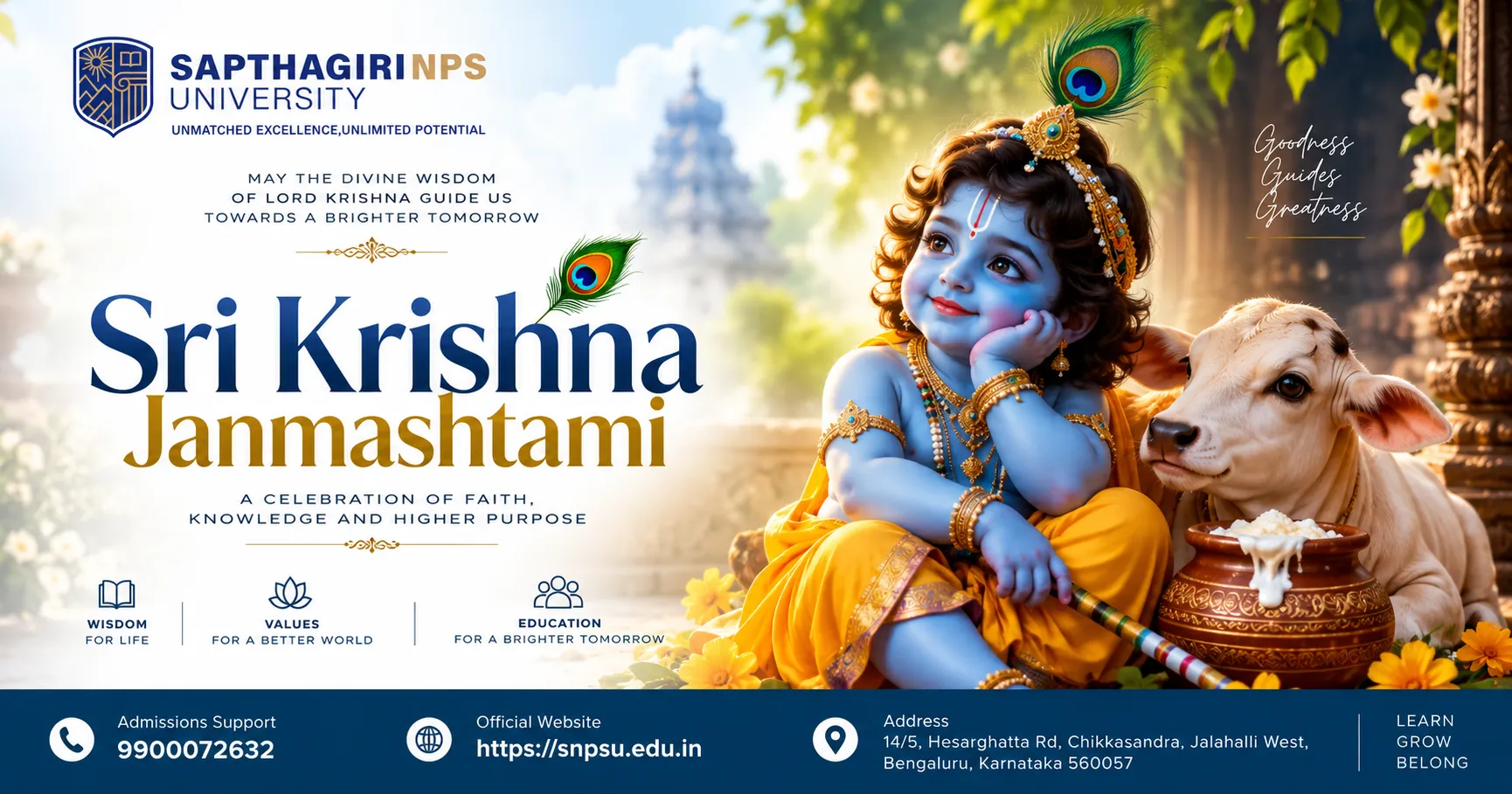
Krishna has inspired Indian visual artists for centuries, appearing in paintings, sculptures, textiles, temple art and modern artistic interpretations. Traditional representations often include recognizable elements such as a flute, peacock feather and distinctive clothing, although artistic styles differ across regions and historical periods. Krishna's childhood scenes, pastoral surroundings, relationships and stories from the Mahabharata have all become subjects of visual art. These representations provide valuable material for students interested in art, design, history and culture. An art exhibition organized around Sri Krishna Janmashtami can display student-created paintings, posters, illustrations and digital artwork. Students can also research traditional artistic styles and explain the cultural significance of selected motifs. Our university can use such exhibitions to encourage creative expression while introducing students to India's artistic heritage. Digital design students can explore how traditional themes can be represented using contemporary visual techniques. Such activities demonstrate how cultural traditions can inspire innovation without losing their historical identity. Art therefore becomes an important bridge between the past and present during Sri Krishna Janmashtami celebrations.
Sri Krishna Janmashtami and Student Life
Sri Krishna Janmashtami can have special relevance in university life because cultural events provide opportunities for students to interact beyond academic classrooms. Students from different departments can come together to organize performances, competitions, decorations, exhibitions and educational programmes. Such activities help students develop communication, leadership, teamwork and organizational skills. Cultural events can also create opportunities for students who have talents in music, dance, theatre, art, photography, writing and event management. Participation allows students to discover and develop skills that may not always be visible through academic assessments. A well-organized Sri Krishna Janmashtami programme can therefore contribute to a vibrant campus environment. Our university can encourage students to take active roles in planning and executing the celebration. Students can form committees for cultural programmes, stage management, decoration, communication, photography and technical coordination. Working together towards a shared event can provide valuable practical experience. The celebration can also strengthen relationships among students and create positive memories during their university years.
Sri Krishna Janmashtami Celebration at Our University
Sri Krishna Janmashtami can be celebrated as a vibrant cultural and educational occasion within our university community. Students can participate in traditional and contemporary activities that introduce the history and significance of the festival while encouraging creativity and teamwork. The celebration can include cultural performances, devotional music, dance programmes, storytelling sessions, art exhibitions, quiz competitions, essay writing, poster-making and traditional dress activities. Student-created decorations can transform selected university spaces into festive cultural areas while allowing participants to demonstrate their creativity. Educational displays can explain Krishna's birth story, his childhood, his role in the Mahabharata and the importance of the Bhagavad Gita. Different departments can contribute according to their academic strengths, creating an interdisciplinary celebration that involves students with diverse interests. Photography and media teams can document the event and create a digital record of the celebration. Students can also participate in awareness activities connected with sustainable and responsible festival practices. The celebration can encourage students to understand the historical background of Sri Krishna Janmashtami rather than focusing only on entertainment. By combining cultural participation with learning, our university can create a meaningful celebration that reflects the values of heritage, creativity, collaboration and community. Sri Krishna Janmashtami can thus become an occasion where students celebrate together while developing a deeper appreciation of India's cultural traditions.
Traditional Decorations for Sri Krishna Janmashtami
Decorations play an important role in creating the festive atmosphere associated with Sri Krishna Janmashtami. Traditional decorative elements may include flowers, lamps, artistic motifs, peacock-feather-inspired designs and representations connected with Krishna's childhood. University students can participate in decoration activities by creating handmade displays using recyclable and reusable materials. Such activities can encourage creativity while reducing dependence on disposable decorations. Students can create educational panels explaining the history of Janmashtami alongside the decorative displays. This combination of visual appeal and information can make campus spaces both festive and educational. Design students can experiment with different concepts while respecting traditional themes. Engineering and technology students can also explore responsible lighting and digital display solutions. Our university can encourage departments and student clubs to collaborate on decorations rather than working separately. This creates opportunities for teamwork and shared responsibility. A well-planned decorative programme can help students understand that cultural celebrations involve planning, creativity and cooperation. Through sustainable and student-led decoration activities, Sri Krishna Janmashtami can become a memorable part of campus life.
Sri Krishna Janmashtami Cultural Programmes
Cultural programmes can form an important part of Sri Krishna Janmashtami celebrations in our university. Students can present dance performances, music, theatre, storytelling, poetry and instrumental programmes based on Krishna's life and Indian cultural traditions. Each performance can be introduced with a brief explanation of its historical or cultural background, helping audiences understand what they are watching. Theatre groups can present selected stories from Krishna's childhood or his role in the Mahabharata. Dance groups can explore different classical and folk interpretations. Music groups can perform appropriate devotional or traditional compositions. Students interested in public speaking can host the programme and introduce each segment. Such activities provide practical experience in stage management, communication, event coordination and teamwork. Cultural programmes can also give students an opportunity to showcase talents that extend beyond their academic specializations. Our university can encourage participation from students across departments to make the celebration diverse and inclusive. By combining cultural performance with historical context, the programme can entertain audiences while also educating them about Sri Krishna Janmashtami.
Sri Krishna Janmashtami Quiz Competition
A Sri Krishna Janmashtami quiz can make the celebration interactive and educational for students. Questions can cover Krishna's traditional birth story, Mathura, Gokul, Vrindavan, the Mahabharata, the Bhagavad Gita, regional Janmashtami traditions, Indian literature, music, dance and art. Students can participate individually or in teams, encouraging both independent preparation and group discussion. A quiz can also motivate students to research information before the event. Questions can be designed for different levels of knowledge so that students from different academic backgrounds can participate. The event can include visual questions, audio-based cultural questions and historical topics to make it engaging. Students can learn about the diversity of Sri Krishna Janmashtami celebrations across India while developing their general knowledge. Our university can organize the quiz as part of a larger cultural programme and recognize outstanding participants. The activity can encourage healthy competition while maintaining the educational purpose of the celebration. Through such interactive programmes, students can explore cultural heritage in an enjoyable format. A quiz also provides an opportunity for students to discover aspects of Krishna traditions that they may not have encountered previously.
Essay Writing on Sri Krishna Janmashtami
Essay writing is another useful activity for encouraging students to explore the historical and cultural significance of Sri Krishna Janmashtami. Students can be given topics such as the history of Janmashtami, Krishna's influence on Indian culture, Krishna in the Mahabharata, Krishna and the Bhagavad Gita, regional Janmashtami traditions, Krishna in Indian literature or the importance of cultural festivals in modern society. Researching these topics can help students improve their reading, writing and analytical skills. Students can be encouraged to distinguish between traditional narratives, historical interpretation and cultural practices while preparing their essays. This approach supports academic thinking and respectful cultural discussion. Our university can organize an essay competition as part of the Janmashtami celebration and display selected entries for the wider university community. Students from different disciplines can contribute perspectives based on their academic interests. Engineering students may explore technology and cultural preservation, while humanities students may focus on literature, history or philosophy. Such interdisciplinary writing can demonstrate the broad relevance of Sri Krishna Janmashtami. The activity can also create a lasting written record of how students understand the festival and its place in contemporary society.
Art and Poster-Making Activities
Art and poster-making activities can provide students with an opportunity to express their understanding of Sri Krishna Janmashtami through visual creativity. Students can create traditional paintings, digital illustrations, educational posters, cultural infographics or contemporary artwork inspired by Krishna's life and the history of the festival. Participants can be encouraged to research the themes they represent so that their artwork has both creative and educational value. Posters can explain Krishna's birth story, regional celebrations, important cultural traditions or values associated with his life. Selected artwork can be displayed in appropriate university spaces or presented through digital platforms. Such activities can involve students from design, fine arts, media and other disciplines. Our university can encourage students to combine creativity with cultural awareness and responsible representation. Poster competitions can also develop students' visual communication skills, which are useful in many academic and professional fields. By connecting traditional themes with contemporary design, students can explore how heritage can be communicated to modern audiences. Art therefore becomes an important component of an engaging Sri Krishna Janmashtami celebration.
Traditional Dress and Cultural Expression
Traditional dress activities can add a strong visual and cultural dimension to Sri Krishna Janmashtami celebrations. Students may participate in traditional attire programmes that reflect Indian clothing styles and regional diversity. Such activities can encourage students to learn about textiles, colours, designs and clothing traditions from different parts of India. Rather than focusing only on appearance, the activity can be connected with short presentations explaining the cultural background of selected attire. Students can also incorporate traditional accessories and artistic elements in appropriate ways. A cultural dress programme can create opportunities for students from different regions to share aspects of their heritage with their peers. Our university can encourage respectful cultural representation and inclusive participation. Photography can document the event and create a digital cultural gallery. The activity can also help students appreciate the diversity of Indian traditions. By connecting traditional dress with historical and cultural explanations, Sri Krishna Janmashtami celebrations can become more educational. Such programmes can contribute to a festive atmosphere while strengthening awareness of India's cultural diversity.
Sustainable Sri Krishna Janmashtami Celebration
Sustainability can become an important part of modern Sri Krishna Janmashtami celebrations. Festivals often involve decorations, food, lighting and public gatherings, making responsible resource management valuable. Students can be encouraged to reduce single-use plastic, choose reusable decorations, avoid unnecessary waste and maintain cleanliness throughout the celebration. Handmade decorations created from recyclable materials can provide both creative and environmental benefits. Digital invitations and announcements can reduce unnecessary paper use. Food planning can also focus on minimizing waste and ensuring responsible distribution. Our university can encourage student clubs to include environmental awareness as part of the festival programme. A sustainability-themed exhibition can explain how traditional celebrations can be adapted to modern environmental concerns. Such activities help students understand that cultural heritage and environmental responsibility can exist together. Sustainability also provides practical opportunities for students to apply problem-solving skills to event management. Through responsible planning, Sri Krishna Janmashtami can become an example of how cultural celebrations can be joyful while remaining mindful of environmental needs.
Sri Krishna Janmashtami and Leadership
Leadership is an important theme that can be connected with the university celebration of Sri Krishna Janmashtami. Krishna's role in traditional narratives includes guidance, strategy, diplomacy and decision-making, making his stories useful for discussions about leadership. Modern student leadership also involves communication, responsibility, teamwork and the ability to make thoughtful decisions. Organizing a large cultural programme provides students with practical opportunities to develop these qualities. Student coordinators may need to manage schedules, communicate with performers, coordinate volunteers and solve unexpected problems. These responsibilities help students gain confidence and organizational experience. Our university can encourage student-led planning for Sri Krishna Janmashtami activities while providing appropriate guidance and supervision. Different student teams can take responsibility for different aspects of the event. Through this process, students learn that effective leadership involves listening, cooperation and accountability rather than simply giving instructions. The festival can therefore become a practical leadership-learning opportunity. Connecting cultural traditions with student development can make the celebration more meaningful and relevant to university life.
Sri Krishna Janmashtami and Teamwork
Teamwork is another major value that can be highlighted during Sri Krishna Janmashtami celebrations. Many cultural activities require students to work together towards a common objective. Organizing a stage programme, creating decorations, preparing an exhibition, conducting a quiz or managing an event requires coordination among multiple participants. Students must communicate clearly, divide responsibilities and support one another. These are also important skills in academic projects and professional workplaces. The traditional symbolism of activities such as Dahi Handi can provide a useful example of how collective effort can achieve a shared goal. Our university can encourage students to organize team-based competitions and cultural activities that emphasize cooperation rather than individual achievement alone. Students can learn to respect different abilities and contributions within a team. Such experiences can strengthen interpersonal skills and improve confidence. Teamwork developed through cultural activities can complement classroom learning. Sri Krishna Janmashtami can therefore become an opportunity to demonstrate that successful communities and organizations depend on people working together with trust and responsibility.
Sri Krishna Janmashtami and Student Creativity
Creativity is an important part of cultural celebrations because students can interpret traditional themes through new forms of expression. Sri Krishna Janmashtami provides a wide range of subjects for creative exploration, including Krishna's childhood, Mathura, Vrindavan, traditional music, dance, literature and philosophical teachings. Students can create short films, digital artwork, animations, theatre performances, poems, posters, photography projects and multimedia presentations. These activities allow students to combine cultural knowledge with modern creative skills. Students can also experiment with new ways of communicating historical information to younger audiences. Our university can encourage such projects as part of cultural competitions and exhibitions. Technology can help students create interactive presentations and digital storytelling experiences. The combination of tradition and innovation can make Sri Krishna Janmashtami relevant to contemporary university students. Creative activities also provide opportunities for students from different academic backgrounds to collaborate. Through these projects, students can learn that cultural heritage is not only something to preserve but also something that can inspire new forms of creativity and communication.
Sri Krishna Janmashtami and Cultural Diversity
Sri Krishna Janmashtami demonstrates the diversity of Indian cultural traditions because different regions celebrate the festival through their own customs and artistic expressions. The differences can be seen in music, dance, food, decorations, temple rituals, public events and storytelling traditions. This diversity provides students with an opportunity to understand that Indian culture contains many regional identities and interpretations. A university community often includes students from different parts of the country, making it an ideal environment for sharing these perspectives. Students can present the Janmashtami customs of their home regions through cultural exhibitions and presentations. Such activities can encourage mutual respect and curiosity. Our university can create opportunities for students to explain how their communities celebrate Sri Krishna Janmashtami. This can turn the festival into a celebration not only of Krishna but also of India's cultural diversity. Students learn that traditions can be shared without requiring every community to celebrate in exactly the same way. Such understanding is valuable in a diverse academic environment and in modern professional life. Sri Krishna Janmashtami can therefore support cultural awareness and appreciation among students.
Sri Krishna Janmashtami and Social Responsibility
Cultural festivals can also provide opportunities for social responsibility. Students can connect the values traditionally associated with Krishna with practical initiatives that benefit the wider community. Activities may include campus cleanliness campaigns, community outreach, awareness programmes, educational initiatives or responsible resource distribution. The objective is to encourage students to think about how celebrations can contribute positively to society. Such activities can demonstrate that cultural traditions can inspire action rather than remaining limited to ceremonial observance. Our university can encourage student groups to develop socially responsible initiatives around Sri Krishna Janmashtami. These activities can also provide practical experience in planning, communication and community engagement. Students learn that social responsibility involves understanding the needs of others and contributing in meaningful ways. Such programmes can complement cultural performances and celebrations. By incorporating community-oriented activities, Sri Krishna Janmashtami can become a broader celebration of compassion, responsibility and collective participation.
The Educational Importance of Sri Krishna Janmashtami
Sri Krishna Janmashtami can provide significant educational opportunities when students are encouraged to explore the festival's historical, cultural and philosophical dimensions. Students can study ancient texts, regional traditions, Indian literature, performing arts, cultural geography and the social development of festivals. Different academic disciplines can approach Krishna traditions from different perspectives. History students can explore the development of cultural traditions, literature students can examine Krishna-related poetry, design students can study visual representations and management students can examine event organization. Technology students can explore digital heritage preservation and media students can document cultural events. Our university can encourage interdisciplinary learning through such activities. The festival can therefore become an example of how education extends beyond conventional classroom subjects. Students can research, present, perform, organize and collaborate while learning about cultural heritage. This combination of academic and cultural learning can make Sri Krishna Janmashtami relevant to students across disciplines. The educational value of the festival becomes stronger when students are active participants rather than passive audiences.
The Role of Faculty in Sri Krishna Janmashtami Celebrations
Faculty members can contribute significantly to the educational and cultural value of Sri Krishna Janmashtami celebrations. Faculty can guide students in researching historical and cultural topics, support student activities and participate in discussions or cultural programmes. Faculty members from different academic disciplines can provide different perspectives on the festival. History and humanities faculty can discuss cultural development, while literature faculty can explore Krishna's presence in Indian writing. Management faculty can guide students in event planning and communication, while technology-oriented faculty can support digital presentations. Such interdisciplinary participation can make the celebration more comprehensive. Our university can encourage faculty and students to work together in planning meaningful activities. Faculty involvement can also help ensure that cultural programmes are organized responsibly and respectfully. Students benefit from the opportunity to interact with faculty outside conventional classroom settings. This can strengthen relationships within the university community. Through collaborative participation, Sri Krishna Janmashtami can become a shared learning experience for both students and faculty members.
Digital Celebration of Sri Krishna Janmashtami
Digital technology provides new ways to communicate the history and significance of Sri Krishna Janmashtami. Students can create digital posters, short videos, presentations, podcasts, photo stories and educational social media content related to the festival. Digital storytelling can introduce the traditional birth narrative and explain regional celebrations in formats that appeal to younger audiences. Students can also create virtual exhibitions featuring artwork, historical information and cultural explanations. Our university can encourage responsible digital content creation as part of the celebration. Media and technology students can collaborate with cultural clubs to produce high-quality educational content. Digital documentation can also preserve memories of university celebrations for future students. Online activities can allow wider participation from members of the university community who may not be able to attend every physical programme. Technology therefore provides an additional platform for cultural learning. By combining traditional knowledge with modern communication tools, Sri Krishna Janmashtami can reach students in new and engaging ways.
Sri Krishna Janmashtami and Modern Youth
Modern students live in a rapidly changing environment shaped by technology, globalization, social media and international communication. In such an environment, cultural awareness can help young people understand their historical roots while engaging confidently with the wider world. Sri Krishna Janmashtami offers an opportunity to introduce traditional stories through contemporary forms of communication. Students can explore Krishna through literature, music, digital art, theatre, short films and educational presentations. This allows cultural heritage to remain relevant without simply repeating traditional formats. Our university can encourage students to interpret the festival through their own creative perspectives while maintaining respect for its cultural significance. Modern youth can also explore the festival from academic viewpoints rather than only through celebration. They can investigate how traditions evolve and how communities preserve cultural identity. This approach encourages curiosity, critical thinking and cultural appreciation. Sri Krishna Janmashtami can therefore become a bridge between historical heritage and contemporary student life.
Sri Krishna Janmashtami and the Spirit of Togetherness
One of the strongest aspects of Sri Krishna Janmashtami is its ability to bring people together. Families, communities, temples, cultural groups and educational institutions can participate in different activities connected with the festival. Shared celebrations create opportunities for people to interact, communicate and develop a sense of community. University life also benefits from such experiences because students spend much of their time within academic groups and departments. Cultural celebrations can bring these groups together around common activities. Our university can use Sri Krishna Janmashtami to encourage collaboration across departments and student organizations. Students can participate in cultural programmes regardless of their academic specialization. Shared experiences can strengthen friendships and create lasting memories. The spirit of togetherness can also encourage students to appreciate the contributions of people with different talents and backgrounds. A successful celebration is therefore not only about the programme itself but also about the relationships developed through participation. Sri Krishna Janmashtami can provide an opportunity to strengthen the sense of community within our university.
Why Cultural Festivals Matter in University Life
University education is not limited to academic qualifications. Students also develop social skills, confidence, cultural awareness, communication abilities and leadership qualities through their experiences outside the classroom. Cultural festivals provide opportunities for these forms of development. Students who organize events learn planning and coordination, while performers develop confidence and stage skills. Volunteers develop responsibility and teamwork, and creative participants develop artistic abilities. Sri Krishna Janmashtami can contribute to this broader educational environment by bringing together students with different interests. Our university can encourage cultural celebrations as part of a holistic student experience. Such celebrations also create opportunities for students to understand India's diverse traditions. By participating in cultural activities, students can develop a stronger connection with their peers and university community. These experiences can become valuable memories of university life. Cultural events can therefore complement academic education and contribute to overall student development.
Frequently Asked Questions About Sri Krishna Janmashtami
1. What is Sri Krishna Janmashtami and why is it celebrated?
Sri Krishna Janmashtami is a significant Indian festival that commemorates the traditional birth of Lord Krishna. It is observed on the eighth day of the Krishna Paksha, or the dark fortnight, of the relevant lunar month. The festival is celebrated with prayers, devotional activities, cultural programmes, music, dance, storytelling, traditional decorations and community gatherings. The occasion is also an opportunity to learn about Krishna's life, his childhood stories, his role in the Mahabharata and the teachings associated with the Bhagavad Gita. Beyond the celebration itself, Sri Krishna Janmashtami encourages people to reflect on values such as courage, wisdom, responsibility, friendship, compassion, devotion and perseverance.
2. When is Sri Krishna Janmashtami celebrated?
Sri Krishna Janmashtami is traditionally celebrated on the Ashtami, or eighth lunar day, of the Krishna Paksha. Since the Hindu lunar calendar does not correspond directly with the Gregorian calendar, the date of Sri Krishna Janmashtami changes every year. The festival is traditionally associated with midnight because Krishna's birth is believed to have taken place at midnight. Many devotees therefore observe special prayers and celebrations during the late evening and around midnight. Different regions and communities may follow slightly different calendar conventions when determining the date, but the central purpose of the festival remains the commemoration of Krishna's birth.
3. Where was Lord Krishna traditionally born?
According to traditional accounts, Lord Krishna was born in Mathura, an ancient city that holds a special place in Krishna-related cultural traditions. His birth is traditionally described as taking place in a prison where his parents, Devaki and Vasudeva, were being held by Kamsa. The story of Krishna's birth is central to Sri Krishna Janmashtami celebrations and is frequently represented through storytelling, devotional programmes, theatrical performances and temple observances. Mathura continues to be strongly associated with Krishna's birth and is an important cultural and pilgrimage centre connected with the festival.
4. Who were Lord Krishna's parents and who raised him?
Traditional accounts identify Devaki and Vasudeva as the biological parents of Lord Krishna. Because of the danger posed by Kamsa, Krishna was taken from Mathura after his birth and was raised by Nanda and Yashoda in Gokul. The relationship between Krishna and Yashoda forms an important part of his childhood stories and has inspired numerous songs, paintings, dance performances and literary works. Krishna's childhood in Gokul and later Vrindavan is associated with stories of friendship, playfulness, family affection and community life. These narratives remain particularly popular during Sri Krishna Janmashtami celebrations.
5. Why is midnight important in Sri Krishna Janmashtami celebrations?
Midnight has special significance in Sri Krishna Janmashtami because traditional narratives describe Krishna's birth as occurring at midnight. Consequently, many celebrations are structured around this time, with devotees observing prayers, devotional singing and other activities before commemorating the birth. The midnight moment is also symbolically associated with the arrival of hope during a difficult period in the traditional birth narrative. Temples and communities may organize special programmes during the late evening and midnight hours. Understanding this tradition helps students appreciate why the timing of Sri Krishna Janmashtami celebrations is different from many other festivals.
6. What are the major traditions associated with Sri Krishna Janmashtami?
Sri Krishna Janmashtami is celebrated through a variety of traditions depending on the region and community. Common activities include fasting, prayers, devotional singing, temple visits, storytelling, traditional decorations, cultural performances and special food preparations. In some regions, Dahi Handi is an important public tradition inspired by stories of Krishna's childhood and his association with butter and curd. Dance and music performances are also popular because Krishna has had a strong influence on Indian classical and folk arts. These traditions demonstrate the diversity of Indian culture and show how the same festival can be celebrated in different ways across the country.
7. What is the significance of Dahi Handi during Sri Krishna Janmashtami?
Dahi Handi is a popular tradition associated with Krishna celebrations, particularly in Maharashtra. It is inspired by traditional stories about Krishna and his friends obtaining butter and curd. Participants traditionally form human pyramids to reach and break a pot suspended above the ground. The activity is often associated with teamwork, coordination, balance, determination and collective effort. These qualities make Dahi Handi an interesting cultural tradition for students to understand. In university celebrations, the cultural meaning of the tradition can be highlighted while ensuring that any physical activity is conducted responsibly with appropriate safety arrangements.
8. What values can students learn from Sri Krishna Janmashtami?
Sri Krishna Janmashtami provides students with opportunities to reflect on several values traditionally associated with Krishna's life and teachings. Courage can inspire students to face challenges confidently, while wisdom can encourage thoughtful decision-making. Stories about Krishna's friendships highlight cooperation, trust and mutual support. Teachings associated with the Bhagavad Gita emphasize responsibility and performing one's duties sincerely. Krishna's role as a guide and strategist can also introduce students to ideas about leadership and decision-making. Through cultural programmes and educational activities, our university can encourage students to connect these values with academic life, teamwork, personal development and future professional responsibilities.
9. How can students celebrate Sri Krishna Janmashtami at our university?
Students can participate in Sri Krishna Janmashtami celebrations at our university through a wide range of cultural and educational activities. These may include traditional and contemporary dance performances, devotional music, storytelling, theatre, art exhibitions, poster-making, essay writing, quizzes and cultural presentations. Students can also contribute to campus decorations using creative and environmentally responsible materials. Different departments and student groups can work together to organize programmes, providing opportunities to develop teamwork, leadership, communication and event-management skills. Digital activities such as short videos, presentations and cultural awareness campaigns can further extend participation and help students understand the history and significance of Sri Krishna Janmashtami.
10. Why is Sri Krishna Janmashtami important for our university community?
Sri Krishna Janmashtami is important for our university community because it provides an opportunity to combine cultural learning, creativity, student participation and community engagement. The festival allows students to explore India's rich heritage through history, literature, music, dance, art, storytelling and traditional practices. It also creates opportunities for students from different academic backgrounds and regions to work together and share their cultural perspectives. Cultural celebrations can help students develop confidence, teamwork, leadership and communication skills beyond the classroom. By celebrating Sri Krishna Janmashtami in a meaningful and inclusive manner, our university can encourage students to appreciate cultural heritage while connecting traditional values with contemporary student life.
Sri Krishna Janmashtami Celebration at Our University
Sri Krishna Janmashtami provides our university with an opportunity to bring students, faculty members and the wider university community together through culture, creativity and learning. The festival can be celebrated through meaningful programmes that highlight its rich history, traditional stories, artistic influence and cultural diversity. Students can actively contribute through performances, exhibitions, competitions, decorations, storytelling, music, dance and digital initiatives. By giving students opportunities to research and present the history of Sri Krishna Janmashtami, the celebration can become an educational experience as well as a festive occasion. The festival can also encourage students to develop teamwork, leadership, communication and organizational skills through event participation. Sustainable celebration practices can further demonstrate the importance of responsible cultural activities in the modern world. Most importantly, Sri Krishna Janmashtami can create a sense of togetherness among students from different academic disciplines and cultural backgrounds. Our university can use this occasion to celebrate India's heritage while encouraging students to appreciate the values of knowledge, responsibility, friendship, courage and compassion. With active student participation and meaningful cultural programming, Sri Krishna Janmashtami can become a memorable part of university life and an opportunity to connect India's rich traditions with the aspirations of today's young generation.
Sri Krishna Janmashtami is a festival with a rich historical background, deep cultural significance and a remarkable diversity of traditions. The festival commemorates the traditional birth of Lord Krishna and connects generations through stories, music, dance, literature, art, philosophy and community practices. From the traditional account of Krishna's birth in Mathura to his childhood in Gokul and Vrindavan, his role in the Mahabharata and his teachings in the Bhagavad Gita, Krishna's story has influenced Indian culture in numerous ways. The different regional forms of Sri Krishna Janmashtami demonstrate the diversity and adaptability of Indian cultural traditions. For students, the festival offers opportunities to explore history, literature, philosophy, performing arts, visual culture and social traditions while also reflecting on values such as courage, wisdom, friendship, responsibility, perseverance and teamwork. Our university can celebrate Sri Krishna Janmashtami through cultural programmes, music, dance, storytelling, art exhibitions, quizzes, essay competitions, traditional activities, digital initiatives and sustainable event practices. Such celebrations can provide students with opportunities to participate actively, develop practical skills and learn about India's cultural heritage. The occasion can also encourage students to work together, respect diversity and build stronger relationships within the university community. By combining tradition with creativity and learning, our university can make Sri Krishna Janmashtami a meaningful and memorable cultural experience. The festival reminds us of the importance of hope, responsibility, friendship, wisdom and perseverance while connecting contemporary students with a heritage that has continued across generations. Sri Krishna Janmashtami can therefore be celebrated not only as a traditional festival but also as an opportunity for education, cultural appreciation, student creativity and community participation. Through meaningful celebration and active student involvement, our university can create an environment where heritage and modern education come together, allowing students to celebrate the occasion with enthusiasm while developing a deeper understanding of the cultural traditions that have shaped India.
Sri Krishna Janmashtami Wishes & Contact Details
Warm wishes on the auspicious occasion of Sri Krishna Janmashtami! May Lord Krishna bless everyone with happiness, peace, wisdom, prosperity, and success. May this joyous occasion inspire us to follow the values of love, compassion, righteousness, and devotion.
| Contact Information | Details |
|---|---|
| Janmashtami Enquiries | Contact Sapthagiri NPS University for more information about the celebration and university programmes. |
| Phone | 9900072632 |
| Application | Start Your Application Journey – Click Here |
| Address | Sapthagiri NPS University, 14/5, Hesarghatta Rd, Chikkasandra, Jalahalli West, Bengaluru, Karnataka – 560057 |
Leave a Comment