
Sapthagiri NPS University Placement Assistance: Career Development, Industry Exposure, Admissions & Student Success
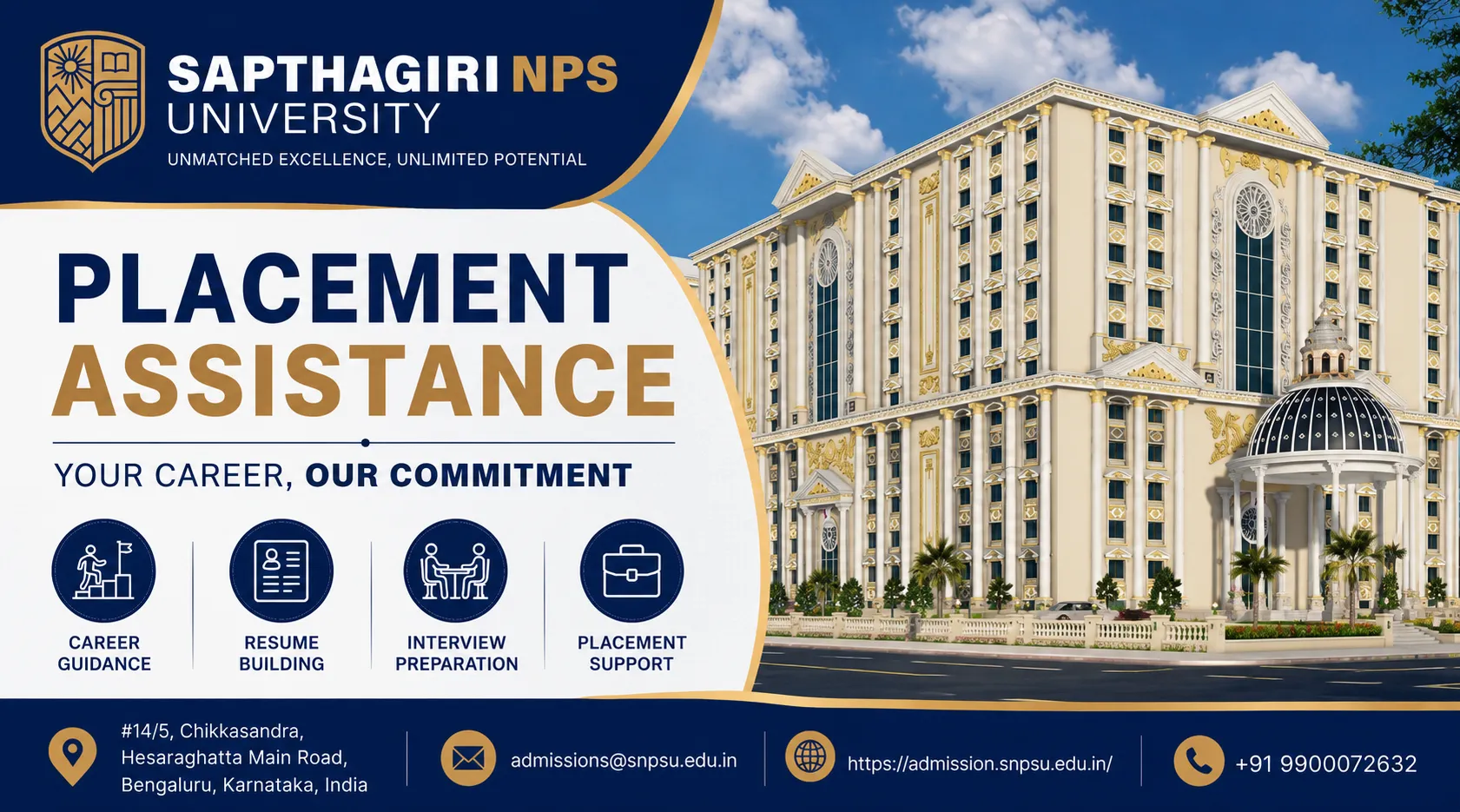
Sapthagiri NPS University Placement Assistance – Preparing Students for Professional Success
Choosing the right university is about more than earning a degree. It is about becoming part of an academic community that inspires learning, encourages innovation, develops practical skills, and prepares students to achieve lasting professional success. Our University, we are committed to providing an educational experience that empowers every student to grow academically, professionally, and personally while building a strong foundation for a successful future.Our University believes that quality education should create opportunities beyond the classroom. Every academic programme is thoughtfully designed to integrate theoretical knowledge with practical learning, industry engagement, research, innovation, and professional development. Through modern teaching methodologies, advanced laboratories, experiential learning, project-based education, internships, and collaborative activities, students develop the knowledge and confidence required to excel in today's competitive global environment. Career preparation begins from the very first day of a student's academic journey at Our University. We understand that professional success requires much more than academic excellence. Employers seek graduates who possess technical expertise, effective communication skills, leadership qualities, analytical thinking, teamwork, adaptability, ethical values, and the ability to solve real-world challenges. Our University continuously nurtures these essential qualities through structured learning experiences and comprehensive career development initiatives.
Placement Assistance at Our University is an integral part of our commitment to student success. Rather than viewing placements as an activity limited to the final semester, we adopt a continuous and progressive approach that prepares students throughout their academic journey. Our Career Development Team works closely with students to enhance employability skills, strengthen professional confidence, and provide the guidance necessary to achieve meaningful career opportunities across diverse industries. Students benefit from a wide range of career-focused programmes, including aptitude development, communication and soft skills training, technical workshops, resume-building sessions, personality development programmes, mock interviews, group discussions, career counselling, industry interactions, internships, industrial visits, certification programmes, and expert lectures by professionals from leading organisations. These initiatives help students understand workplace expectations while developing the competencies required to succeed in modern professional environments.Faculty members, mentors, and career development professionals at Our University provide continuous guidance to every student. Individual mentoring, academic support, research opportunities, innovation projects, interdisciplinary learning, and practical exposure enable students to discover their strengths, build confidence, and prepare themselves for rewarding careers. Our supportive learning environment encourages students to explore new ideas, think creatively, and develop solutions that address real-world challenges. Industry-oriented education remains one of the defining strengths of Our University. Academic programmes are regularly enhanced to align with emerging technologies, evolving industry requirements, healthcare advancements, business practices, scientific research, and global professional standards. This ensures that students graduate with current knowledge, practical expertise, and industry-relevant skills that increase their career readiness and professional competitiveness.Admissions Open – Your Future Begins Here ➜ Call Now
Whether students aspire to establish careers in engineering, technology, management, commerce, computer applications, healthcare, applied sciences, research, entrepreneurship, or pursue higher education, Our University provides the academic support, career guidance, and professional development opportunities required to help them achieve their ambitions. Students are encouraged to participate in internships, live projects, research activities, innovation challenges, technical events, seminars, workshops, conferences, and collaborative learning experiences that contribute to their overall growth. Our University also recognises that successful professionals require strong character in addition to technical competence. Leadership development, ethical decision-making, communication excellence, teamwork, problem-solving abilities, and lifelong learning are integrated throughout the educational experience. This holistic approach enables students to become responsible professionals who can contribute meaningfully to organisations, industries, communities, and society.
Modern infrastructure, advanced laboratories, digital learning resources, experienced faculty members, industry collaborations, innovation initiatives, student support services, and career-focused learning environments collectively create a strong foundation for student achievement. Every initiative at Our University is guided by the objective of preparing graduates who are knowledgeable, confident, adaptable, and ready to meet the challenges of an evolving professional world. Our University, placement assistance represents far more than campus recruitment. It is a continuous journey of learning, skill development, mentoring, professional growth, and career readiness. By combining academic excellence with industry-oriented education and comprehensive career development support, Our University empowers every student to transform aspirations into achievements and build a successful future with confidence.
A Gateway to Academic and Professional Growth
Admissions represent far more than the completion of an application form or the fulfilment of eligibility requirements. They mark the beginning of an exciting educational journey where aspirations take shape, knowledge expands, and future careers begin to develop. Our University, every admission is viewed as an opportunity to welcome ambitious learners into a vibrant academic community that is committed to excellence, innovation, and holistic student development. Every student arrives with unique ambitions, personal interests, academic strengths, and professional goals. Some aspire to become engineers, healthcare professionals, entrepreneurs, scientists, researchers, managers, or technology experts, while others seek opportunities in emerging multidisciplinary fields. Recognising that each student's journey is different, Our University has developed an admission process that is transparent, supportive, and student-centric. Rather than simply processing applications, we focus on helping students understand their educational options so they can make informed decisions about their future.Admissions Open ➜ Register Today
Our Admissions Team works closely with prospective students and their families throughout every stage of the admission process. From the initial enquiry to programme selection and final enrolment, applicants receive personalised guidance that helps them understand the University's academic offerings, eligibility requirements, career prospects, scholarship opportunities, campus facilities, and student support services. Every interaction is designed to ensure that students feel confident, informed, and well-prepared before beginning their higher education journey. The admission experience also provides an opportunity for students to explore the University's learning philosophy, academic culture, research environment, innovation initiatives, and career development opportunities. By understanding how their chosen programme aligns with their interests and long-term aspirations, students are better equipped to make decisions that contribute to both academic success and professional achievement. Our University believes that an informed decision at the admission stage creates a strong foundation for lifelong learning and career excellence.
A Student-Centred Admission Experience
Our University, admissions extend well beyond administrative formalities. They represent the beginning of a collaborative partnership between students, faculty members, mentors, and academic advisors who work together to support every learner throughout their educational journey. From the moment students connect with the University, they become part of an academic environment that values curiosity, innovation, inclusivity, leadership, and continuous personal growth. The University understands that selecting the right academic programme is one of the most important decisions in a student's life. Choosing a programme influences future career opportunities, higher education prospects, professional development, and personal fulfilment. Therefore, every applicant receives detailed guidance that helps them evaluate different academic disciplines, understand curriculum structures, identify specialisation opportunities, and explore career pathways associated with each programme.
Parents and guardians also play an important role during the admission process. Our Admissions Team ensures that families receive accurate and comprehensive information regarding academic standards, student welfare initiatives, campus safety, infrastructure, hostel facilities, placement assistance, research opportunities, scholarships, and financial support. This transparent approach enables families to make well-informed decisions while feeling confident about the educational environment their children will join.
Throughout the admission journey, applicants receive continuous assistance regarding programme selection, eligibility verification, documentation requirements, fee structure, scholarship options, admission schedules, counselling sessions, orientation programmes, and campus facilities. Dedicated admission counsellors remain available to answer questions, provide clarification, and ensure that every step of the process is completed smoothly and efficiently. Our student-first philosophy reflects the University's commitment to creating a welcoming and supportive admission experience where every learner feels respected, encouraged, and guided. By reducing uncertainty and providing personalised assistance, Our University helps students begin their academic journey with clarity, confidence, and enthusiasm.
Programme Selection
Selecting the right academic programme is one of the most significant decisions a student will make before entering higher education. Our University, programme selection is treated as an important counselling process rather than a simple admission requirement. Every student possesses different interests, talents, academic backgrounds, and professional aspirations, making personalised guidance essential for choosing a programme that aligns with individual career objectives. Our Admissions Counsellors help students understand the scope, curriculum, learning outcomes, practical exposure, research opportunities, and career prospects associated with each programme. Whether students are interested in Engineering, Computer Applications, Business Management, Commerce, Applied Sciences, Healthcare, or other multidisciplinary disciplines, they receive detailed information that enables them to compare available options and make confident academic choices.
Students are encouraged to evaluate their strengths, interests, aptitude, and long-term career goals before finalising a programme. Counsellors explain how different academic pathways can lead to opportunities in industry, entrepreneurship, government services, higher education, research, innovation, and international careers. This comprehensive guidance enables students to select programmes that not only match their academic interests but also support their future professional ambitions. The University also introduces prospective students to the distinctive features of each programme, including modern laboratories, specialised facilities, industry collaborations, internship opportunities, research initiatives, project-based learning, skill development activities, and placement assistance. Understanding these academic advantages allows applicants to appreciate how their chosen programme contributes to practical learning and career readiness.
Our University continuously updates its academic programmes to reflect technological advancements, industry trends, and emerging global opportunities. Students therefore benefit from contemporary curricula that integrate theoretical knowledge with practical application, innovation, interdisciplinary learning, and professional skill development. This forward-looking approach ensures that graduates remain competitive in rapidly evolving professional environments. By providing comprehensive counselling and personalised academic guidance, Our University empowers students to make informed programme selections that support both immediate educational goals and long-term career success. The University's commitment extends beyond admissions, ensuring that every learner begins their higher education journey with confidence, purpose, and a clear vision for the future.
Academic Pathways
Our University offers a diverse range of academic pathways designed to help students achieve their educational and professional aspirations. Whether students are pursuing undergraduate, postgraduate, or research programmes, each academic pathway is structured to provide a balanced combination of theoretical knowledge, practical learning, interdisciplinary exposure, and professional development. Students have the opportunity to choose programmes that align with their interests while exploring emerging fields that prepare them for future industry requirements. Academic advisors and admissions counsellors guide students in understanding programme structures, specialisations, elective choices, research opportunities, internship options, and career progression. This personalised guidance enables students to make informed academic decisions while building a strong foundation for higher education, professional careers, entrepreneurship, and lifelong learning.
Eligibility Requirements
Understanding admission eligibility is an essential part of the application process. Our University maintains transparent and clearly defined eligibility criteria for every academic programme to ensure that students are fully aware of the qualifications required before applying. Eligibility requirements vary according to the programme, level of study, and applicable regulatory guidelines. The Admissions Team assists applicants in verifying their academic qualifications, entrance examination requirements where applicable, subject combinations, minimum qualifying marks, and other programme-specific criteria. Students are encouraged to seek clarification whenever necessary, ensuring that every application is submitted accurately and confidently. This transparent approach helps minimise confusion while making the admission process smooth and efficient for applicants from diverse educational backgrounds.
Required Documentation
Preparing the necessary documents in advance helps simplify the admission process and ensures timely application processing. Our University provides comprehensive guidance regarding all documents required during admission so that applicants can complete every stage without unnecessary delays. The Admissions Team verifies submitted documents carefully while assisting students in understanding any additional requirements that may apply to specific programmes. Depending on the programme and admission category, applicants may be required to submit academic mark sheets, qualifying certificates, transfer certificates, migration certificates, identity proof, passport-size photographs, entrance examination scorecards, category certificates where applicable, and other supporting documents. Students receive continuous assistance throughout the documentation process, ensuring accuracy, transparency, and compliance with admission guidelines.
Career Opportunities
Every academic programme at Our University is designed with future career opportunities in mind. The University believes that higher education should prepare students not only with academic knowledge but also with the professional competencies required to succeed in today's competitive employment landscape. Through industry-oriented education, practical learning experiences, internships, skill development programmes, and career guidance initiatives, students develop the confidence and capabilities expected by employers across various sectors. Admissions counsellors provide valuable insights into career prospects associated with different programmes, helping students understand potential employment opportunities, higher education pathways, entrepreneurship prospects, research careers, and emerging professional domains. This career-focused guidance enables students to select programmes that align with their ambitions while preparing them for meaningful professional success after graduation.
Campus Facilities
A supportive learning environment plays an important role in shaping a student's academic experience. Our University provides modern infrastructure and comprehensive campus facilities that encourage learning, research, innovation, collaboration, and overall student well-being. Every facility is developed to create an environment where students can pursue academic excellence while participating in extracurricular, cultural, and professional development activities. Students have access to well-equipped classrooms, advanced laboratories, modern libraries, digital learning resources, computer centres, seminar halls, innovation spaces, research facilities, sports infrastructure, hostels, dining facilities, healthcare support, transportation services, and recreational areas. These facilities contribute to a vibrant campus experience that promotes academic achievement, personal growth, and holistic development throughout the educational journey.
Student Support Services
Our University believes that student success extends beyond classroom learning. Comprehensive student support services are available to assist learners throughout their academic journey by providing guidance, mentoring, counselling, and academic assistance whenever required. Every student receives continuous support that encourages confidence, well-being, and personal development while helping them overcome academic or personal challenges. Support services include academic mentoring, career counselling, placement guidance, psychological counselling, wellness initiatives, skill development programmes, orientation sessions, grievance redressal mechanisms, anti-ragging measures, hostel support, international student assistance, and various student engagement activities. These services create a nurturing educational environment where students can focus on learning while receiving assistance whenever needed.
Financial Guidance
Investing in higher education is an important decision for students and families. Our University is committed to ensuring that applicants receive clear, transparent, and accurate information regarding tuition fees, scholarships, financial assistance, payment options, and educational support available during the admission process. Financial guidance enables students to plan their education with confidence while understanding the resources available to support their academic journey. Admissions counsellors explain fee structures, scholarship opportunities based on eligibility, payment schedules, education loan assistance, instalment options where applicable, and other financial support mechanisms. By providing comprehensive financial guidance, the University helps families make informed decisions while ensuring that financial planning does not become a barrier to quality education.
Application Timelines
Timely application submission plays an important role in securing admission to the desired academic programme. Our University follows a structured admission schedule that allows applicants sufficient time to complete every stage of the process while meeting important deadlines. Students are encouraged to begin their applications early to ensure adequate time for counselling, document verification, programme selection, and enrolment. Throughout the admission cycle, applicants receive regular updates regarding application opening dates, submission deadlines, entrance examinations where applicable, counselling schedules, document verification, admission confirmation, fee payment timelines, orientation programmes, and commencement of academic sessions. Clear communication and continuous guidance ensure that students remain informed throughout the admission process, allowing them to begin their educational journey smoothly and confidently.
Learning That Extends Beyond the Classroom
Our University, learning extends far beyond textbooks and lecture halls. We believe that higher education should prepare students not only to excel academically but also to become competent professionals, innovative thinkers, and responsible global citizens. Today's industries seek graduates who possess technical expertise along with critical thinking, communication skills, adaptability, leadership, teamwork, and the ability to solve complex real-world challenges. To address these evolving expectations, Our University has created a dynamic learning environment where theoretical knowledge is continuously reinforced through practical experiences, collaborative activities, research initiatives, and industry engagement.
Every academic programme is carefully designed to bridge the gap between classroom education and professional practice. Students are encouraged to participate actively in discussions, experiments, projects, internships, presentations, and experiential learning activities that promote deeper understanding and practical application of concepts. Faculty members employ modern teaching methodologies that inspire curiosity, creativity, innovation, and analytical thinking while preparing students to confidently navigate the rapidly changing global workplace. The University's learner-centric approach ensures that education remains engaging, interactive, and outcome-oriented. Through continuous academic support, mentorship, industry exposure, and skill development initiatives, students graduate with the confidence and competencies required to pursue successful careers, higher education, entrepreneurship, and lifelong learning.
Practical Assignments
Practical assignments play a significant role in reinforcing classroom learning by enabling students to apply theoretical concepts to real-world situations. Our University, assignments are thoughtfully designed to encourage independent thinking, research, analysis, creativity, and problem-solving. Rather than focusing solely on written submissions, students participate in practical exercises, technical tasks, field-based activities, and application-oriented projects that strengthen conceptual understanding and professional competence. These assignments promote active learning, improve decision-making abilities, and help students develop the confidence to apply academic knowledge in diverse professional environments.
Case-Based Learning
Case-based learning enables students to understand how theoretical principles are applied to solve practical challenges encountered by industries, businesses, healthcare organisations, and society. Our University incorporates case discussions across various disciplines to encourage analytical thinking, informed decision-making, strategic planning, and collaborative problem-solving. Students evaluate real-world scenarios, identify challenges, analyse multiple perspectives, and recommend practical solutions. This interactive learning approach strengthens critical thinking, communication skills, teamwork, and professional judgement while exposing students to situations they may encounter during their careers.
Laboratory Experience
Laboratory education forms an essential component of academic learning by providing students with opportunities to experiment, observe, analyse, and validate theoretical concepts through practical application. Our University offers modern laboratories equipped with contemporary equipment, technology, and learning resources that support experiential education across multiple disciplines. Under the guidance of experienced faculty members, students conduct experiments, develop technical competencies, improve analytical skills, and gain valuable hands-on experience. Laboratory learning encourages scientific inquiry, precision, innovation, and confidence while preparing students for research, industry, and advanced professional practice.
Industry Exposure
Understanding workplace expectations is essential for building successful careers. Our University provides students with meaningful industry exposure through industrial visits, expert lectures, professional interactions, internships, collaborative initiatives, and knowledge-sharing sessions with experienced professionals. These experiences enable students to understand organisational practices, emerging technologies, industry trends, workplace culture, and evolving professional expectations. Exposure to real business and industrial environments helps students connect classroom learning with practical implementation while developing a broader perspective on career opportunities.
Project-Based Education
Project-based education enables students to transform theoretical knowledge into practical solutions by working on meaningful academic and industry-oriented projects. Our University, students are encouraged to participate in individual and collaborative projects that promote innovation, creativity, research, teamwork, and problem-solving throughout their academic journey. Projects often require students to investigate challenges, design solutions, apply technical knowledge, evaluate outcomes, and present their findings. This comprehensive learning process strengthens technical expertise, leadership abilities, project management skills, and professional confidence while preparing graduates for dynamic workplace responsibilities.
Research Opportunities
Research encourages students to explore new ideas, generate innovative solutions, and contribute to the advancement of knowledge within their chosen disciplines. Our University actively promotes a research-oriented academic culture where students are encouraged to participate in research projects, scholarly activities, innovation initiatives, and interdisciplinary collaborations. Faculty members guide students in developing research methodologies, conducting systematic investigations, analysing data, interpreting findings, and presenting meaningful conclusions. Participation in research enhances intellectual curiosity, critical thinking, analytical capabilities, and academic excellence while preparing students for higher education, specialised careers, and lifelong learning.
Collaborative Learning
Modern workplaces value professionals who can work effectively within diverse teams. Our University therefore promotes collaborative learning experiences that encourage students to exchange ideas, learn from peers, respect diverse perspectives, and work together toward common academic objectives. Through group projects, classroom discussions, workshops, seminars, innovation challenges, and interdisciplinary activities, students develop communication, leadership, interpersonal, and conflict-resolution skills. Collaborative learning also fosters mutual respect, creativity, teamwork, and professional relationships that contribute to both academic success and future career development.
Presentation Skills
The ability to communicate ideas confidently and effectively is an essential professional competency. Our University provides numerous opportunities for students to strengthen their presentation skills through seminars, project reviews, classroom presentations, technical symposiums, conferences, workshops, and academic competitions. Students learn to organise information logically, communicate with clarity, use appropriate visual aids, engage audiences effectively, and respond confidently to questions. Continuous presentation practice enhances public speaking abilities, leadership qualities, professional confidence, and communication effectiveness that are valuable across every career path.
Professional Communication
Effective communication is fundamental to academic success, workplace collaboration, leadership, and professional growth. Our University places significant emphasis on developing strong communication skills that enable students to interact confidently within academic, corporate, research, and global environments. Dedicated communication training focuses on verbal communication, written correspondence, interpersonal interaction, business communication, technical writing, interview preparation, group discussions, and workplace etiquette. Through regular practice and expert guidance, students develop the confidence to express ideas clearly, collaborate effectively, build professional relationships, and succeed in diverse organisational settings. Our University, learning is designed to be practical, engaging, and career-oriented. By integrating experiential education with academic excellence, we prepare students to become knowledgeable professionals, innovative thinkers, ethical leaders, and lifelong learners who are ready to contribute meaningfully to industries and society.
Guidance Throughout the Academic Journey
Our University, student success is built upon continuous guidance, personalised mentoring, and meaningful academic support. We believe that every student has unique strengths, aspirations, and learning needs, and our responsibility extends beyond delivering classroom instruction. From the first semester until graduation, students receive consistent guidance from experienced faculty members, academic advisors, mentors, and career development professionals who are committed to helping them achieve both academic excellence and professional success. Mentoring at Our University is a continuous process that encourages students to overcome academic challenges, discover their potential, strengthen their capabilities, and confidently pursue their educational and career aspirations. Regular interactions with mentors provide opportunities to discuss academic performance, career objectives, research opportunities, personal development, and professional growth. These discussions create a supportive learning environment where students feel encouraged to ask questions, seek guidance, and make informed decisions throughout their higher education journey. The University's mentoring framework also helps students develop confidence, resilience, leadership qualities, critical thinking, and problem-solving abilities while promoting lifelong learning. Through individual counselling, academic reviews, career guidance sessions, skill development initiatives, and professional mentoring, students receive the support necessary to maximise their learning experience and prepare for future opportunities.Admissions Open → Take the First Step ➜ Register Now
Academic Progress
Monitoring academic progress is an essential component of student development. Faculty members and academic mentors regularly evaluate each student's learning journey by reviewing academic performance, classroom participation, practical work, projects, and overall progress. Students receive constructive feedback that helps them identify strengths, improve learning strategies, and overcome academic challenges with confidence. Regular academic mentoring ensures that students remain focused on achieving their educational objectives while continuously improving their knowledge, analytical abilities, and subject expertise throughout their programme.
Personal Development
Our University believes that education should contribute to the overall development of every student. Personal development initiatives are designed to build confidence, emotional intelligence, leadership qualities, ethical values, adaptability, communication skills, and self-discipline. Students are encouraged to participate in extracurricular activities, cultural events, leadership programmes, community engagement initiatives, and personality development workshops that contribute to their holistic growth. Faculty mentors provide continuous encouragement and motivation, helping students develop positive attitudes, responsible behaviour, and the confidence required to succeed both personally and professionally.
Career Planning
Career planning begins early at Our University to help students make informed decisions regarding their future. Academic advisors and career development professionals assist students in understanding industry trends, employment opportunities, higher education options, entrepreneurship pathways, and emerging professional sectors relevant to their chosen disciplines. Through regular counselling sessions, students receive guidance in identifying career goals, selecting appropriate academic pathways, developing professional competencies, and preparing strategically for future employment. This proactive approach enables students to graduate with greater confidence and a well-defined career direction.
Research Interests
Students with an interest in research are encouraged to explore innovative ideas and contribute to academic advancement through structured research opportunities. Faculty members mentor students in identifying research topics, developing methodologies, conducting investigations, analysing data, and presenting meaningful findings within their respective disciplines. Participation in research activities enhances intellectual curiosity, analytical thinking, creativity, and innovation while preparing students for advanced studies, specialised careers, and contributions to scientific, technological, and societal development.
Skill Enhancement
Professional success requires continuous skill development alongside academic learning. Our University provides numerous opportunities for students to enhance technical competencies, communication skills, leadership abilities, analytical thinking, digital literacy, teamwork, and problem-solving capabilities through workshops, certification programmes, seminars, and practical learning experiences. Mentors help students identify areas for improvement while recommending appropriate training programmes that strengthen employability and prepare them for evolving industry expectations.
Internship Preparation
Internships provide valuable opportunities for students to gain practical exposure before entering the professional world. Our University prepares students for internship experiences by offering guidance on professional communication, resume preparation, interview techniques, workplace ethics, organisational behaviour, and industry expectations. Faculty mentors and career advisors assist students in understanding internship objectives, maximising learning opportunities, and applying classroom knowledge in professional environments. This preparation enables students to approach internships with confidence while developing valuable workplace experience.
Professional Growth
Professional growth is viewed as a continuous journey that extends throughout a student's academic experience. Our University encourages students to develop leadership capabilities, professional ethics, effective communication, teamwork, adaptability, and lifelong learning habits that contribute to long-term career success. Through mentoring, industry interactions, skill development programmes, seminars, conferences, networking opportunities, and career guidance initiatives, students gain the confidence and professional maturity required to excel in diverse organisational environments. The University's holistic mentoring approach ensures that graduates are well-prepared to embrace future opportunities while making meaningful contributions to their professions and society. Our University, mentoring is not limited to academic guidance, it is a lifelong partnership that nurtures confidence, inspires excellence, and empowers every student to realise their full academic and professional potential.
Academic Environment Designed for Future-Ready Learning
The future belongs to graduates who possess not only strong academic foundations but also the ability to innovate, collaborate, adapt, and solve complex challenges. Our University, we recognise that industries are evolving rapidly due to technological advancements, digital transformation, artificial intelligence, sustainability initiatives, and changing global business practices. As a result, the University continuously strengthens its academic ecosystem to ensure that students receive an education that is relevant, practical, and aligned with the expectations of the modern workforce. Our University is committed to creating a future-ready learning environment where students develop technical expertise alongside analytical thinking, creativity, leadership, ethical values, communication skills, and lifelong learning habits. Every aspect of the academic experience is carefully designed to prepare learners for professional success while encouraging innovation, research, and interdisciplinary collaboration. Learning at Our University combines classroom instruction with experiential education, laboratory practice, research, project-based learning, industry engagement, internships, seminars, workshops, and technology-enabled teaching methodologies. Students are encouraged to participate actively in discussions, collaborative activities, innovation challenges, and practical learning experiences that strengthen both academic knowledge and professional competencies. The University's learner-centric approach ensures that students remain engaged throughout their educational journey while developing the confidence to address real-world challenges. Modern infrastructure, advanced laboratories, digital learning resources, experienced faculty members, and continuous academic support collectively create an environment where students can explore ideas, develop practical expertise, and achieve academic excellence.
Industry-Aligned Curriculum
An effective curriculum should prepare students not only for today's careers but also for the opportunities of tomorrow. Our University, every academic programme is developed with a clear focus on industry relevance, academic excellence, innovation, and professional growth. The curriculum is periodically reviewed and updated to reflect emerging technologies, evolving industry practices, regulatory developments, and global educational standards, ensuring that students receive an education that remains current and career-oriented. Rather than relying solely on conventional teaching methods, the curriculum integrates theoretical knowledge with practical applications that encourage students to analyse, evaluate, innovate, and apply concepts confidently in professional environments. Students benefit from exposure to multidisciplinary learning, experiential education, research activities, industrial interactions, internships, live projects, and collaborative assignments that strengthen both technical and professional capabilities. Continuous interaction with academic experts, industry professionals, employers, and subject specialists enables the University to identify changing workforce expectations and incorporate relevant learning outcomes into academic programmes. This proactive approach ensures that graduates are equipped with the competencies required to thrive in competitive national and international employment markets while contributing meaningfully to society.
Key Curriculum Features
Outcome-Based Education
Academic programmes at Our University follow an outcome-based approach that focuses on measurable learning achievements. Students progressively develop subject expertise, analytical abilities, technical competencies, communication skills, ethical values, and professional confidence through clearly defined learning objectives and continuous assessment.
Interdisciplinary Learning
Modern industries increasingly require professionals who can collaborate across multiple disciplines. Our University encourages interdisciplinary learning by enabling students to explore complementary areas of knowledge, broaden their perspectives, and develop innovative solutions to complex problems.
Practical Applications
Theoretical concepts are reinforced through laboratory work, demonstrations, simulations, field activities, practical assignments, workshops, and technology-enabled learning experiences. This practical approach enables students to confidently apply academic knowledge in professional settings.
Industry-Relevant Case Studies
Students regularly analyse real-world business, engineering, healthcare, scientific, and technological case studies that develop analytical thinking, decision-making abilities, and strategic problem-solving skills while exposing them to contemporary industry practices.
Planning Your Academic Future?
Our Admissions Team is available to assist you with programme selection, eligibility requirements, admission procedures, scholarships, career guidance, and campus facilities.
Admissions Open - 📞 Call Now
Connect with Our University to receive personalised guidance and begin your journey toward academic excellence and professional success.
Project Work
Project-based learning forms an integral part of academic programmes at Our University. Students work individually and collaboratively on projects that encourage innovation, research, technical application, creativity, and teamwork. These experiences strengthen professional competencies while preparing students for workplace responsibilities.
Continuous Assessment
Student learning is evaluated through a balanced assessment framework that includes assignments, laboratory work, presentations, seminars, projects, quizzes, practical examinations, classroom participation, and periodic evaluations. Continuous assessment provides regular feedback while encouraging consistent academic engagement and progressive improvement.
Experiential Learning
Learning becomes meaningful when students experience concepts through practical application. Our University promotes experiential learning through internships, industrial visits, live projects, community engagement, innovation activities, research participation, workshops, seminars, and collaborative academic initiatives that connect classroom knowledge with real-world practice.
Faculty Expertise
The strength of any university lies in the knowledge, experience, and commitment of its faculty members. Our University, students are guided by experienced academicians, researchers, mentors, and industry professionals who are dedicated to nurturing intellectual curiosity, innovation, and academic excellence. Faculty members combine strong academic credentials with practical industry exposure, enabling students to gain both conceptual understanding and professional insights throughout their educational journey.
Teaching at Our University extends beyond delivering lectures. Faculty members inspire students to think critically, ask meaningful questions, conduct research, explore innovative ideas, and develop practical solutions to contemporary challenges. Through continuous mentoring and personalised academic support, they encourage students to realise their full potential while preparing them for lifelong learning and professional achievement.
Faculty members actively participate in curriculum development, research initiatives, industry collaborations, conferences, academic publications, innovation projects, and professional development programmes, ensuring that students benefit from contemporary knowledge and evolving educational practices.
Faculty Contributions
Interactive Lectures
Classroom sessions are designed to promote active participation, discussion, collaborative learning, and critical thinking. Faculty members use modern teaching methodologies, multimedia resources, demonstrations, and practical examples to make learning engaging and meaningful.
Research Supervision
Students interested in research receive continuous guidance from experienced faculty members throughout every stage of their academic investigations. Research supervision encourages innovation, analytical thinking, scientific inquiry, and academic excellence while preparing students for advanced studies and specialised careers.
Student Mentoring
Faculty mentors provide personalised academic guidance, monitor student progress, identify strengths, address learning challenges, and encourage continuous improvement throughout the educational journey. This supportive mentoring framework contributes significantly to student confidence and academic success.
Industry Collaborations
Faculty members actively engage with industry professionals, organisations, research institutions, and academic partners to strengthen practical learning opportunities, knowledge exchange, internships, guest lectures, collaborative projects, and emerging technology initiatives.
Academic Advising
Academic advisors assist students in selecting appropriate learning pathways, understanding curriculum requirements, planning elective courses, exploring higher education opportunities, and achieving long-term academic objectives through informed decision-making.
Innovation Projects
Innovation and creativity are encouraged through interdisciplinary projects, research activities, technology development, entrepreneurship initiatives, and collaborative learning experiences. Faculty members inspire students to develop original ideas, transform concepts into practical solutions, and contribute meaningfully to academic and industrial advancement.
Professional Development Initiatives
Faculty members continuously guide students through workshops, seminars, certification programmes, leadership development activities, communication training, career readiness sessions, and skill enhancement initiatives that strengthen employability and professional competence.
Through its future-ready academic environment, industry-aligned curriculum, experienced faculty, and student-centred learning approach, Our University remains committed to developing knowledgeable, innovative, ethical, and professionally competent graduates who are prepared to lead, innovate, and succeed in an ever-evolving global landscape.
Practical Learning Experiences
Our University, learning is designed to extend beyond theoretical instruction by providing students with meaningful opportunities to apply academic knowledge in practical and professional settings. We believe that genuine understanding is achieved when students experience concepts through observation, experimentation, collaboration, and real-world application. Practical learning therefore forms an integral part of every academic programme, enabling students to transform classroom knowledge into professional competence.
The University follows an experiential learning approach that encourages students to actively participate in laboratories, workshops, research activities, industry interactions, field-based learning, technical projects, innovation initiatives, and collaborative assignments. These experiences help students understand how theoretical principles are applied to solve practical challenges while developing confidence, creativity, analytical thinking, and decision-making abilities.
Modern industries expect graduates to possess more than academic qualifications. Employers seek professionals who can adapt to changing technologies, work effectively in multidisciplinary teams, analyse complex situations, communicate ideas confidently, and develop innovative solutions. To meet these expectations, Our University integrates practical learning experiences throughout the academic journey, ensuring that every student gains valuable exposure to professional environments before graduation.
Faculty members continuously encourage students to participate in hands-on learning activities that strengthen technical expertise while nurturing curiosity, independent thinking, leadership, and problem-solving capabilities. By combining academic excellence with practical exposure, Our University prepares graduates to confidently transition from higher education into successful professional careers.
Laboratory Sessions
Laboratory education provides students with opportunities to validate theoretical concepts through experimentation and observation. Our University offers modern laboratories equipped with advanced instruments, contemporary technology, and specialised learning resources that support practical education across various disciplines.
Under the supervision of experienced faculty members, students perform experiments, analyse observations, interpret results, and develop practical skills that reinforce classroom learning. Laboratory sessions promote scientific thinking, technical precision, research aptitude, and confidence while enabling students to understand the practical applications of academic concepts in professional environments.
Technical Workshops
Technical workshops provide valuable opportunities for students to acquire specialised knowledge beyond the prescribed curriculum. Our University regularly organises workshops conducted by experienced academicians, industry professionals, technology experts, and subject specialists to introduce students to emerging technologies, innovative practices, and current industry developments.
These interactive learning sessions encourage students to develop technical competencies, practical problem-solving abilities, digital skills, and professional awareness while gaining exposure to the latest tools, methodologies, and technological advancements relevant to their chosen disciplines.
Group Projects
Collaborative project work enables students to apply academic knowledge while developing essential interpersonal and professional skills. At Our University, students participate in group projects that encourage teamwork, communication, leadership, planning, coordination, and collective problem-solving.
Working together on shared objectives allows students to exchange ideas, appreciate diverse perspectives, delegate responsibilities, manage timelines, and deliver practical solutions. These collaborative experiences closely reflect professional workplace environments where teamwork and effective communication are essential for organisational success.
Case Analyses
Case analysis enables students to examine real-world situations and understand how academic theories are applied to address practical challenges across industries. Our University incorporates case-based learning into academic programmes to strengthen critical thinking, analytical reasoning, strategic planning, and informed decision-making.
Students evaluate complex scenarios, identify key issues, interpret available information, consider multiple perspectives, and recommend evidence-based solutions. Through continuous case analysis, learners develop the ability to approach professional situations with confidence, logical reasoning, and sound judgement.
Simulations
Simulation-based learning provides students with realistic academic and professional experiences in controlled learning environments. Our University integrates simulations into teaching methodologies wherever appropriate to help students understand workplace situations, operational procedures, decision-making processes, and problem-solving strategies without the risks associated with real-world environments.
Simulation exercises encourage students to apply theoretical knowledge, analyse situations, respond to challenges, and improve their decision-making capabilities while enhancing confidence, adaptability, and professional preparedness.
Field Visits
Learning extends beyond campus through organised field visits that expose students to industries, organisations, research institutions, healthcare facilities, manufacturing units, business establishments, and other professional environments relevant to their academic disciplines.
Field visits enable students to observe operational processes, understand organisational structures, interact with professionals, and gain valuable insights into industry practices. These experiences strengthen classroom learning while helping students appreciate the practical relevance of their academic studies and explore future career opportunities.
Industry Interactions
Meaningful interaction with industry professionals enables students to understand current workplace expectations and emerging employment trends. Our University regularly facilitates guest lectures, expert talks, panel discussions, industrial collaborations, networking sessions, and professional engagement programmes that connect students with experienced practitioners from various sectors.
These interactions provide valuable insights into industry practices, technological innovations, professional ethics, organisational culture, and evolving career opportunities. Students also gain exposure to employer expectations, enabling them to prepare effectively for internships, campus recruitment, higher education, and long-term professional success.
Capstone Projects
Capstone projects represent the culmination of academic learning by allowing students to integrate knowledge acquired throughout their programme into comprehensive, practical solutions. These projects encourage students to identify real-world challenges, conduct systematic research, apply technical and analytical skills, evaluate outcomes, and present innovative solutions.
Faculty members provide continuous mentorship throughout the project lifecycle, helping students strengthen research methodologies, project planning, technical execution, documentation, presentation skills, and professional confidence. Capstone projects also encourage creativity, interdisciplinary collaboration, independent learning, and innovation while preparing students for professional responsibilities after graduation.
Preparing Students for Professional Excellence
Every practical learning experience at Our University is carefully designed to bridge the gap between academic knowledge and professional application. By integrating laboratory education, technical workshops, collaborative projects, case analyses, simulations, field visits, industry engagement, and capstone projects into the curriculum, the University creates a comprehensive learning ecosystem that nurtures confident, skilled, and industry-ready graduates.
This commitment to experiential education ensures that students graduate with not only strong academic foundations but also the practical expertise, analytical capabilities, communication skills, leadership qualities, and professional confidence required to excel in competitive workplaces, pursue higher education, embrace entrepreneurship, and contribute meaningfully to society.
Skill Development Beyond Academics
Our University, education is designed to prepare students for lifelong success by developing not only academic excellence but also the professional competencies expected by today's employers. While subject knowledge forms the foundation of higher education, true career readiness is achieved through a combination of technical expertise, interpersonal abilities, leadership qualities, adaptability, and ethical values. Recognising the evolving demands of the global workforce, Our University integrates comprehensive skill development initiatives throughout every stage of the academic journey.
Students are encouraged to participate in structured training programmes, workshops, seminars, professional development sessions, collaborative activities, industry interactions, and experiential learning opportunities that strengthen their overall personality and workplace readiness. These initiatives complement classroom learning by enabling students to build confidence, communicate effectively, solve complex problems, work collaboratively, and respond positively to changing professional environments.
Our University believes that employability is a continuous developmental process rather than a destination achieved at graduation. Therefore, students receive continuous guidance from faculty members, mentors, career advisors, and industry professionals who help them identify strengths, improve competencies, and prepare for rewarding career opportunities. Through this holistic approach, graduates develop the knowledge, confidence, and practical skills required to excel in competitive national and international workplaces.
Communication Skills
Effective communication is one of the most valuable professional competencies in today's interconnected world. Our University places significant emphasis on developing clear, confident, and professional communication skills that enable students to interact successfully in academic, corporate, research, and multicultural environments.
Students participate in communication workshops, classroom discussions, seminars, presentations, group activities, and professional interaction sessions that strengthen verbal, written, interpersonal, and business communication. These experiences help learners express ideas confidently, collaborate effectively, and build meaningful professional relationships throughout their careers.
Presentation Techniques
The ability to present ideas with confidence and clarity is essential for academic achievement and professional growth. Our University provides numerous opportunities for students to develop effective presentation techniques through seminars, project reviews, technical symposiums, classroom presentations, conferences, and innovation showcases.Admissions Open ➤ Join Us. Register Today.
Students learn how to organise information logically, prepare engaging presentations, communicate technical concepts clearly, use visual aids effectively, and respond confidently to audience questions. Regular presentation practice enhances self-confidence, leadership qualities, and public speaking abilities while preparing students for interviews, meetings, conferences, and workplace responsibilities.
Leadership Development
Leadership is cultivated through experience, responsibility, and continuous learning. Our University encourages students to develop leadership qualities by participating in student organisations, academic committees, cultural events, technical clubs, community engagement programmes, innovation initiatives, and collaborative projects.
Leadership development activities help students strengthen decision-making abilities, strategic thinking, responsibility, teamwork, motivation, and ethical leadership. These experiences prepare graduates to lead teams, manage projects, inspire innovation, and contribute positively to organisations and society.
Team Collaboration
Modern organisations rely on professionals who can work effectively within diverse teams. Our University promotes collaborative learning through group assignments, interdisciplinary projects, laboratory activities, workshops, research initiatives, and student engagement programmes that encourage cooperation and shared learning.
Students develop interpersonal skills, mutual respect, active listening, conflict resolution, coordination, and collective decision-making while working towards common objectives. These collaborative experiences closely reflect professional workplace environments and prepare graduates for successful careers across various industries.
Critical Thinking
Critical thinking enables students to analyse information objectively, evaluate evidence, identify solutions, and make informed decisions. Our University integrates analytical thinking into classroom instruction, practical learning, case discussions, research activities, and project-based education to encourage students to approach challenges systematically.
Faculty members motivate students to question assumptions, examine multiple perspectives, evaluate alternatives, and develop innovative solutions to academic and professional problems. These intellectual capabilities strengthen independent thinking and prepare students for leadership roles in dynamic professional environments.
Time Management
Managing time effectively is essential for balancing academic responsibilities, personal commitments, professional development, and extracurricular activities. Our University encourages students to develop disciplined study habits, effective planning techniques, prioritisation skills, and organisational abilities that improve productivity and academic performance.
Students learn strategies for managing assignments, project deadlines, examinations, internships, and collaborative activities efficiently. Strong time management skills not only contribute to academic success but also prepare graduates for the fast-paced demands of modern workplaces.
Problem-Solving
Employers highly value professionals who can analyse challenges and develop practical, innovative solutions. Our University nurtures problem-solving abilities by engaging students in laboratory experiments, technical projects, simulations, research activities, industry case studies, innovation challenges, and experiential learning exercises.
Students learn to identify problems, evaluate available information, consider alternative approaches, implement effective solutions, and assess outcomes systematically. These competencies strengthen confidence, creativity, analytical reasoning, and professional decision-making.
Digital Literacy
Technology continues to transform every sector of the global economy. Our University ensures that students develop strong digital literacy skills required for academic excellence and professional success. Students gain exposure to modern digital tools, information technology applications, online learning platforms, data management systems, research resources, productivity software, and technology-enabled collaboration.
Digital competency enables graduates to adapt confidently to evolving technological environments while supporting innovation, continuous learning, and effective workplace performance across multiple disciplines.
Professional Ethics
Professional success is built upon integrity, responsibility, accountability, and ethical conduct. Our University places great importance on developing ethical values that guide students throughout their academic and professional lives. Ethical awareness is integrated into teaching, mentoring, research activities, teamwork, community engagement, and professional interactions.
Students are encouraged to demonstrate honesty, respect, fairness, social responsibility, and professionalism in every aspect of their education. By developing strong ethical foundations, graduates become responsible professionals capable of earning the trust of employers, colleagues, clients, and society.
Skill Development Beyond Academics
Our University, education is designed to prepare students for lifelong success by developing not only academic excellence but also the professional competencies expected by today's employers. While subject knowledge forms the foundation of higher education, true career readiness is achieved through a combination of technical expertise, interpersonal abilities, leadership qualities, adaptability, and ethical values. Recognising the evolving demands of the global workforce, Our University integrates comprehensive skill development initiatives throughout every stage of the academic journey.
Students are encouraged to participate in structured training programmes, workshops, seminars, professional development sessions, collaborative activities, industry interactions, and experiential learning opportunities that strengthen their overall personality and workplace readiness. These initiatives complement classroom learning by enabling students to build confidence, communicate effectively, solve complex problems, work collaboratively, and respond positively to changing professional environments.
Our University believes that employability is a continuous developmental process rather than a destination achieved at graduation. Therefore, students receive continuous guidance from faculty members, mentors, career advisors, and industry professionals who help them identify strengths, improve competencies, and prepare for rewarding career opportunities. Through this holistic approach, graduates develop the knowledge, confidence, and practical skills required to excel in competitive national and international workplaces.
Communication Skills
Effective communication is one of the most valuable professional competencies in today's interconnected world. Our University places significant emphasis on developing clear, confident, and professional communication skills that enable students to interact successfully in academic, corporate, research, and multicultural environments.
Students participate in communication workshops, classroom discussions, seminars, presentations, group activities, and professional interaction sessions that strengthen verbal, written, interpersonal, and business communication. These experiences help learners express ideas confidently, collaborate effectively, and build meaningful professional relationships throughout their careers.
Presentation Techniques
The ability to present ideas with confidence and clarity is essential for academic achievement and professional growth. Our University provides numerous opportunities for students to develop effective presentation techniques through seminars, project reviews, technical symposiums, classroom presentations, conferences, and innovation showcases.
Students learn how to organise information logically, prepare engaging presentations, communicate technical concepts clearly, use visual aids effectively, and respond confidently to audience questions. Regular presentation practice enhances self-confidence, leadership qualities, and public speaking abilities while preparing students for interviews, meetings, conferences, and workplace responsibilities.
Leadership Development
Leadership is cultivated through experience, responsibility, and continuous learning. Our University encourages students to develop leadership qualities by participating in student organisations, academic committees, cultural events, technical clubs, community engagement programmes, innovation initiatives, and collaborative projects.
Leadership development activities help students strengthen decision-making abilities, strategic thinking, responsibility, teamwork, motivation, and ethical leadership. These experiences prepare graduates to lead teams, manage projects, inspire innovation, and contribute positively to organisations and society.
Team Collaboration
Modern organisations rely on professionals who can work effectively within diverse teams. Our University promotes collaborative learning through group assignments, interdisciplinary projects, laboratory activities, workshops, research initiatives, and student engagement programmes that encourage cooperation and shared learning.
Students develop interpersonal skills, mutual respect, active listening, conflict resolution, coordination, and collective decision-making while working towards common objectives. These collaborative experiences closely reflect professional workplace environments and prepare graduates for successful careers across various industries.
Critical Thinking
Critical thinking enables students to analyse information objectively, evaluate evidence, identify solutions, and make informed decisions. Our University integrates analytical thinking into classroom instruction, practical learning, case discussions, research activities, and project-based education to encourage students to approach challenges systematically.
Faculty members motivate students to question assumptions, examine multiple perspectives, evaluate alternatives, and develop innovative solutions to academic and professional problems. These intellectual capabilities strengthen independent thinking and prepare students for leadership roles in dynamic professional environments.
Time Management
Managing time effectively is essential for balancing academic responsibilities, personal commitments, professional development, and extracurricular activities. Our University encourages students to develop disciplined study habits, effective planning techniques, prioritisation skills, and organisational abilities that improve productivity and academic performance.
Students learn strategies for managing assignments, project deadlines, examinations, internships, and collaborative activities efficiently. Strong time management skills not only contribute to academic success but also prepare graduates for the fast-paced demands of modern workplaces.
Problem-Solving
Employers highly value professionals who can analyse challenges and develop practical, innovative solutions. Our University nurtures problem-solving abilities by engaging students in laboratory experiments, technical projects, simulations, research activities, industry case studies, innovation challenges, and experiential learning exercises.
Students learn to identify problems, evaluate available information, consider alternative approaches, implement effective solutions, and assess outcomes systematically. These competencies strengthen confidence, creativity, analytical reasoning, and professional decision-making.
Digital Literacy
Technology continues to transform every sector of the global economy. Our University ensures that students develop strong digital literacy skills required for academic excellence and professional success. Students gain exposure to modern digital tools, information technology applications, online learning platforms, data management systems, research resources, productivity software, and technology-enabled collaboration.
Digital competency enables graduates to adapt confidently to evolving technological environments while supporting innovation, continuous learning, and effective workplace performance across multiple disciplines.
Professional Ethics
Professional success is built upon integrity, responsibility, accountability, and ethical conduct. Our University places great importance on developing ethical values that guide students throughout their academic and professional lives. Ethical awareness is integrated into teaching, mentoring, research activities, teamwork, community engagement, and professional interactions.
Students are encouraged to demonstrate honesty, respect, fairness, social responsibility, and professionalism in every aspect of their education. By developing strong ethical foundations, graduates become responsible professionals capable of earning the trust of employers, colleagues, clients, and society.
Preparing Graduates for Lifelong Success
Our University, skill development extends far beyond academic achievement. Through continuous training, mentoring, experiential learning, industry engagement, and holistic personality development, students graduate with the communication abilities, leadership qualities, critical thinking skills, technical competence, professional ethics, and confidence required to succeed in an increasingly competitive global environment.
By integrating professional skill development into every stage of higher education, Our University empowers students to become adaptable, innovative, and future-ready professionals who are prepared to contribute meaningfully to organisations, industries, communities, and society while building successful and fulfilling careers.
Why Sapthagiri NPS University Bangalore Admissions Can Shape Your Career Journey
Choosing the right university is one of the most significant decisions in a student's life because it influences not only academic achievement but also future career opportunities, professional growth, personal development, and lifelong success.Our University, admission represents the beginning of a transformative educational experience where students are encouraged to discover their potential, develop future-ready skills, and prepare themselves for meaningful careers in an increasingly competitive global environment.
Our University believes that higher education should go beyond awarding degrees. It should inspire innovation, encourage critical thinking, nurture leadership qualities, and provide students with the practical knowledge required to excel in diverse professional sectors. Every academic programme is designed to combine academic excellence with industry-oriented learning, experiential education, research opportunities, and professional development, ensuring that graduates are well-equipped to meet evolving workforce expectations.
Students become part of a vibrant academic community where learning is supported by experienced faculty members, advanced infrastructure, modern laboratories, research facilities, digital learning resources, industry collaborations, and continuous mentoring. Throughout their educational journey, students are encouraged to participate in practical learning experiences, internships, innovation projects, technical workshops, seminars, collaborative assignments, and career development initiatives that prepare them for professional success.
The University's commitment extends beyond academic instruction by creating an environment where students continuously enhance their communication skills, analytical thinking, technical expertise, leadership abilities, ethical values, and confidence. This holistic educational approach enables graduates to pursue successful careers, higher education, entrepreneurship, research, and leadership opportunities both nationally and internationally.
Career-Oriented Learning
Career preparation begins from the first semester at Our University. Academic programmes are carefully designed to balance theoretical understanding with practical application so that students develop both subject expertise and professional competence. Learning experiences are aligned with industry expectations, enabling students to acquire the knowledge, technical skills, and workplace readiness required by modern employers.
Students actively participate in classroom discussions, laboratory sessions, practical assignments, industry-based projects, technical workshops, seminars, internships, case studies, collaborative learning activities, and experiential education. These opportunities strengthen academic understanding while developing confidence, creativity, decision-making abilities, and professional maturity.
The University's learner-centred teaching methodology encourages students to think independently, question existing ideas, evaluate evidence, and develop innovative solutions to real-world challenges. Continuous mentoring, constructive feedback, and project-based learning further enhance professional preparedness while supporting long-term career development.
Career-Oriented Education Encourages Students To:
Think Analytically
Students are encouraged to examine situations critically, evaluate information objectively, interpret data accurately, and develop logical conclusions. Analytical thinking strengthens academic performance while enabling graduates to address complex professional challenges with confidence.
Solve Real-World Problems
Learning extends beyond textbooks through practical assignments, simulations, research activities, laboratory experiences, case analyses, and industry-oriented projects. Students develop structured approaches to identifying problems, evaluating alternatives, and implementing effective solutions.
Communicate Effectively
Strong communication skills are developed through presentations, seminars, group discussions, technical documentation, project reviews, and collaborative learning experiences. Students gain the confidence to communicate ideas clearly and professionally in academic and workplace environments.
Collaborate With Peers
Team-based projects and interdisciplinary learning encourage students to work effectively with individuals from diverse academic and cultural backgrounds. Collaborative learning strengthens interpersonal relationships, teamwork, leadership, and workplace readiness.
Adapt to Emerging Technologies
The University continuously integrates evolving technologies into academic programmes, ensuring that students remain familiar with current tools, digital platforms, technological innovations, and modern professional practices relevant to their chosen disciplines.
Develop Leadership Qualities
Leadership opportunities are created through student organisations, innovation activities, technical clubs, academic events, project coordination, and community engagement programmes. These experiences help students develop responsibility, confidence, strategic thinking, and effective decision-making skills.
Industry Exposure
Meaningful interaction with industry professionals is essential for understanding the practical expectations of today's workplaces. Our University actively promotes industry engagement through guest lectures, expert talks, industrial visits, workshops, professional networking events, collaborative initiatives, internship opportunities, and knowledge-sharing sessions conducted by experienced practitioners from various sectors.
Industry exposure enables students to observe professional environments, understand organisational culture, explore emerging technologies, and gain valuable insights into evolving employment trends. These interactions help bridge the gap between academic learning and professional practice while enhancing students' confidence before entering the workforce.
Continuous collaboration with industries also supports curriculum enhancement, practical learning opportunities, innovation initiatives, and career guidance, ensuring that academic programmes remain aligned with changing market requirements.
Industry Engagement Helps Students:
Understand Professional Environments
Students gain first-hand exposure to workplace practices, organisational structures, business operations, professional responsibilities, and industry expectations, enabling them to transition smoothly into professional careers.
Explore Career Pathways
Interactions with experienced professionals introduce students to diverse employment opportunities, specialised career options, higher education prospects, entrepreneurship, and emerging multidisciplinary professions.
Build Professional Networks
Networking sessions, seminars, conferences, and industry interactions encourage students to establish valuable professional relationships with academicians, researchers, alumni, and industry experts that may support future career opportunities.
Learn Emerging Technologies
Students gain exposure to current technological developments, digital transformation initiatives, automation, artificial intelligence, advanced engineering practices, healthcare innovations, and other evolving industry trends that influence future employment.
Develop Workplace Confidence
Practical industry engagement enhances communication, professionalism, adaptability, teamwork, and decision-making while preparing students to confidently participate in internships, campus recruitment processes, and professional careers.
Research and Innovation
Research and innovation are fundamental pillars of academic excellence at Our University. Students are encouraged to cultivate intellectual curiosity, investigate contemporary challenges, explore emerging ideas, and contribute to meaningful academic and technological advancements through research-oriented learning.
The University promotes an innovation-driven academic culture where students participate in research projects, interdisciplinary collaborations, laboratory investigations, innovation competitions, technical development initiatives, scholarly activities, and faculty-guided research programmes. These experiences strengthen critical thinking, scientific inquiry, creativity, and analytical reasoning while encouraging lifelong learning.
Faculty members provide continuous mentorship throughout research activities, helping students identify meaningful research topics, develop systematic methodologies, analyse data, interpret findings, and present their work confidently in academic and professional forums.
Research Opportunities Help Students:
Explore New Ideas
Students are encouraged to investigate innovative concepts, emerging technologies, scientific discoveries, and contemporary industry challenges while developing curiosity and creative thinking.
Develop Analytical Abilities
Research activities strengthen observation, interpretation, evaluation, evidence-based reasoning, and systematic investigation, enabling students to make informed academic and professional decisions.
Strengthen Technical Knowledge
Practical research experiences deepen subject understanding by integrating theoretical concepts with experimentation, technological applications, laboratory investigations, and real-world problem-solving.
Enhance Problem-Solving Skills
Students learn to identify research challenges, formulate hypotheses, evaluate alternative solutions, conduct systematic investigations, and develop innovative approaches that address practical and academic problems.
Contribute to Knowledge Creation
Research enables students to contribute meaningful ideas, innovative solutions, technological developments, and scholarly insights that support academic progress, industrial innovation, and societal advancement.
Building Careers Through Quality Education
Our University, admissions represent the beginning of a comprehensive educational journey focused on academic excellence, professional development, industry engagement, innovation, and lifelong learning. Through career-oriented education, industry exposure, research opportunities, experienced faculty, modern infrastructure, and continuous mentoring, students develop the knowledge, practical expertise, confidence, and leadership qualities required to succeed in an ever-evolving global workforce.
Every initiative at Our University is designed with one objective to empower students to transform their aspirations into achievements and graduate as competent, ethical, innovative, and future-ready professionals capable of making meaningful contributions to their professions and society.
Advanced Infrastructure Supporting Student Success
Our University, we believe that an exceptional educational experience is built upon more than academic excellence alone. A modern learning environment requires advanced infrastructure that encourages innovation, supports research, enhances collaboration, and promotes holistic student development. Every facility on campus is thoughtfully designed to create an atmosphere where students can learn, explore, innovate, and prepare themselves for successful professional careers.
The University continuously invests in upgrading its academic infrastructure to meet evolving educational standards and emerging technological advancements. Modern classrooms, advanced laboratories, digital learning resources, research facilities, innovation spaces, seminar halls, libraries, computing centres, student activity areas, sports facilities, and collaborative learning environments collectively contribute to a comprehensive educational ecosystem.
Our campus is designed to support interactive teaching methodologies, experiential learning, interdisciplinary collaboration, and technology-enabled education. Students have access to facilities that encourage creativity, critical thinking, teamwork, research, and professional development throughout their academic journey. By integrating modern infrastructure with quality teaching and continuous academic support, Our University creates an environment where students can achieve their full academic and personal potential.
The University's commitment to infrastructure development extends beyond physical facilities. Every investment is made with the objective of enriching the student learning experience, strengthening academic outcomes, supporting research initiatives, and preparing graduates for the demands of a rapidly evolving global workforce.
Smart Classrooms
Technology has transformed the way education is delivered, making learning more engaging, interactive, and accessible. Our University, smart classrooms are equipped with modern teaching technologies that enhance both classroom instruction and student participation. These technology-enabled learning spaces encourage active engagement while allowing faculty members to adopt innovative teaching methodologies that improve understanding and knowledge retention.
Smart classrooms integrate multimedia presentations, digital learning platforms, interactive teaching tools, high-quality audio-visual systems, and collaborative learning technologies to create a dynamic educational environment. Instead of relying solely on conventional lecture-based instruction, faculty members utilise digital resources, demonstrations, simulations, videos, presentations, and interactive discussions that encourage students to participate actively in the learning process.
Technology-enabled instruction also enables students to access learning materials more efficiently, visualise complex concepts, collaborate with classmates, and participate in engaging classroom activities that strengthen conceptual understanding. This interactive approach promotes curiosity, analytical thinking, creativity, and continuous academic engagement while supporting diverse learning styles.
The University continually upgrades classroom technologies to ensure that students benefit from contemporary educational practices aligned with international standards. These modern learning environments foster meaningful interaction between faculty and students while creating opportunities for collaborative learning, problem-solving, innovation, and academic excellence.
Students Benefit From:
Multimedia Learning
Visual presentations, instructional videos, digital demonstrations, simulations, animations, and interactive educational content help students understand complex concepts more effectively. Multimedia-supported instruction enhances comprehension, improves knowledge retention, and creates a more engaging classroom experience across various academic disciplines.
Interactive Sessions
Learning becomes more effective when students actively participate in classroom discussions rather than passively receiving information. Smart classrooms encourage question-and-answer sessions, collaborative problem-solving, brainstorming activities, case discussions, peer learning, and faculty-student interaction that promote critical thinking and deeper conceptual understanding.
Digital Resources
Students gain access to a wide range of digital learning resources that complement classroom teaching. Electronic study materials, online references, digital libraries, academic databases, learning management systems, educational software, and multimedia content provide continuous academic support both inside and outside the classroom, encouraging independent learning and research.
Collaborative Discussions
Modern learning emphasises teamwork, communication, and the exchange of ideas. Smart classroom environments encourage collaborative discussions where students work together on academic activities, analyse case studies, participate in group presentations, share perspectives, and develop practical solutions to real-world challenges. These collaborative experiences strengthen interpersonal skills while preparing students for professional workplace environments.
Technology-Assisted Instruction
Faculty members utilise advanced educational technologies to enhance teaching effectiveness and improve student engagement. Interactive digital boards, presentation tools, virtual demonstrations, online assessments, technology-enabled assignments, and digital collaboration platforms support innovative teaching methodologies that make learning more practical, flexible, and outcome-oriented.
Technology-assisted instruction also enables continuous assessment, personalised learning experiences, immediate feedback, and improved academic monitoring, helping students remain actively engaged throughout their educational journey.
Creating an Inspiring Learning Environment
Our University, advanced infrastructure is more than a collection of modern facilities, it is an essential component of the University's commitment to academic excellence and student success. Every classroom, laboratory, library, innovation centre, and collaborative learning space is designed to inspire curiosity, encourage creativity, support research, and prepare students for the challenges of the modern professional world.
By combining state-of-the-art infrastructure with experienced faculty, industry-oriented education, practical learning opportunities, and continuous academic support, Our University provides students with an educational environment where knowledge is transformed into skills, innovation becomes a habit, and aspirations develop into successful careers.
Modern Laboratories
Our University, practical learning is considered an essential component of quality higher education. While classroom instruction provides the theoretical foundation, laboratories enable students to transform academic concepts into practical knowledge through observation, experimentation, analysis, and innovation. Our modern laboratories are designed to create an engaging learning environment where students gain hands-on experience, strengthen technical competencies, and develop the confidence required to excel in professional careers.
The University continually upgrades its laboratory infrastructure to align with evolving academic standards, technological advancements, and industry expectations. Well-equipped laboratories across various disciplines provide students with access to modern equipment, specialised instruments, advanced software, and contemporary learning resources that support experiential education. These facilities enable students to explore concepts in greater depth while developing practical skills that complement classroom learning.
Laboratory education at Our University extends beyond performing routine experiments. Students are encouraged to investigate scientific principles, analyse observations, validate theoretical concepts, solve technical challenges, and apply innovative approaches to practical situations. Faculty members provide continuous guidance throughout laboratory sessions, ensuring that students understand not only the procedures but also the underlying concepts, methodologies, and professional applications.
Through regular practical sessions, demonstrations, technical exercises, project work, research activities, and collaborative experimentation, students develop critical thinking, analytical reasoning, precision, and scientific curiosity. These experiences prepare graduates to adapt confidently to professional environments where practical expertise, technical accuracy, and problem-solving abilities are highly valued.
The University's laboratories also support interdisciplinary learning, innovation, research, and project-based education, enabling students to work collaboratively while gaining valuable exposure to real-world applications. This comprehensive approach bridges the gap between theoretical instruction and professional practice, ensuring that students graduate with both academic knowledge and practical competence.
Laboratory Learning Encourages Students To:
Apply Theoretical Concepts
Laboratory sessions enable students to translate classroom knowledge into practical application. By performing experiments and observing outcomes, learners gain a deeper understanding of theoretical principles while recognising how academic concepts are applied in professional practice. This experiential approach strengthens conceptual clarity and improves long-term knowledge retention.
Conduct Experiments
Students actively participate in carefully designed experiments that encourage observation, investigation, data collection, interpretation, and scientific analysis. Practical experimentation develops curiosity, precision, discipline, and confidence while helping students understand established methodologies and explore innovative approaches to solving technical challenges.
Develop Technical Competencies
Modern laboratories provide opportunities for students to become familiar with advanced instruments, specialised equipment, software applications, laboratory procedures, and professional techniques relevant to their academic disciplines. Continuous practical exposure strengthens technical proficiency and prepares graduates to perform effectively in industrial, healthcare, scientific, technological, and research environments.
Improve Analytical Thinking
Laboratory education encourages students to evaluate observations, interpret results, identify patterns, compare findings, and draw logical conclusions based on evidence. These activities enhance analytical thinking, systematic reasoning, critical evaluation, and informed decision-making essential competencies for academic success and professional excellence.
Gain Practical Exposure
Hands-on learning enables students to experience professional practices before entering the workforce. Through regular laboratory sessions, demonstrations, technical exercises, research activities, and project-based learning, students gain valuable practical exposure that strengthens confidence, improves workplace readiness, and supports successful career development.
Building Professional Competence Through Practical Learning
Our University, modern laboratories serve as centres of discovery, experimentation, and innovation where students transform academic knowledge into practical expertise. By integrating laboratory education with classroom instruction, research activities, industry-oriented projects, and faculty mentorship, the University creates a comprehensive learning environment that nurtures technical excellence, scientific inquiry, creativity, and professional confidence.
This commitment to practical education ensures that graduates leave Our University with the knowledge, hands-on experience, analytical abilities, and technical competencies required to contribute effectively to their professions, embrace emerging technologies, pursue advanced research, and succeed in an increasingly competitive global environment.
Comprehensive Library Resources
Our University, the library is far more than a repository of books, it is the intellectual heart of the campus, fostering academic excellence, research, innovation, and lifelong learning. Designed to support the diverse academic needs of students, faculty members, and researchers, the library provides a comprehensive collection of printed and digital resources that enrich classroom learning and encourage independent exploration. It serves as a dynamic knowledge centre where learners can expand their understanding, strengthen research capabilities, and cultivate a habit of continuous learning.
The University continually enhances its library resources to align with evolving academic disciplines, emerging technologies, and global educational standards. Students have access to an extensive collection of textbooks, reference books, scholarly journals, research publications, periodicals, e-books, digital databases, academic repositories, and multimedia learning materials that support teaching, research, and professional development.
Beyond providing academic resources, the library offers a quiet and conducive environment for reading, research, project work, collaborative learning, and intellectual engagement. Comfortable study areas, digital access facilities, reference assistance, and modern information services create an atmosphere where students can concentrate on their academic pursuits while developing independent learning habits.
Faculty members also encourage students to make effective use of library resources for assignments, project work, literature reviews, research publications, seminar presentations, innovation activities, and competitive examination preparation. This integrated approach strengthens academic performance while nurturing curiosity, critical thinking, and scholarly excellence throughout the educational journey.
Library Facilities Support:
Academic Research
The library provides students with access to reliable academic resources that support research across various disciplines. Books, journals, research papers, dissertations, technical publications, and scholarly databases enable students to conduct systematic investigations, analyse information critically, and develop evidence-based academic work. These resources encourage intellectual curiosity while strengthening research competencies and academic excellence.
Independent Learning
Our University encourages students to become self-directed learners who continuously seek knowledge beyond the prescribed curriculum. The library supports independent learning by offering access to diverse educational resources that enable students to explore subjects in greater depth, broaden their perspectives, and develop lifelong learning habits that contribute to personal and professional growth.
Literature Review
Conducting comprehensive literature reviews is an essential aspect of higher education and research. The library provides extensive reference materials, scholarly publications, academic journals, and digital archives that help students evaluate existing knowledge, identify research gaps, understand contemporary developments, and strengthen the quality of academic projects and research studies.
Digital Learning
Modern libraries extend beyond physical collections by integrating digital technologies into the learning process. Students have convenient access to electronic books, online journals, academic databases, digital repositories, multimedia resources, and electronic reference materials that support flexible learning, continuous research, and academic engagement from anywhere.
Competitive Examination Preparation
Students aspiring to pursue higher education, government services, professional certifications, or competitive examinations benefit from specialised study materials, reference books, aptitude preparation resources, previous examination papers, and subject-specific learning content available through the University library. These resources help learners strengthen their preparation while improving confidence and examination readiness.
Innovation and Collaboration Spaces
Innovation thrives in environments where ideas are shared, knowledge is exchanged, and creativity is encouraged. Our University, dedicated innovation and collaboration spaces provide students with opportunities to work together on academic projects, research initiatives, entrepreneurial ventures, interdisciplinary activities, and creative problem-solving. These collaborative environments promote active learning while encouraging students to transform innovative ideas into practical solutions.dmissions Open • Apply Today. Achieve Tomorrow. ➜ Register Now
The University believes that many of today's global challenges require multidisciplinary thinking and collaborative approaches. Therefore, students from different academic backgrounds are encouraged to interact, exchange perspectives, develop innovative concepts, and participate in project-based learning that reflects real-world professional environments.
Innovation spaces are designed to support brainstorming sessions, teamwork, research discussions, design activities, prototype development, startup initiatives, and technology-driven learning. Faculty members and mentors actively guide students throughout these collaborative experiences, encouraging originality, critical thinking, leadership, and innovation.
These creative learning environments also strengthen interpersonal communication, teamwork, project management, and entrepreneurial skills, preparing students to contribute confidently within industries, research organisations, and emerging business ecosystems.
Innovation Spaces Support:
Group Discussions
Collaborative discussions enable students to exchange ideas, analyse concepts, debate perspectives, and solve academic challenges collectively. These interactions strengthen communication skills, teamwork, critical thinking, and collaborative learning while encouraging intellectual curiosity.
Student Projects
Innovation spaces provide supportive environments where students can plan, develop, implement, and present academic and interdisciplinary projects. Working collaboratively enables learners to strengthen technical competencies, project management abilities, creativity, and professional confidence.
Startup Ideation
Entrepreneurship begins with innovative thinking. Our University encourages aspiring entrepreneurs to explore business ideas, evaluate opportunities, develop innovative concepts, and understand entrepreneurial processes through collaborative discussions, mentorship, and innovation-oriented activities that nurture future business leaders.
Research Collaboration
Collaborative research encourages students to work alongside faculty members, researchers, and peers on meaningful academic investigations. These activities promote knowledge sharing, interdisciplinary learning, scientific inquiry, innovation, and the development of practical solutions to contemporary challenges.
Design Thinking
Students are encouraged to adopt structured design thinking methodologies that emphasise empathy, creativity, experimentation, prototyping, and continuous improvement. This approach enables learners to develop user-focused solutions while strengthening innovation, problem-solving, and strategic thinking skills.
Innovation Challenges
Innovation competitions, technical events, hackathons, idea-generation programmes, and academic challenges inspire students to apply theoretical knowledge creatively while addressing real-world issues. These initiatives foster confidence, resilience, teamwork, leadership, and a culture of continuous innovation.
Digital Learning Ecosystem
Technology continues to redefine the future of higher education by making learning more flexible, accessible, interactive, and personalised. Our University, the digital learning ecosystem complements classroom instruction by providing students with continuous access to educational resources, online learning platforms, digital communication tools, virtual academic support, and technology-enabled learning experiences.
The University integrates digital technologies across academic programmes to enhance teaching effectiveness, encourage student engagement, and facilitate collaborative learning. Students can access digital course materials, recorded lectures, e-learning modules, academic resources, assessments, announcements, research databases, and communication platforms that support learning beyond the classroom.
Digital learning also enables students to learn at their own pace, revisit academic concepts, participate in online discussions, collaborate on projects, and access educational resources whenever required. This flexible learning environment accommodates diverse learning preferences while encouraging independent study, continuous improvement, and lifelong learning.
Faculty members utilise digital tools to deliver interactive instruction, monitor student progress, provide timely feedback, conduct assessments, and facilitate meaningful academic engagement throughout the learning process. This integration of technology strengthens educational outcomes while preparing students for digitally connected professional environments.
Digital Resources Contribute To:
Flexible Learning
Students can access educational materials anytime and from anywhere, allowing them to learn according to their individual schedules, revisit important concepts, and balance academic responsibilities effectively.
Continuous Academic Engagement
Digital platforms support uninterrupted learning by providing regular access to lectures, assignments, announcements, assessments, discussion forums, and academic resources, ensuring that students remain actively connected with their educational journey.
Resource Accessibility
Electronic books, academic journals, digital libraries, multimedia content, online databases, and learning management systems provide students with immediate access to reliable academic information, supporting research, assignments, project work, and independent learning.
Interactive Education
Technology-enabled learning encourages active participation through multimedia presentations, virtual demonstrations, online discussions, collaborative activities, digital assessments, and interactive educational content that enhance understanding and student engagement.
Academic Collaboration
Digital communication platforms facilitate collaboration between students, faculty members, mentors, researchers, and project teams. These technologies support knowledge sharing, collaborative assignments, virtual meetings, research discussions, and interdisciplinary learning while preparing students for technology-driven workplaces.
Empowering Students Through Modern Learning Resources
Our University, comprehensive library facilities, innovation and collaboration spaces, and an advanced digital learning ecosystem work together to create a rich academic environment that supports intellectual growth, creativity, research, and professional development. By combining traditional academic resources with modern technology and collaborative learning opportunities, the University empowers students to become independent learners, innovative thinkers, skilled researchers, and future-ready professionals capable of making meaningful contributions to their professions and society.
Placement Support and Career Development Opportunities
Our University, education is designed to create graduates who are academically competent, professionally confident, and prepared to contribute meaningfully to their chosen careers. While classroom learning establishes a strong academic foundation, career preparation requires a broader approach that includes practical exposure, skill enhancement, professional mentoring, and industry engagement. This philosophy forms the foundation of Sapthagiri NPS University Placement Assistance, where students receive structured guidance to strengthen their employability throughout their academic journey.
Our Career Development Team collaborates with faculty members, industry professionals, alumni, and employers to provide students with opportunities that bridge the gap between academic learning and workplace expectations. Career development is not viewed as a final-year activity but as a continuous process that begins early in a student's university experience.
Students are encouraged to identify their strengths, develop essential workplace competencies, explore career interests, and build confidence through progressive learning experiences. By integrating academic excellence with professional development, Our University supports learners in becoming adaptable professionals who are ready to navigate evolving industry landscapes.
Whether students aspire to pursue careers in engineering, management, healthcare, computer applications, sciences, commerce, or entrepreneurship, Sapthagiri NPS University Placement Assistance provides a structured framework to support career planning and professional growth.
A Career Development Journey That Begins Early
Our University, career development is viewed as a continuous journey rather than a process that begins in the final year of study. We believe that preparing students for professional success requires consistent guidance, structured skill development, practical exposure, and industry engagement from the very beginning of their academic journey. By introducing career-focused initiatives during the early semesters, the University enables students to develop the knowledge, confidence, and professional competencies required to succeed in an increasingly competitive global workforce.
The transition from school to higher education is an important phase in every student's life. During this period, students begin to discover their interests, identify their strengths, and explore potential career pathways. Our University provides continuous mentoring and career guidance throughout this journey, helping students make informed academic and professional decisions while gradually preparing them for future employment, higher education, entrepreneurship, and research opportunities.
Career readiness at Our University extends beyond classroom learning. Students are encouraged to participate in practical learning experiences, skill enhancement programmes, industry interactions, technical workshops, seminars, innovation projects, leadership activities, internships, and collaborative learning initiatives that contribute to their overall professional development. Every academic experience is carefully designed to strengthen both technical expertise and essential workplace competencies.
Faculty members, academic mentors, career advisors, and industry professionals work together to create a supportive learning environment where students receive personalised guidance at every stage of their education. Through regular mentoring, career counselling, professional development sessions, and experiential learning opportunities, students gradually build the confidence required to transition successfully from university life into rewarding professional careers.
This structured approach ensures that graduates leave Our University not only with academic qualifications but also with the practical knowledge, interpersonal abilities, professional ethics, leadership qualities, and adaptability required to excel in dynamic workplace environments.
Early Career Development Enables Students To:
Understand Emerging Career Opportunities
The professional world is constantly evolving with the emergence of new industries, technologies, and specialised career domains. Our University introduces students to diverse career opportunities from the beginning of their academic programmes through counselling sessions, career awareness initiatives, expert interactions, and industry-oriented activities. This early exposure helps students understand employment trends, identify future career possibilities, and make informed decisions regarding their professional aspirations.
Develop Professional Communication Skills
Communication plays a vital role in academic success and career advancement. Throughout their educational journey, students participate in communication workshops, classroom presentations, seminars, group discussions, professional interactions, and collaborative learning activities that strengthen verbal, written, interpersonal, and business communication skills. These experiences help students express ideas confidently while preparing them for interviews, workplace collaboration, and professional leadership.
Build Confidence Through Practical Learning
Practical exposure significantly enhances self-confidence by allowing students to apply theoretical concepts in real-world situations. Laboratory sessions, technical workshops, project-based learning, research activities, case studies, simulations, field visits, and experiential learning opportunities encourage students to develop practical competencies while strengthening decision-making abilities and professional confidence.
Participate in Industry-Oriented Activities
Meaningful engagement with industry professionals enables students to understand current workplace expectations and emerging market trends. Our University regularly organises guest lectures, industrial visits, expert talks, seminars, workshops, networking sessions, and collaborative initiatives that provide valuable insights into professional environments. These experiences bridge the gap between academic learning and industry requirements while preparing students for future employment.
Explore Interdisciplinary Learning
Today's industries increasingly value professionals who can integrate knowledge from multiple disciplines to solve complex challenges. Our University encourages interdisciplinary learning by providing opportunities for collaborative projects, innovation initiatives, research activities, and academic interactions that broaden students' perspectives and strengthen creative thinking. This approach prepares graduates to adapt successfully to multidisciplinary professional environments.
Prepare for Internships
Internships provide valuable opportunities for students to gain first-hand professional experience before graduation. The University prepares students through structured guidance on resume development, interview preparation, workplace communication, organisational behaviour, professional etiquette, and industry expectations. Early internship preparation enables students to maximise learning opportunities while developing practical workplace competencies and professional confidence.
Develop Workplace Ethics
Professional success depends not only on technical knowledge but also on integrity, accountability, responsibility, and ethical conduct. Our University emphasises the importance of workplace ethics throughout the academic journey by encouraging honesty, professionalism, respect, discipline, teamwork, and social responsibility. Students develop strong ethical foundations that prepare them to become responsible professionals capable of earning the trust of employers, colleagues, and society.
Improve Analytical Thinking
Analytical thinking enables students to evaluate information critically, solve complex problems, interpret data accurately, and make informed decisions. Through research activities, case analyses, project work, laboratory experiments, innovation challenges, and practical learning experiences, students strengthen their analytical reasoning while developing confidence in addressing real-world academic and professional challenges.
Preparing Students for Long-Term Professional Success
Our University, career preparation begins long before campus recruitment or graduation. Every semester contributes to the development of academic knowledge, technical expertise, communication abilities, leadership qualities, professional ethics, and workplace readiness. This gradual and structured approach allows students to build a strong foundation for successful careers while continuously enhancing their employability and professional competence.
Rather than waiting until the final stages of their education, students progressively develop the skills, confidence, and experience required to pursue internships, participate in campus recruitment, continue higher education, engage in research, or establish entrepreneurial ventures. By integrating career development into every stage of the educational journey, Our University empowers students to graduate as confident, competent, innovative, and future-ready professionals prepared to contribute meaningfully to industries, organisations, and society.
A Career Development Journey That Begins Early
Our University, career development is not viewed as a destination that begins during the final semester, it is a continuous journey that starts from the very first day a student enters the campus. We believe that building successful professionals requires consistent learning, structured mentoring, practical exposure, industry engagement, and continuous skill enhancement throughout the academic journey. By introducing career-focused initiatives from the early semesters, the University enables students to gradually develop the knowledge, confidence, and professional competencies required to excel in today's competitive employment landscape.
The transition from school to higher education is a significant milestone, and it is during this period that students begin to discover their interests, identify their strengths, and shape their future aspirations. Our University provides a supportive learning environment where faculty members, academic mentors, and career development professionals guide students in making informed academic and career decisions. Rather than waiting until placement season, students receive continuous opportunities to enhance their technical expertise, communication abilities, leadership qualities, and workplace readiness throughout their education.
Career-focused learning is integrated into the overall academic experience through practical assignments, technical workshops, seminars, industry interactions, innovation projects, collaborative learning activities, research opportunities, and professional development programmes. These experiences allow students to connect classroom knowledge with real-world applications while preparing them to confidently meet the expectations of employers, higher education institutions, and emerging industries. This structured approach ensures that every student graduates with much more than an academic qualification. They develop professional confidence, practical exposure, analytical thinking, ethical values, and lifelong learning habits that support sustainable career growth in an evolving global environment.
Understand Emerging Career Opportunities
The employment landscape continues to evolve with advancements in technology, digital transformation, artificial intelligence, healthcare innovations, business management practices, and scientific research. Our University helps students understand these changing trends by introducing them to diverse career pathways through career counselling sessions, industry interactions, expert lectures, alumni engagement, and professional development programmes. Early awareness of career opportunities enables students to make informed academic choices, identify emerging employment sectors, explore specialised domains, and align their educational journey with long-term professional goals.
Develop Professional Communication Skills
Professional success depends significantly on effective communication. Throughout their academic journey, students participate in presentations, seminars, workshops, classroom discussions, technical demonstrations, group activities, and communication development programmes that strengthen verbal, written, interpersonal, and professional communication skills. These learning experiences help students communicate ideas clearly, participate confidently in discussions, prepare professional presentations, perform effectively during interviews, and collaborate successfully within multidisciplinary workplace environments.
Build Confidence Through Practical Learning
Confidence develops through experience, application, and continuous practice. Our University encourages students to participate in laboratory sessions, practical assignments, live projects, technical workshops, simulations, case studies, field visits, and research activities that reinforce classroom learning through hands-on experience. By applying theoretical concepts to practical situations, students develop technical competence, independent thinking, decision-making abilities, and the confidence required to solve real-world challenges within professional settings.
Participate in Industry-Oriented Activities
Meaningful engagement with industries plays an important role in preparing students for successful careers. Our University regularly organises industrial visits, guest lectures, technical seminars, workshops, panel discussions, expert interactions, networking events, and collaborative academic initiatives that expose students to current industry practices and workplace expectations. These activities provide valuable insights into organisational culture, technological advancements, professional responsibilities, and evolving employment trends while helping students bridge the gap between academic learning and industry requirements.
Explore Interdisciplinary Learning
Modern organisations increasingly seek professionals who can integrate knowledge from multiple disciplines to solve complex problems. Our University promotes interdisciplinary learning by encouraging students to participate in collaborative projects, innovation initiatives, research activities, and cross-disciplinary academic engagements that broaden their perspectives and strengthen creative problem-solving. Exposure to interdisciplinary learning enables students to develop adaptability, innovation, teamwork, and strategic thinking while preparing them for careers in dynamic professional environments.
Prepare for Internships
Internships provide valuable opportunities for students to experience professional environments before graduation. The University prepares students well in advance through resume-building workshops, interview preparation sessions, communication training, workplace etiquette programmes, career counselling, and professional mentoring. This systematic preparation enables students to maximise internship opportunities, develop practical workplace experience, understand organisational expectations, and build confidence before entering full-time employment.
Develop Workplace Ethics
Professional excellence is built upon integrity, responsibility, accountability, and ethical behaviour. Our University integrates ethical values throughout the academic experience by encouraging honesty, discipline, respect, teamwork, professionalism, and social responsibility across classroom learning, practical activities, research, and community engagement initiatives. Students graduate with a strong ethical foundation that enables them to become trustworthy professionals who contribute positively to organisations, industries, and society.
Improve Analytical Thinking
Analytical thinking is an essential competency in today's knowledge-driven economy. Through project-based learning, laboratory experiments, research activities, case studies, innovation challenges, technical assignments, and collaborative problem-solving exercises, students develop the ability to evaluate information critically, identify solutions, interpret data, and make informed decisions. These experiences strengthen logical reasoning, creativity, evidence-based thinking, and professional judgement while preparing graduates to address complex workplace challenges confidently.
Preparing Students for Future Career Success
Our University, career preparation is woven into every stage of the educational journey. Instead of limiting professional development to the final year, students progressively build technical expertise, communication abilities, leadership qualities, workplace ethics, analytical thinking, and industry awareness from the beginning of their academic programmes.
This continuous and structured approach empowers graduates to confidently pursue internships, campus recruitment opportunities, higher education, entrepreneurship, research, and leadership roles across diverse professional sectors. By combining academic excellence with comprehensive career development initiatives, Our University prepares students to become future-ready professionals who are equipped to thrive in an ever-evolving global workforce and make meaningful contributions to society.
Career Readiness Programmes
Our University, career readiness is considered an integral part of higher education. While academic excellence provides students with a strong foundation of knowledge, professional success requires a broader combination of technical expertise, communication abilities, leadership qualities, adaptability, and workplace confidence. Today's employers seek graduates who can think critically, solve complex challenges, collaborate effectively, embrace technological advancements, and contribute positively from the very beginning of their careers.
Recognising these evolving expectations, Our University has established comprehensive Career Readiness Programmes that support students throughout their academic journey. These programmes are designed to bridge the gap between university education and professional employment by equipping students with industry-relevant competencies, practical workplace skills, and the confidence required to excel in diverse career environments.
Career readiness initiatives are introduced progressively from the early semesters, allowing students to continuously strengthen their professional capabilities alongside academic learning. Through structured workshops, interactive training sessions, expert lectures, mentoring programmes, practical exercises, industry interactions, and collaborative learning activities, students receive comprehensive guidance that prepares them for internships, campus recruitment, higher education, entrepreneurship, and long-term professional success.
The University's learner-centric approach ensures that every student develops a balanced combination of technical knowledge, interpersonal effectiveness, ethical values, leadership potential, and professional maturity. Faculty members, career advisors, industry experts, and mentors work collaboratively to provide continuous support, enabling students to confidently navigate the transition from higher education to professional careers.
Professional Communication
Effective communication is fundamental to professional success across every industry. Our University provides structured communication development programmes that strengthen students' verbal, written, interpersonal, and professional communication skills. Through presentations, seminars, classroom discussions, technical documentation, interviews, and collaborative activities, students learn to express ideas clearly, communicate confidently, and engage effectively with colleagues, clients, and industry professionals. Strong communication skills enhance academic performance while preparing students to participate successfully in recruitment processes, workplace discussions, client interactions, and leadership responsibilities.
Business Correspondence
Professional communication extends beyond verbal interactions. Students receive guidance in preparing business correspondence, professional emails, formal reports, technical documentation, proposals, meeting summaries, and official communications that reflect clarity, professionalism, and organisational standards. Understanding business correspondence enables graduates to communicate effectively within corporate, governmental, research, healthcare, and entrepreneurial environments while maintaining professional etiquette and accuracy.
Presentation Skills
The ability to present ideas confidently is an essential workplace competency. Our University encourages students to participate in seminars, project presentations, technical symposiums, classroom demonstrations, conferences, and innovation showcases that strengthen public speaking and presentation techniques. Students learn how to organise content logically, deliver presentations with confidence, engage audiences effectively, utilise visual communication tools, and respond professionally to questions. These experiences build confidence while preparing graduates for professional meetings, client presentations, leadership roles, and academic conferences.
Public Speaking
Public speaking contributes significantly to leadership development and professional confidence. Through debates, seminars, workshops, panel discussions, cultural activities, and academic events, students gradually develop the ability to communicate effectively before diverse audiences. Regular speaking opportunities improve confidence, articulation, persuasion, and stage presence while helping students overcome communication anxiety and become effective professional communicators.
Leadership Development
Leadership is cultivated through continuous learning, responsibility, and practical experience. Our University encourages students to develop leadership qualities through student organisations, technical clubs, innovation initiatives, academic committees, project coordination, cultural activities, and community engagement programmes. Leadership development strengthens decision-making, strategic thinking, teamwork, responsibility, initiative, and organisational skills, preparing students to successfully lead projects, teams, and professional initiatives throughout their careers.
Critical Thinking
Critical thinking enables students to evaluate situations objectively, interpret information accurately, identify practical solutions, and make informed decisions. Through case studies, research activities, innovation projects, laboratory experiments, collaborative discussions, and problem-based learning, students develop logical reasoning and evidence-based decision-making skills. These competencies enhance academic performance while preparing graduates to confidently address complex professional challenges.
Quantitative Aptitude
Many competitive recruitment processes evaluate candidates' numerical reasoning and quantitative abilities. Our University provides aptitude development sessions that strengthen mathematical reasoning, data interpretation, analytical calculations, numerical problem-solving, and logical evaluation. Continuous aptitude training enhances confidence while preparing students for campus recruitment assessments, competitive examinations, and professional aptitude tests.
Logical Reasoning
Logical reasoning plays a vital role in problem-solving, analytical thinking, and decision-making. Students participate in structured reasoning exercises, analytical activities, puzzles, case analyses, and cognitive development programmes that improve systematic thinking and intellectual flexibility. These learning experiences help students analyse situations logically, evaluate alternatives, and develop practical solutions in academic as well as professional environments.
Team Collaboration
Successful organisations rely on professionals who can work effectively within diverse teams. Our University promotes collaborative learning through group assignments, interdisciplinary projects, workshops, research activities, innovation challenges, and team-based academic initiatives. Students develop interpersonal communication, cooperation, conflict resolution, leadership, mutual respect, and collaborative decision-making skills that prepare them for modern workplace environments.
Workplace Etiquette
Professional behaviour is an essential aspect of career success. Career readiness programmes introduce students to workplace etiquette, organisational culture, professional conduct, business communication, meeting protocols, corporate expectations, and ethical workplace practices. Students learn how to maintain professionalism, demonstrate respect, communicate appropriately, manage responsibilities effectively, and represent themselves confidently within professional organisations.
Time Management
Balancing academic responsibilities, practical learning, internships, projects, and extracurricular activities requires effective time management. Students receive guidance on planning, prioritisation, scheduling, productivity improvement, and goal setting that enables them to manage responsibilities efficiently. These organisational skills remain valuable throughout professional careers where effective time management contributes significantly to workplace performance and productivity.
Problem-Solving Techniques
Problem-solving forms the foundation of professional competence across every discipline. Through practical assignments, case analyses, simulations, laboratory exercises, research projects, and innovation activities, students learn structured approaches to identifying challenges, evaluating alternatives, implementing solutions, and assessing outcomes. These experiences strengthen creativity, independent thinking, analytical reasoning, and confidence while preparing students to respond effectively to real-world professional situations.
Emotional Intelligence
Technical knowledge alone is insufficient for long-term professional success. Emotional intelligence enables individuals to understand emotions, manage stress, communicate empathetically, build relationships, and work effectively within diverse professional environments. Our University encourages students to develop emotional resilience, self-awareness, empathy, interpersonal sensitivity, adaptability, and conflict-management skills through mentoring, leadership activities, collaborative learning, and personality development programmes.
Professional Ethics
Ethics and integrity remain fundamental to sustainable professional success. Throughout their academic journey, students are encouraged to uphold honesty, accountability, discipline, respect, responsibility, fairness, and social commitment in every aspect of learning and professional interaction. Professional ethics are integrated into classroom instruction, research activities, practical learning, internships, teamwork, and community engagement, enabling graduates to become responsible professionals who contribute positively to organisations and society.
Building Confident and Future-Ready Professionals
Our University, Career Readiness Programmes are designed to nurture well-rounded professionals who possess both technical expertise and essential workplace competencies. Through continuous mentoring, structured skill development, experiential learning, and industry-oriented training, students progressively build the confidence, professionalism, adaptability, and leadership qualities required to thrive in competitive employment environments. By integrating career readiness into every stage of higher education, Our University ensures that graduates are not only academically accomplished but also prepared to embrace professional challenges, pursue higher education, lead innovative initiatives, and make meaningful contributions to industries, organisations, and society.
Professional Communication and Workplace Skills
Professional communication is recognised as one of the most valuable competencies for career success. Our University believes that while technical knowledge enables graduates to perform their professional responsibilities, the ability to communicate ideas effectively, collaborate with colleagues, build professional relationships, and represent organisations with confidence often determines long-term professional growth. Employers across every industry seek graduates who can communicate with clarity, listen actively, present ideas confidently, and interact professionally with clients, colleagues, and stakeholders in diverse workplace environments.
Recognising the growing importance of workplace communication, Our University integrates structured communication development initiatives throughout every stage of the academic journey. Rather than limiting communication training to the placement season, students receive continuous opportunities to strengthen their interpersonal and professional communication skills from the early semesters. Through workshops, classroom presentations, seminars, group discussions, role-play activities, mock interviews, technical demonstrations, and collaborative learning experiences, students gradually develop confidence, professionalism, and effective communication abilities.
Communication development programmes are carefully designed to prepare students for academic excellence as well as professional success. Faculty members, communication trainers, career mentors, and industry experts provide continuous guidance that enables students to communicate confidently while maintaining professionalism, accuracy, and ethical conduct. These initiatives complement academic learning by strengthening employability and preparing graduates for internships, campus recruitment, workplace collaboration, leadership responsibilities, and client interactions.
Communication Development Helps Students Improve
Verbal Communication
Confident verbal communication enables students to participate effectively in classroom discussions, workplace meetings, presentations, interviews, and professional interactions. Regular participation in seminars, workshops, technical discussions, and interactive classroom activities helps students improve fluency, articulation, confidence, and clarity while learning to express ideas professionally.
Written Communication
Professional environments require graduates to prepare reports, technical documentation, project summaries, proposals, and official correspondence with clarity and precision. Our University encourages students to strengthen written communication through assignments, technical writing exercises, documentation, research reports, and academic projects that emphasise structure, professionalism, and effective written expression.
Business Email Writing
Digital communication has become an essential aspect of modern organisations. Students receive practical guidance in preparing professional emails that demonstrate clarity, appropriate formatting, business etiquette, and effective workplace communication. These learning experiences help graduates communicate confidently within professional organisations.
Presentation Delivery
The ability to present ideas confidently before an audience is an essential professional competency. Students regularly participate in seminars, project presentations, technical symposiums, conferences, innovation showcases, and classroom demonstrations that help them organise information logically, engage audiences effectively, and communicate technical concepts with confidence.
Interview Communication
Professional interviews require preparation, confidence, and effective communication. Structured mock interviews, career guidance sessions, aptitude training, and communication workshops enable students to strengthen interview techniques, improve body language, enhance professional etiquette, and communicate confidently during campus recruitment and employment interviews.
Active Listening
Successful communication involves listening with attention and understanding. Collaborative discussions, mentoring sessions, workshops, and teamwork activities help students develop active listening skills, empathy, professional respect, and effective workplace collaboration while improving interpersonal relationships.
Professional Vocabulary
Every profession requires familiarity with discipline-specific terminology and professional language. Continuous academic interaction, technical discussions, industry engagement, and practical learning experiences help students build a professional vocabulary that supports confident communication within engineering, management, healthcare, commerce, technology, and research environments.
Group Discussions
Group discussions provide valuable opportunities to strengthen communication, analytical thinking, leadership, teamwork, and professional confidence. Students learn to organise ideas logically, express viewpoints respectfully, analyse different perspectives, and contribute meaningfully to collaborative decision-making while preparing for recruitment processes and workplace responsibilities.
Building Workplace Confidence Through Communication
Communication skills are strengthened not only through formal training but also through continuous participation in classroom discussions, technical workshops, collaborative projects, leadership programmes, seminars, presentations, innovation activities, and professional engagement initiatives. These practical experiences encourage confidence, adaptability, interpersonal effectiveness, and professional presentation while preparing students to perform successfully in dynamic workplace environments.Transform Your Aspirations into Achievement ➜ Register Now
Through continuous communication development, Our University empowers graduates to become confident professionals who can collaborate effectively, communicate with purpose, lead responsibly, and contribute meaningfully within organisations across diverse industries.
Internship Opportunities That Strengthen Practical Learning
Internships provide an essential bridge between academic education and professional practice. Our University considers internship experiences an important component of career development because they enable students to apply classroom learning within real organisational environments while gaining valuable exposure to workplace expectations, organisational culture, professional responsibilities, and industry practices.
Students are encouraged to participate in internship opportunities that complement their academic programmes and align with their long-term career aspirations. Faculty members, mentors, and career development professionals provide continuous guidance in identifying suitable internship opportunities, preparing professional resumes, improving interview performance, and understanding workplace expectations before entering industry.
Internship experiences expose students to emerging technologies, organisational workflows, project execution, teamwork, professional communication, and business operations. These practical experiences strengthen technical competencies while developing confidence, adaptability, professionalism, and workplace maturity. Students also gain valuable insights into industry expectations, enabling them to make informed decisions regarding future employment and higher education.
As an important component of Sapthagiri NPS University Placement Assistance, internship participation is encouraged throughout the academic journey to enhance employability, strengthen professional capabilities, and prepare students for successful careers.
Internships Help Students
Apply Theoretical Concepts
Internship experiences enable students to translate classroom learning into practical workplace applications. Applying academic knowledge to real organisational projects strengthens conceptual understanding while demonstrating how theoretical principles support professional decision-making and operational success.
Understand Organisational Workflows
Students gain practical exposure to organisational structures, departmental coordination, project execution, operational procedures, and workplace responsibilities. This understanding helps graduates transition more confidently into professional careers.
Develop Technical Competencies
Working on practical assignments allows students to improve technical knowledge, operate professional tools, understand industry practices, and strengthen discipline-specific competencies that contribute to long-term career readiness.
Improve Workplace Communication
Regular interaction with supervisors, colleagues, clients, and project teams enhances communication skills, teamwork, workplace etiquette, interpersonal relationships, and professional collaboration while building confidence in organisational settings.
Gain Practical Exposure
Practical workplace experiences help students understand industry operations, professional expectations, business processes, and organisational responsibilities while reinforcing classroom learning through direct application.
Learn Project Management
Participation in organisational projects introduces students to planning, scheduling, execution, coordination, reporting, documentation, resource utilisation, and quality management, strengthening organisational abilities and professional responsibility.
Build Professional Confidence
Working within professional environments enables students to develop confidence, adaptability, independent decision-making, responsibility, and workplace maturity before beginning full-time employment.
Explore Future Career Options
Internships allow students to explore different industries, specialised roles, organisational environments, and professional pathways. This exposure supports informed decisions regarding employment, higher education, research opportunities, entrepreneurship, and long-term career planning.
Transforming Learning into Professional Experience
Internships represent far more than temporary industry exposure. They provide meaningful opportunities for students to strengthen technical knowledge, develop professional competencies, enhance communication skills, improve workplace confidence, and understand the expectations of modern employers. By integrating experiential learning with Sapthagiri NPS University Placement Assistance, Our University prepares graduates to enter the professional world with confidence, competence, ethical values, and the practical expertise required to build successful careers while contributing meaningfully to organisations and society.
Industry Engagement Initiatives
A strong connection between academia and industry plays an essential role in preparing students for successful professional careers. Our University believes that meaningful interaction with experienced industry professionals enhances classroom learning by exposing students to real-world business practices, technological advancements, professional expectations, and emerging employment trends. These experiences help students understand how academic knowledge is applied within industries while broadening their perspectives on future career opportunities.
Industry engagement is integrated throughout the academic journey to ensure that students remain informed about the latest developments across engineering, technology, management, healthcare, commerce, applied sciences, and other professional disciplines. Regular interaction with professionals enables students to understand current market requirements, workplace culture, innovation trends, and the competencies expected by employers in today's competitive global environment.
These engagements also encourage students to think beyond conventional classroom learning by introducing practical insights, professional experiences, and emerging industry practices that cannot always be fully explored through textbooks alone. Faculty members actively facilitate these interactions to create opportunities for students to learn directly from accomplished professionals, business leaders, entrepreneurs, researchers, technologists, and subject matter experts.
Industry-oriented learning strengthens academic understanding while inspiring students to develop technical expertise, professional confidence, communication skills, adaptability, leadership qualities, and a lifelong commitment to continuous learning.
Industry Engagement Activities Include
Guest Lectures
Industry experts regularly interact with students through guest lectures that provide valuable insights into professional practices, technological innovations, organisational challenges, and emerging career opportunities. These sessions bridge the gap between academic education and practical industry experience while helping students understand the real-world application of their academic knowledge.
Technical Seminars
Technical seminars expose students to the latest advancements within their respective disciplines. Experienced professionals, researchers, and technical experts share knowledge about new technologies, industry developments, evolving methodologies, and future innovations, encouraging students to remain informed and academically relevant.
Expert Talks
Interactive sessions with experienced professionals enable students to gain practical perspectives on industry expectations, professional growth, leadership, innovation, entrepreneurship, and workplace success. These discussions inspire students while providing valuable guidance for long-term career planning.
Industry Panel Discussions
Panel discussions bring together experts from diverse sectors to discuss emerging industry trends, technological transformation, business challenges, research developments, and future employment opportunities. Students benefit from multiple perspectives while developing a broader understanding of rapidly changing professional environments.
Workshops
Industry-oriented workshops provide practical exposure to contemporary technologies, workplace methodologies, technical applications, and professional problem-solving approaches. These sessions encourage active participation while strengthening technical competencies and workplace readiness.
Professional Networking Sessions
Networking opportunities allow students to interact with professionals, researchers, entrepreneurs, alumni, and organisational leaders. These interactions help students build meaningful professional relationships, understand career opportunities, exchange ideas, and gain valuable career guidance that may benefit their future professional journey.
Technology Demonstrations
Technology demonstrations introduce students to advanced tools, equipment, software applications, automation systems, digital platforms, and emerging innovations that are transforming modern industries. Practical demonstrations enhance conceptual understanding while preparing students to work confidently with contemporary technologies.
Knowledge-Sharing Events
Knowledge-sharing programmes encourage collaboration between academia and industry through discussions, conferences, innovation forums, research interactions, and professional exchange initiatives. These activities foster intellectual curiosity, encourage continuous learning, and expose students to diverse ideas that contribute to academic excellence and professional growth.
Preparing Students for an Evolving Professional World
Industry engagement extends far beyond individual events or academic activities. Continuous interaction with experienced professionals helps students understand employer expectations, workplace culture, technological transformation, ethical responsibilities, and the importance of lifelong learning. These experiences strengthen professional confidence while enabling students to make informed decisions regarding internships, higher education, research, entrepreneurship, and long-term career development.
Through meaningful industry partnerships and professional engagement initiatives, Our University creates an educational environment where students graduate with greater awareness of industry expectations and the confidence to succeed in competitive professional environments.
Skill Enhancement Workshops
Continuous learning is essential for long-term professional success. Our University believes that education should extend beyond the prescribed curriculum by providing students with opportunities to develop practical skills that complement academic knowledge and strengthen employability. Skill Enhancement Workshops are organised throughout the academic year to help students acquire contemporary competencies that are increasingly valued across industries.
These workshops are designed to provide practical exposure to modern technologies, innovative methodologies, professional tools, research techniques, and workplace practices. Students actively participate in hands-on training sessions, interactive demonstrations, collaborative exercises, problem-solving activities, and expert-led workshops that encourage experiential learning and continuous professional development.
Faculty members collaborate with industry experts, researchers, technology specialists, and experienced professionals to ensure that workshop content reflects current industry expectations and technological advancements. This learner-centric approach enables students to strengthen both technical and professional competencies while preparing them for internships, campus recruitment, entrepreneurship, higher education, and future leadership roles.
Skill enhancement initiatives also encourage curiosity, innovation, adaptability, creativity, and independent learning qualities that remain essential in an increasingly technology-driven and rapidly evolving professional landscape.
Skill Enhancement Programmes May Include
Technical Software Training
Students receive practical exposure to discipline-specific software applications, digital platforms, engineering tools, business technologies, analytical systems, and professional software that strengthen technical competencies and improve workplace readiness.
Digital Productivity Tools
Modern organisations rely heavily on digital collaboration and productivity solutions. Workshops introduce students to widely used productivity platforms, documentation tools, collaborative applications, scheduling systems, presentation technologies, and digital workflows that improve organisational efficiency and professional effectiveness.
Data Analysis Fundamentals
Data-driven decision-making has become essential across industries. Students develop a foundational understanding of data collection, organisation, interpretation, visualisation, and analytical techniques that support informed decision-making and problem-solving in professional environments.
Emerging Technologies
Technology continues to reshape industries worldwide. Workshops introduce students to contemporary innovations such as artificial intelligence, automation, cloud computing, cybersecurity, Internet of Things (IoT), digital transformation, advanced manufacturing, and other emerging technologies relevant to their academic disciplines.
Innovation Workshops
Innovation workshops encourage students to generate creative ideas, develop practical solutions, evaluate opportunities, and transform concepts into meaningful outcomes. These programmes strengthen creativity, design thinking, teamwork, and entrepreneurial confidence while encouraging continuous improvement and innovation.
Research Methodology
Students interested in academic research and innovation receive guidance in research design, literature review, data collection techniques, analytical methods, ethical research practices, documentation, and scholarly writing. These workshops strengthen research capabilities while preparing students for higher education and advanced academic pursuits.
Design Thinking
Design thinking workshops encourage students to approach challenges from a user-centred perspective by emphasising creativity, empathy, experimentation, prototyping, and iterative problem-solving. This structured methodology develops innovative thinking while preparing students to address complex professional challenges.
Entrepreneurship Awareness
Entrepreneurship awareness programmes inspire students to explore business opportunities, understand entrepreneurial ecosystems, identify market needs, evaluate innovative ideas, and develop an entrepreneurial mindset. These initiatives encourage independent thinking, leadership, innovation, and responsible business development.
Building Future-Ready Professionals Through Continuous Learning
Professional excellence requires a commitment to continuous improvement, adaptability, and lifelong learning. Through comprehensive Industry Engagement Initiatives and Skill Enhancement Workshops, Our University equips students with practical knowledge, technical expertise, professional confidence, and industry awareness that extend far beyond traditional classroom education. By integrating industry interaction, practical training, innovation, and skill development into the academic experience, Our University prepares graduates to confidently adapt to technological advancements, embrace professional challenges, and build successful careers in an increasingly dynamic global workforce.
Resume Building Workshops
A professionally prepared resume is often the first introduction a student has with a prospective employer. It serves as a reflection of academic achievements, technical competencies, practical experiences, leadership qualities, certifications, projects, internships, research activities, and extracurricular accomplishments. A well-structured resume not only highlights a student's qualifications but also demonstrates professionalism, attention to detail, and readiness for career opportunities. Our University recognises the importance of creating a strong first impression and therefore provides structured guidance to help students develop resumes that effectively showcase their strengths and career potential.
Resume development is introduced as part of the University's comprehensive career preparation initiatives rather than being limited to the placement season. Students are encouraged to begin documenting their academic progress, practical learning experiences, technical skills, certifications, research participation, leadership roles, and achievements from the early stages of their academic journey. This continuous approach enables students to create comprehensive and professionally organised resumes that accurately represent their educational and professional growth.
The Career Development Team conducts dedicated Resume Building Workshops that help students understand current recruitment expectations and professional resume-writing standards. Through personalised guidance, practical exercises, review sessions, and expert feedback, students learn how to present their qualifications in a clear, organised, and achievement-oriented manner. Faculty members and career mentors also provide valuable suggestions that help students continuously refine their resumes as they gain additional experience throughout their academic programmes.
A thoughtfully prepared resume enhances confidence while improving students' readiness for internships, campus recruitment, higher education applications, research opportunities, and professional interviews. By learning how to present their accomplishments effectively, students are better positioned to communicate their potential to employers and academic institutions.
Students Receive Guidance On
Resume Structure
Students learn how to organise information into a professional format that highlights academic qualifications, technical competencies, internships, projects, research activities, certifications, achievements, and extracurricular involvement in a logical and easily understandable manner.
Professional Formatting
A well-formatted resume improves readability and creates a positive impression during recruitment. Students receive guidance on layout design, section organisation, typography, spacing, consistency, and presentation techniques that enhance professionalism while ensuring clarity and visual appeal.
Achievement-Oriented Writing
Rather than simply listing responsibilities, students learn how to present measurable accomplishments, academic achievements, leadership experiences, project contributions, and practical learning outcomes in a manner that demonstrates impact and professional value.
Project Presentation
Academic and technical projects often demonstrate practical competence and problem-solving abilities. Students are guided in presenting project objectives, methodologies, technologies used, individual contributions, outcomes, and learning experiences that effectively showcase their technical capabilities.
Internship Documentation
Internship experiences provide valuable workplace exposure and practical learning. Students learn how to professionally describe internship responsibilities, organisational contributions, technical assignments, workplace achievements, and skills developed during their industry experience.
Technical Skills
Technical competencies represent an important component of career readiness. Resume workshops help students organise and present software proficiency, laboratory expertise, technical tools, programming languages, analytical methods, and discipline-specific competencies in a manner that aligns with industry expectations.
Certifications
Professional certifications demonstrate continuous learning and specialised knowledge. Students receive guidance on effectively presenting certification programmes, online learning achievements, technical qualifications, workshops, and skill development initiatives that strengthen their professional profiles.
Career Objectives
An effective career objective communicates professional aspirations with clarity and purpose. Students are guided in preparing concise, realistic, and personalised career objectives that align academic qualifications with long-term professional goals and organisational expectations.
Continuous Resume Improvement
Resume development is viewed as an ongoing process rather than a one-time activity. Students regularly receive constructive feedback from faculty members, career mentors, and placement professionals who help them strengthen content quality, improve presentation, update achievements, and refine professional communication. Continuous review ensures that students maintain current, competitive, and industry-ready resumes before participating in internships, campus recruitment, higher education admissions, or professional networking opportunities.
Aptitude Development Programmes
Success in modern recruitment processes requires more than academic excellence. Many organisations assess candidates through aptitude examinations that evaluate logical reasoning, analytical thinking, numerical ability, quantitative aptitude, verbal skills, critical thinking, and decision-making capabilities. These assessments help employers identify graduates who possess structured thinking, problem-solving abilities, and the capacity to perform effectively in dynamic professional environments.
Understanding the importance of these competencies, Our University conducts comprehensive Aptitude Development Programmes that prepare students for competitive recruitment processes, higher education entrance examinations, scholarship assessments, and professional evaluations. These structured programmes are introduced progressively throughout the academic journey, allowing students to continuously strengthen analytical abilities alongside technical education.
Training sessions are designed to improve reasoning skills, mathematical accuracy, problem-solving efficiency, decision-making confidence, and examination strategies through regular practice, interactive exercises, mock assessments, and guided learning. Faculty members and aptitude trainers provide personalised support while helping students identify areas for improvement and develop systematic approaches to solving complex assessment questions.
Continuous aptitude preparation not only enhances recruitment readiness but also strengthens intellectual discipline, analytical thinking, concentration, and confidence that benefit students throughout their academic and professional careers.
Aptitude Development Sessions Focus On
Numerical Ability
Students strengthen their understanding of numerical concepts through structured practice involving arithmetic operations, percentages, ratios, averages, profit and loss, time and work, number systems, and mathematical reasoning. These exercises improve calculation speed, numerical accuracy, and logical application of mathematical principles.
Logical Reasoning
Logical reasoning sessions encourage students to analyse patterns, interpret relationships, identify sequences, evaluate information, and solve reasoning-based questions using systematic thinking. These activities strengthen cognitive abilities that are valuable during recruitment assessments and professional decision-making.
Data Interpretation
Students develop the ability to interpret charts, graphs, tables, statistical information, and numerical data accurately. Data interpretation exercises improve analytical reasoning while enabling students to draw meaningful conclusions from quantitative information commonly encountered in professional assessments.
Quantitative Aptitude
Quantitative aptitude training enhances mathematical reasoning, numerical problem-solving, analytical calculations, and logical evaluation through structured learning modules and continuous practice. These competencies contribute significantly to performance during campus recruitment and competitive examinations.
Analytical Reasoning
Students participate in exercises that encourage systematic evaluation of information, evidence-based thinking, pattern recognition, and structured problem-solving. Analytical reasoning strengthens intellectual flexibility while preparing students to address complex academic and workplace challenges.
Verbal Ability
Strong verbal ability contributes to effective communication, reading comprehension, vocabulary development, grammar, sentence interpretation, and language proficiency. These sessions improve students' ability to understand written information, communicate professionally, and perform confidently in recruitment assessments.
Critical Thinking
Critical thinking enables students to evaluate situations objectively, analyse alternatives, interpret information, and develop practical solutions based on logical reasoning. Continuous exposure to case studies, analytical exercises, and problem-solving activities enhances independent thinking and informed decision-making.
Time Management Strategies
Many aptitude examinations require candidates to answer numerous questions within limited timeframes. Students receive guidance on prioritisation techniques, efficient problem-solving methods, examination strategies, and time management practices that improve productivity and maximise assessment performance.
Strengthening Recruitment Readiness
Regular aptitude practice helps students build confidence, improve speed and accuracy, develop structured problem-solving techniques, and perform effectively during competitive recruitment processes. Combined with communication training, technical education, resume development, internship experiences, and professional mentoring, Aptitude Development Programmes contribute significantly to preparing students for successful careers.
Through its comprehensive career preparation initiatives, Our University ensures that students graduate with strong analytical abilities, professional confidence, technical competence, and the intellectual readiness required to excel in campus recruitment, higher education, competitive examinations, and evolving professional environments.
Mock Interviews and Group Discussions
Preparing students for successful careers requires more than academic excellence and technical knowledge. Professional recruitment processes evaluate a candidate's communication skills, confidence, critical thinking, interpersonal abilities, and overall professional presentation. Our University recognises that interviews and group discussions are important stages of campus recruitment, higher education admissions, and professional selection processes. To help students approach these opportunities with confidence, the University conducts structured Mock Interview and Group Discussion Programmes as part of its comprehensive career development initiatives.
These programmes provide students with realistic recruitment experiences in a supportive learning environment where they can practise professional interactions, receive constructive guidance, and continuously improve their performance. Faculty members, career mentors, communication trainers, and industry professionals guide students throughout the preparation process by offering practical suggestions, personalised mentoring, and performance evaluations.
Rather than viewing interviews as isolated events, Our University encourages students to develop interview skills progressively throughout their academic journey. Continuous participation in mock interviews, communication workshops, presentation sessions, technical discussions, and personality development programmes helps students build confidence while preparing them for diverse professional opportunities.
The University's career preparation framework also recognises the importance of group discussions in modern recruitment processes. Employers increasingly assess a candidate's ability to communicate effectively, collaborate with others, analyse situations logically, and contribute meaningfully within team environments. Through structured practice sessions, students gradually strengthen these competencies while developing professional confidence and workplace readiness.
Mock Interview Preparation
Mock interviews recreate real recruitment environments, allowing students to experience professional interview situations before participating in campus placements, internship interviews, higher education admissions, or competitive recruitment processes. These simulated interviews help students understand employer expectations while providing opportunities to improve communication, technical presentation, body language, and professional confidence.Admissions Open ➜ Register Now
Each mock interview is designed to evaluate multiple aspects of a student's readiness, including subject knowledge, analytical thinking, communication effectiveness, problem-solving abilities, professional behaviour, and overall interview performance. Detailed feedback from faculty members and career mentors enables students to identify strengths, address improvement areas, and refine their approach before actual recruitment opportunities.
Mock Interview Sessions Focus On
Personal Introductions
Creating a positive first impression is an important aspect of every interview. Students learn how to introduce themselves confidently while presenting their academic background, strengths, achievements, interests, career aspirations, and personal qualities in a clear, structured, and professional manner.
Technical Discussions
Technical interviews evaluate discipline-specific knowledge and the practical application of academic concepts. Students participate in technical discussions that strengthen subject understanding, improve analytical thinking, and develop the confidence to explain concepts, projects, internships, and technical experiences effectively.
Behavioural Questions
Behavioural interview questions assess how candidates respond to challenges, teamwork, leadership responsibilities, problem-solving situations, and workplace experiences. Students receive guidance on presenting structured responses that demonstrate professionalism, integrity, adaptability, initiative, and effective decision-making.
Situational Responses
Employers frequently assess how candidates would respond to hypothetical workplace scenarios. Mock interview sessions encourage students to analyse situations logically, evaluate alternatives, and communicate practical solutions confidently while demonstrating critical thinking and professional judgement.
Professional Etiquette
Professional etiquette contributes significantly to interview success. Students receive guidance on interview preparation, formal greetings, professional appearance, body language, eye contact, listening skills, courtesy, punctuality, and respectful communication that reflects organisational expectations.
Confidence Building
Confidence develops through continuous practice and constructive mentoring. Repeated participation in mock interviews enables students to overcome anxiety, improve verbal expression, strengthen interpersonal communication, and approach recruitment opportunities with greater self-assurance and professionalism.
Interview Feedback
Detailed and personalised feedback forms an important part of every mock interview. Faculty members and career mentors provide practical suggestions regarding communication, technical responses, confidence, presentation, behavioural skills, and overall interview performance. This continuous evaluation helps students improve systematically while preparing for future recruitment opportunities.
Group Discussion Preparation
Group discussions have become an essential component of modern recruitment processes because they evaluate a candidate's communication skills, teamwork, analytical thinking, leadership potential, and professional behaviour. Our University organises regular group discussion sessions that allow students to participate in structured conversations on academic, technical, business, social, and contemporary topics while developing confidence in collaborative environments.
These sessions encourage students to organise their thoughts logically, express opinions respectfully, analyse multiple viewpoints, and contribute constructively to team discussions. Faculty members observe each discussion carefully and provide valuable guidance that enables students to strengthen communication effectiveness, leadership abilities, listening skills, and professional interaction.
Group discussion practice also prepares students to collaborate effectively within multidisciplinary teams, an essential competency valued across industries and professional organisations.
Group Discussion Practice Helps Students Improve
Communication Clarity
Students develop the ability to communicate ideas confidently, organise thoughts logically, and present viewpoints clearly while maintaining professionalism during academic and workplace discussions.
Listening Skills
Effective communication requires attentive listening as much as confident speaking. Group discussions encourage students to understand different perspectives, respond thoughtfully, respect diverse opinions, and engage meaningfully with fellow participants.
Team Participation
Students learn how to contribute constructively within collaborative environments by supporting discussions, encouraging participation, sharing knowledge, and working collectively toward meaningful outcomes.
Leadership Abilities
Leadership opportunities naturally emerge during group discussions as students initiate conversations, guide discussions, summarise viewpoints, encourage participation, and facilitate productive interaction. These experiences strengthen confidence, responsibility, and decision-making abilities.
Structured Thinking
Professional discussions require logical organisation of ideas and systematic reasoning. Students learn to analyse topics, evaluate information, present arguments, support viewpoints with relevant examples, and communicate solutions in a structured and convincing manner.
Professional Interaction
Group discussions strengthen interpersonal communication, workplace etiquette, mutual respect, collaboration, adaptability, and relationship-building skills that contribute significantly to long-term professional success.
Continuous Improvement Through Personalised Guidance
Every student progresses at a different pace, which is why personalised mentoring remains an essential part of career preparation at Our University. Following each mock interview and group discussion session, participants receive individual feedback that highlights strengths, identifies areas for improvement, and provides practical recommendations for future development.
This continuous cycle of practice, evaluation, and mentoring enables students to refine their communication abilities, strengthen technical presentation, improve professional confidence, and develop the workplace competencies expected by leading organisations.
By integrating mock interviews, group discussions, communication training, aptitude development, and personalised career guidance into the academic experience, Our University prepares students to participate confidently in internships, campus recruitment, higher education admissions, and professional opportunities while building successful and rewarding careers.
Individual Career Mentoring
Every student has unique aspirations, talents, interests, and professional ambitions. Recognising that career success cannot be achieved through a one-size-fits-all approach, Our University provides personalised career mentoring that supports students throughout their academic journey. Individual mentoring enables students to explore their interests, recognise their strengths, identify areas for improvement, and develop realistic career plans that align with their academic qualifications and long-term aspirations.
Career mentoring begins early and continues throughout the student's educational experience. Rather than focusing solely on placement preparation, the mentoring process encourages students to make informed academic choices, understand emerging career opportunities, strengthen professional competencies, and prepare systematically for future employment, higher education, research, entrepreneurship, and competitive examinations.
Experienced faculty members, academic advisors, career development professionals, and industry mentors work closely with students through regular one-to-one interactions, counselling sessions, and career guidance programmes. These personalised discussions provide valuable insights into academic progression, professional development, skill enhancement, industry expectations, and future career planning. Students receive practical guidance that helps them make confident decisions while adapting to the evolving demands of the global employment landscape.
Individual mentoring also encourages students to develop confidence, self-awareness, leadership qualities, critical thinking, adaptability, and lifelong learning habits. By understanding each student's aspirations and capabilities, mentors are able to provide meaningful guidance that supports both academic excellence and long-term professional growth.
Career Mentoring May Include
Career Planning
Effective career planning begins with understanding personal interests, academic strengths, professional aspirations, and future opportunities. Career mentors help students explore different career pathways, understand employment trends, evaluate professional options, and establish realistic short-term and long-term career goals. This structured planning process enables students to make informed decisions while building a strong foundation for future success.
Academic Pathways
Selecting appropriate academic pathways is an important step in achieving long-term career objectives. Students receive guidance in understanding programme structures, elective choices, interdisciplinary learning opportunities, specialisations, research activities, and academic progression. This support enables learners to align their educational journey with their professional ambitions while maximising available learning opportunities.
Higher Education Options
Many students aspire to pursue postgraduate studies, specialised professional programmes, research degrees, or international education opportunities after graduation. Career mentoring provides valuable information regarding higher education pathways, admission requirements, entrance examinations, specialisations, research opportunities, and academic planning that helps students prepare confidently for advanced studies.
Competitive Examinations
Students interested in government services, public sector careers, research institutions, or professional entrance examinations receive guidance regarding examination patterns, preparation strategies, study planning, aptitude development, and skill enhancement. Early awareness and systematic preparation enable students to approach competitive examinations with greater confidence and clarity.
Professional Certifications
Professional certifications complement academic qualifications by strengthening specialised knowledge and industry relevance. Mentors guide students in identifying certification programmes that align with their career interests and professional goals. Participation in recognised certification programmes enhances technical competencies, supports lifelong learning, and improves employability across diverse industries.
Skill Development
Continuous skill enhancement remains essential for professional success in today's rapidly changing workplace. Career mentoring helps students identify competencies that require improvement while recommending suitable training programmes, workshops, communication development sessions, leadership activities, technical training, and professional development opportunities. This personalised approach enables students to build balanced technical and interpersonal capabilities throughout their academic journey.
Internship Planning
Internships provide practical exposure that strengthens professional confidence and workplace readiness. Career mentors assist students in identifying internship opportunities relevant to their academic disciplines, preparing professional resumes, improving interview performance, understanding organisational expectations, and setting meaningful learning objectives. Structured internship planning enables students to maximise practical learning while developing valuable industry experience.
Interview Preparation
Professional interviews require effective communication, technical knowledge, confidence, and structured presentation. Individual mentoring helps students prepare through mock interviews, communication coaching, resume reviews, professional etiquette guidance, technical discussions, behavioural interview preparation, and personalised feedback. These sessions enable students to improve their interview performance while developing confidence for campus recruitment, higher education admissions, and professional employment opportunities.
Empowering Students to Make Informed Career Decisions
Career development is a continuous process of learning, reflection, planning, and growth. Through personalised mentoring, Our University empowers students to understand their potential, identify meaningful opportunities, strengthen professional competencies, and confidently navigate every stage of their academic and career journey.
By combining individual guidance with academic excellence, industry engagement, skill development initiatives, and comprehensive Sapthagiri NPS University Placement Assistance, Our University prepares graduates to make informed decisions, embrace emerging opportunities, and build successful careers with confidence, integrity, and a commitment to lifelong learning.
Recruiter Engagement and Industry Connections
Meaningful engagement with employers helps students understand current recruitment practices, workplace expectations, and emerging career opportunities. As part of Sapthagiri NPS University Placement Assistance, Our Career Development Team facilitates interactions that enable students to connect with professionals from diverse industries.
These engagements are designed to provide practical insights into recruitment processes while helping students develop confidence in professional settings. Students have opportunities to learn directly from industry experts through structured sessions that encourage discussion, knowledge sharing, and career exploration. Recruiter engagement initiatives may include:
- Campus recruitment interactions
- Pre-placement talks
- Industry presentations
- Employer networking sessions
- Career awareness seminars
- Technical interaction sessions
- Professional panel discussions
- Employer feedback sessions
Such interactions help students understand employer expectations regarding technical knowledge, communication skills, teamwork, adaptability, and professional ethics.
Career Counselling and Professional Guidance
Career planning is an ongoing process that benefits from informed guidance. Our Career Development Team supports students in evaluating career options based on their academic interests, skills, and long-term aspirations. Career counselling focuses on helping students:
- Identify career interests
- Understand industry sectors
- Explore higher education opportunities
- Plan professional certifications
- Improve employability skills
- Set achievable career goals
- Build long-term career strategies
Regular mentoring encourages students to make well-informed decisions while remaining adaptable to changing professional environments.
Entrepreneurship and Innovation Support
Not every student aims to pursue conventional employment. Many aspire to establish startups, develop innovative solutions, or contribute to family businesses. Our University encourages entrepreneurial thinking by creating an environment where creativity, innovation, and leadership are valued. Students interested in entrepreneurship may benefit from activities such as:
- Innovation workshops
- Startup awareness sessions
- Business idea presentations
- Entrepreneurship seminars
- Mentoring by experienced professionals
- Innovation challenges
- Project incubation guidance
- Leadership development programmes
These initiatives encourage learners to think creatively, identify opportunities, and develop problem-solving approaches that can contribute to sustainable business ventures and social impact.
Alumni Interaction and Professional Networking
A strong alumni network reflects the lasting impact of a university's academic community and serves as an important bridge between higher education and the professional world. Our University values the continued relationship with its alumni and recognises the significant role they play in inspiring, guiding, and supporting the next generation of students. Alumni bring with them valuable industry experience, professional knowledge, leadership insights, and practical perspectives that enrich the overall learning environment.
Graduates who have established successful careers across engineering, technology, management, healthcare, commerce, research, entrepreneurship, and other professional domains contribute meaningfully to the University's academic ecosystem. Their experiences help current students understand how classroom learning, practical exposure, skill development, and perseverance contribute to long-term professional success. By sharing their journeys, alumni provide realistic insights into career growth while motivating students to pursue their aspirations with confidence.
Alumni engagement is more than an opportunity to reconnect with former students. It creates a platform where knowledge, professional experiences, and industry insights are shared for the benefit of the University's academic community. Through interactive sessions, mentoring initiatives, networking events, panel discussions, guest lectures, and career guidance programmes, students receive valuable exposure to real-world professional environments while building meaningful connections with accomplished graduates.
These interactions encourage students to think beyond academic achievements by understanding the practical realities of professional life, workplace expectations, leadership responsibilities, and continuous career development. Alumni also help students appreciate the importance of adaptability, ethical values, lifelong learning, and professional networking in achieving sustainable career success.
Alumni Engagement Enables Students To
Learn About Diverse Career Journeys
Every professional journey is unique and shaped by different experiences, challenges, and opportunities. Alumni share their personal career stories, explaining how they transitioned from university life to successful professional careers. These experiences help students understand that career growth often involves continuous learning, adaptability, resilience, and a commitment to professional excellence.
Listening to diverse success stories also exposes students to multiple career options across industries, encouraging them to explore opportunities that align with their interests, strengths, and long-term aspirations.
Understand Workplace Expectations
Academic knowledge forms the foundation of professional success, but workplace environments require additional competencies such as communication, teamwork, responsibility, leadership, adaptability, and ethical conduct. Alumni share valuable insights into organisational culture, professional responsibilities, workplace behaviour, employer expectations, and the practical skills required to succeed in different industries.
These discussions help students prepare more effectively for internships, campus recruitment, and professional careers by developing a realistic understanding of workplace dynamics.
Explore Industry Trends
Industries continue to evolve with rapid technological advancements, digital transformation, innovation, automation, sustainability initiatives, and changing market demands. Alumni working in diverse professional sectors provide students with current information about emerging technologies, evolving business practices, future employment opportunities, and industry developments.
Understanding these trends enables students to align their academic learning, skill development, certifications, and career planning with the future needs of the global workforce.
Receive Professional Guidance
Alumni often serve as mentors by sharing practical advice on career planning, higher education opportunities, skill enhancement, interview preparation, workplace challenges, and professional growth. Their guidance helps students make informed decisions while avoiding common challenges encountered during the early stages of professional careers.
Personal interactions with experienced professionals provide encouragement, confidence, and valuable perspectives that support students throughout their academic journey.
Build Networking Skills
Professional networking has become an essential component of career development. Alumni engagement programmes provide students with opportunities to interact confidently with experienced professionals, exchange ideas, build meaningful relationships, and understand the value of maintaining professional connections throughout their careers.
These experiences help students develop communication skills, professional etiquette, relationship-building abilities, and networking confidence that contribute to long-term career success.
Gain Insights Into Career Progression
Career advancement is a continuous journey of learning, performance, leadership, and professional development. Alumni share their experiences regarding career transitions, promotions, specialised roles, leadership responsibilities, higher education, entrepreneurship, research, and international opportunities.
Understanding these professional journeys enables students to appreciate the importance of continuous learning, adaptability, ethical leadership, and strategic career planning while preparing for long-term professional growth.
Building Lifelong Professional Connections
Meaningful interaction with alumni creates an inspiring learning environment where current students benefit from the experiences of those who have successfully transformed their academic education into rewarding professional careers. These engagements encourage confidence, broaden career perspectives, strengthen professional awareness, and motivate students to pursue excellence throughout their educational journey.
By fostering strong alumni relationships and meaningful professional networking opportunities, Our University continues to strengthen the connection between academic learning and industry practice. Combined with comprehensive career development initiatives, industry engagement, mentoring programmes, and Sapthagiri NPS University Placement Assistance, these interactions help students graduate with greater confidence, stronger professional networks, and a clear understanding of the pathways that lead to successful and fulfilling careers.
Career Opportunities After Graduation
Graduation marks the beginning of a new phase where academic learning is transformed into professional achievement. Our University prepares students with the knowledge, practical skills, professional values, and industry-oriented competencies required to pursue rewarding careers across diverse sectors. Through a balanced combination of quality education, experiential learning, career development initiatives, industry engagement, research opportunities, internships, and continuous mentoring, graduates are equipped to confidently explore a wide range of employment and higher education opportunities.
The rapidly evolving global economy has created new career possibilities across engineering, technology, business, healthcare, applied sciences, research, and entrepreneurship. Employers seek graduates who possess technical expertise, analytical thinking, communication abilities, leadership qualities, digital proficiency, adaptability, and a commitment to lifelong learning. Our University focuses on developing these competencies throughout the academic journey, enabling students to build sustainable and successful professional careers.
Every student's aspirations are unique, and career choices vary depending on academic interests, specialisations, emerging industry trends, and long-term professional goals. Some graduates choose to enter the workforce immediately, while others pursue higher education, research, entrepreneurship, government services, or specialised professional certifications. Our University supports every pathway by providing comprehensive career guidance, mentoring, skill development, and placement assistance that empower students to make informed decisions about their future.
Career Opportunities in Engineering and Technology
Engineering and technology continue to create exciting career opportunities driven by innovation, digital transformation, automation, and sustainable development. Graduates develop strong technical foundations, analytical abilities, and practical competencies that prepare them for diverse engineering roles across national and international industries.
Potential career pathways include:
Software Development
Software development professionals design, develop, test, maintain, and enhance software applications that support businesses, industries, and digital services. Graduates contribute to creating innovative software solutions that address evolving technological needs.
Artificial Intelligence
Artificial Intelligence offers opportunities to develop intelligent systems capable of automation, machine learning, predictive analytics, natural language processing, and intelligent decision-making. Graduates contribute to technological innovation across multiple sectors.
Data Science
Data Science professionals analyse large volumes of information to generate valuable insights that support strategic decision-making. Careers involve data analysis, predictive modelling, business intelligence, statistical evaluation, and data-driven innovation.
Cybersecurity
Cybersecurity specialists protect digital infrastructure, information systems, and organisational data from cyber threats. Graduates develop expertise in network security, risk management, information assurance, ethical security practices, and digital protection.
Cloud Computing
Cloud technologies continue to transform modern business operations. Career opportunities include cloud infrastructure management, cloud application development, virtualisation, cloud security, and enterprise digital transformation.
Electronics
Electronics professionals contribute to the design, development, testing, and maintenance of electronic systems, communication technologies, embedded devices, automation solutions, and advanced electronic equipment across multiple industries.
Embedded Systems
Embedded systems specialists work on hardware-software integration for intelligent devices, automation systems, consumer electronics, automotive technologies, industrial control systems, and Internet of Things (IoT) applications.
Manufacturing
Manufacturing industries require professionals capable of improving production efficiency, quality management, process optimisation, industrial engineering, and sustainable manufacturing practices.
Automation
Automation engineers contribute to the design and implementation of intelligent manufacturing systems, industrial robotics, process automation, control systems, and smart technologies that improve operational efficiency.
Quality Assurance
Quality assurance professionals ensure that products, services, and manufacturing processes meet organisational standards and customer expectations through systematic quality control, testing, compliance, and continuous improvement.
Career Opportunities in Management and Commerce
Management education prepares graduates to lead organisations, manage resources, support business growth, and contribute to strategic decision-making across diverse industries.
Potential career pathways include:
Marketing
Marketing professionals develop strategies for brand management, customer engagement, digital marketing, market research, advertising, product development, and business growth.
Human Resources
Human resource professionals manage recruitment, employee development, organisational behaviour, performance management, talent acquisition, and workforce engagement while supporting organisational success.
Finance
Finance careers involve financial planning, investment analysis, budgeting, accounting, taxation, auditing, financial reporting, and strategic financial management across various organisations.
Business Analytics
Business analysts use data-driven insights to improve organisational performance, evaluate market trends, optimise business processes, and support strategic decision-making.
Operations Management
Operations professionals oversee organisational processes, resource utilisation, supply chain activities, production planning, quality improvement, and operational efficiency.
Banking
The banking and financial services sector offers opportunities in retail banking, corporate banking, financial advisory, investment services, credit analysis, risk management, and customer relationship management.
Entrepreneurship
Students interested in establishing their own ventures receive encouragement to develop entrepreneurial ideas, identify business opportunities, create innovative solutions, and contribute to economic development through successful enterprises.
Retail Management
Retail management professionals oversee customer experience, merchandising, inventory management, business operations, sales performance, and retail strategy across organised retail sectors.
Career Opportunities in Computer Applications
Rapid technological advancement has created exceptional demand for professionals with expertise in software systems, application development, information technology, and digital innovation.
Career opportunities include:
Full Stack Development
Full Stack Developers design, develop, and maintain complete web applications by integrating front-end technologies, back-end programming, databases, and application architecture.
Mobile Application Development
Mobile application developers create innovative applications for smartphones and mobile devices while enhancing user experience, functionality, and digital accessibility.
Database Administration
Database administrators manage organisational information systems by ensuring data security, integrity, optimisation, storage management, backup procedures, and efficient database performance.
Web Technologies
Web technology professionals develop responsive websites, web applications, digital platforms, user interfaces, and interactive online solutions using modern development frameworks and technologies.
System Administration
System administrators maintain organisational computer systems, servers, networks, user accounts, software environments, and information technology infrastructure to ensure efficient operations.
IT Consulting
IT consultants advise organisations on technology implementation, digital transformation, software solutions, cybersecurity, infrastructure planning, and business process improvement through technology-driven strategies.
Career Opportunities in Allied Health Sciences
Healthcare continues to be one of the fastest-growing sectors, creating numerous opportunities for skilled professionals who support patient care, healthcare management, diagnostics, and medical services.
Potential career pathways include:
Healthcare Administration
Healthcare administrators coordinate hospital operations, healthcare services, patient management systems, regulatory compliance, healthcare planning, and organisational administration.
Clinical Support Services
Clinical support professionals assist healthcare teams by contributing to patient care, diagnostics, treatment coordination, medical documentation, and clinical operations.
Laboratory Management
Laboratory professionals manage diagnostic laboratories, quality assurance procedures, laboratory operations, testing protocols, equipment maintenance, and scientific reporting.
Public Health
Public health professionals contribute to community health programmes, disease prevention initiatives, health awareness campaigns, healthcare planning, policy implementation, and population health management.
Medical Technology
Medical technology professionals support healthcare services through advanced diagnostic equipment, medical devices, laboratory technologies, imaging systems, and healthcare innovation.
Research and Higher Education Opportunities
Many graduates choose to continue their academic journey by pursuing advanced education, specialised research, professional qualifications, or competitive examinations. Our University encourages lifelong learning by supporting students who aspire to deepen their academic expertise and expand their professional opportunities through higher education.
Graduates may pursue:
Master's Programmes
Postgraduate education enables students to specialise in their chosen disciplines while strengthening subject expertise, research capabilities, leadership qualities, and professional competencies.
Doctoral Research
Students with an interest in innovation, academic research, and scientific advancement may pursue doctoral programmes that contribute to knowledge creation, technological development, and interdisciplinary research.
Professional Certifications
Industry-recognised certification programmes help graduates strengthen specialised competencies, remain updated with emerging technologies, and improve employability across evolving professional sectors.
Competitive Examinations
Graduates interested in government services, public sector organisations, research institutions, banking, defence services, or specialised professional careers may prepare for competitive examinations supported by systematic planning and continuous learning.
International Education Opportunities
Students aspiring to pursue higher education abroad can explore international universities, specialised programmes, collaborative research, global academic partnerships, and multicultural learning opportunities that contribute to international career development.
Building Successful Careers Through Quality Education
Every educational experience at Our University is designed to prepare students for long-term academic, professional, and personal success. Through industry-oriented learning, practical exposure, research opportunities, career mentoring, internships, innovation initiatives, and comprehensive Sapthagiri NPS University Placement Assistance, graduates develop the knowledge, confidence, and professional competencies required to succeed across diverse industries and global career environments.
Whether students choose to enter the workforce, pursue entrepreneurship, continue higher education, undertake research, or prepare for competitive examinations, Our University remains committed to supporting their lifelong journey of learning, innovation, leadership, and professional excellence.
Continuous Skill Development Throughout the Academic Journey
Professional excellence is built through consistent learning, continuous improvement, and the willingness to adapt to changing industry expectations. Our University believes that career success is not achieved through a single course, examination, or training programme. Instead, it is the result of a continuous process of acquiring knowledge, strengthening practical competencies, developing professional values, and embracing lifelong learning throughout the academic journey.
From the first semester until graduation, students are encouraged to participate in a wide range of academic, technical, research, leadership, innovation, and career development initiatives that contribute to their overall professional growth. Every learning experience is designed to enhance both discipline-specific knowledge and the transferable skills required to succeed in modern workplaces. Faculty members, academic mentors, career advisors, and industry professionals provide continuous guidance that helps students identify their strengths, improve existing competencies, and prepare for future opportunities.
The University's learner-centred approach ensures that students remain actively engaged in workshops, technical projects, research activities, internships, seminars, collaborative assignments, innovation programmes, leadership initiatives, and professional development sessions. These experiences encourage students to become confident, adaptable, and future-ready graduates capable of responding effectively to technological advancements, changing business environments, and evolving professional responsibilities.
Continuous skill development also promotes curiosity, creativity, resilience, independent learning, and self-improvement. By encouraging students to consistently upgrade their knowledge and capabilities, Our University prepares graduates who remain relevant in rapidly changing industries while building sustainable and rewarding professional careers.
Students Are Encouraged to Strengthen
Technical Competency
Strong technical knowledge forms the foundation of professional excellence. Students continuously enhance discipline-specific competencies through laboratory sessions, technical workshops, practical assignments, industry projects, software training, research activities, and experiential learning. This systematic approach enables graduates to confidently apply academic knowledge within professional environments.
Communication Skills
Effective communication supports collaboration, leadership, client interaction, workplace productivity, and professional growth. Students participate in presentations, seminars, technical discussions, report writing, workshops, and communication development programmes that strengthen verbal, written, interpersonal, and professional communication throughout their academic journey.
Leadership Abilities
Leadership is developed through participation, responsibility, and practical experience. Students are encouraged to take part in student organisations, academic committees, innovation projects, technical clubs, cultural activities, and community engagement programmes that strengthen decision-making, initiative, teamwork, strategic thinking, and organisational skills.
Research Aptitude
Research-oriented learning encourages students to investigate contemporary challenges, analyse information systematically, evaluate evidence, and contribute to academic advancement. Faculty mentorship and research initiatives help students strengthen analytical reasoning, scientific inquiry, innovation, and intellectual curiosity while preparing them for higher education and specialised careers.
Innovation
Innovation is an important driver of academic excellence and professional success. Students participate in innovation challenges, interdisciplinary projects, design thinking workshops, research collaborations, and creative problem-solving activities that encourage original thinking and practical solution development for real-world challenges.
Digital Literacy
Technology continues to reshape every profession. Our University encourages students to develop digital competencies through technology-enabled learning, software applications, digital productivity tools, online learning platforms, data management, and emerging technology exposure. These skills prepare graduates for digitally connected workplaces and technology-driven industries.
Critical Thinking
Critical thinking enables students to evaluate information objectively, analyse complex situations, interpret evidence, and develop logical solutions. Through case studies, research activities, project-based learning, laboratory exercises, and practical problem-solving experiences, students strengthen analytical reasoning and informed decision-making.
Collaboration
Modern organisations depend upon teamwork and interdisciplinary cooperation. Students regularly participate in collaborative assignments, group projects, workshops, seminars, innovation initiatives, and research activities that strengthen communication, mutual respect, leadership, interpersonal relationships, and collective problem-solving abilities.
Ethical Decision-Making
Professional success requires sound judgement supported by ethical values. Students are encouraged to evaluate situations responsibly, make informed decisions, demonstrate integrity, and uphold ethical standards in academic work, research, teamwork, and professional interactions. These qualities contribute significantly to long-term professional credibility and leadership.
Building Adaptable and Future-Ready Graduates
Continuous skill development enables students to remain adaptable in rapidly changing professional environments. By strengthening technical expertise, communication abilities, leadership qualities, innovation, research capabilities, and ethical values throughout every semester, Our University prepares graduates who are equipped to embrace emerging technologies, respond confidently to workplace challenges, and pursue lifelong professional growth.
Professional Values and Workplace Readiness
Professional success extends beyond technical knowledge and academic qualifications. Organisations increasingly seek graduates who demonstrate integrity, accountability, professionalism, adaptability, teamwork, ethical behaviour, and a commitment to continuous improvement. Our University believes that these qualities are essential for building meaningful careers, earning professional trust, and contributing positively to organisations and society.
The University's educational philosophy places equal importance on intellectual development and character building. Throughout the academic journey, students are encouraged to cultivate values that support responsible decision-making, respectful relationships, leadership, social awareness, and professional excellence. These values are reinforced through classroom learning, mentoring, practical experiences, research activities, internships, collaborative projects, leadership programmes, and community engagement initiatives.
Faculty members serve as mentors who guide students not only in academic achievement but also in developing the attitudes, behaviours, and professional standards expected in today's workplaces. Through continuous interaction and practical learning experiences, students gradually develop maturity, confidence, responsibility, and ethical leadership that prepare them for long-term career success.
Our Academic Environment Encourages Students to Develop
Professional Ethics
Integrity, honesty, fairness, and ethical conduct form the foundation of professional excellence. Students are encouraged to demonstrate ethical behaviour in academics, research, teamwork, internships, and workplace interactions while understanding the importance of maintaining professional standards throughout their careers.
Responsibility
Students learn to take ownership of their academic commitments, professional responsibilities, project work, deadlines, and collaborative activities. Developing responsibility strengthens discipline, reliability, accountability, and personal confidence while preparing graduates for organisational roles.
Respect for Diversity
Modern workplaces bring together individuals from different cultures, disciplines, backgrounds, and perspectives. Our University encourages students to value diversity, promote inclusiveness, respect differing viewpoints, and collaborate effectively within multicultural academic and professional environments.
Lifelong Learning
Knowledge and technology continue to evolve throughout every profession. Students are encouraged to develop a lifelong learning mindset by continuously upgrading their knowledge, acquiring new skills, pursuing certifications, exploring research opportunities, and remaining responsive to changing industry trends.
Teamwork
Successful organisations depend upon collaboration and collective effort. Through academic projects, laboratory work, workshops, innovation activities, research collaborations, and student organisations, learners develop cooperation, communication, mutual respect, conflict resolution, and team leadership skills that contribute to workplace effectiveness.
Leadership
Leadership opportunities throughout the academic journey encourage students to develop initiative, confidence, strategic thinking, decision-making, and the ability to motivate and inspire others. These experiences prepare graduates to assume leadership responsibilities in professional and community settings.
Accountability
Professional accountability requires individuals to accept responsibility for their actions, decisions, commitments, and performance. Students develop accountability through academic discipline, project management, research integrity, ethical conduct, and continuous self-improvement, enabling them to earn trust and credibility throughout their careers.
Social Responsibility
Education should contribute positively to society. Our University encourages students to participate in community engagement, environmental awareness initiatives, social service activities, outreach programmes, and responsible citizenship that strengthen empathy, compassion, and civic responsibility while fostering holistic personal development.
Developing Professionals with Knowledge, Character, and Purpose
The University's commitment extends beyond preparing students for employment. Our University strives to develop graduates who combine academic excellence with strong ethical values, professional competence, leadership qualities, social responsibility, and a commitment to lifelong learning.
By integrating continuous skill development with workplace readiness, character building, and comprehensive Sapthagiri NPS University Placement Assistance, Our University empowers students to graduate as knowledgeable, responsible, adaptable, and future-ready professionals capable of making meaningful contributions to their organisations, industries, communities, and society.
Building Confidence Through Experiential Learning
Experiential learning is one of the most effective ways to transform academic knowledge into practical understanding. Our University believes that students develop greater confidence, stronger technical competencies, and improved professional readiness when they actively participate in learning experiences that extend beyond traditional classroom instruction. While theoretical education provides a strong academic foundation, practical exposure enables students to understand how concepts are applied to solve real-world challenges across industries, organisations, and communities.
Experiential learning is integrated throughout every stage of the academic journey to encourage active participation, critical thinking, innovation, collaboration, and independent learning. Students are encouraged to engage in practical assignments, technical activities, research initiatives, innovation programmes, industry interactions, and community-based learning experiences that strengthen both academic understanding and workplace preparedness.
Faculty members adopt learner-centred teaching methodologies that promote observation, experimentation, analysis, teamwork, and creative problem-solving. Instead of limiting education to lectures and examinations, students are provided with opportunities to investigate ideas, apply theoretical concepts, develop practical solutions, and gain valuable hands-on experience. These experiences help students become more confident learners while preparing them for the responsibilities of professional life.
Experiential learning also nurtures adaptability, leadership, communication, analytical reasoning, and ethical decision-making qualities that are increasingly valued by employers across every sector. By continuously engaging students in practical activities throughout their education, Our University ensures that graduates are equipped with the confidence and professional competence required to excel in dynamic workplace environments.
Students Participate in Activities Such As
Academic Projects
Academic projects provide opportunities for students to integrate theoretical knowledge with practical application. Students investigate real-world challenges, analyse information, develop innovative solutions, and present meaningful outcomes under the guidance of experienced faculty members. These projects strengthen technical expertise, research capabilities, analytical thinking, and independent learning.
Laboratory Practice
Laboratory sessions enable students to validate classroom concepts through experimentation, observation, and technical application. Practical exposure strengthens conceptual understanding while developing precision, scientific thinking, technical competence, and confidence in applying discipline-specific knowledge.
Case Study Discussions
Case-based learning encourages students to evaluate practical situations, analyse complex problems, interpret information, and recommend evidence-based solutions. Through structured discussions, students strengthen critical thinking, decision-making, communication, and professional judgement while gaining valuable exposure to real-world industry scenarios.
Technical Presentations
Technical presentations help students organise ideas systematically, communicate complex concepts with clarity, and present academic projects confidently before faculty members and peers. These experiences strengthen public speaking abilities, professional communication, confidence, and leadership while preparing students for workplace presentations and professional interactions.
Workshops
Interactive workshops provide practical exposure to emerging technologies, industry practices, research methodologies, technical tools, innovation techniques, and professional competencies. These hands-on learning experiences enable students to continuously upgrade their knowledge while remaining responsive to evolving industry expectations.
Competitions
Academic, technical, cultural, and innovation competitions encourage students to apply their knowledge creatively while developing teamwork, leadership, confidence, resilience, and problem-solving abilities. Healthy competition motivates students to pursue excellence while strengthening professional readiness and personal growth.
Innovation Challenges
Innovation challenges encourage students to generate creative ideas, develop practical solutions, collaborate across disciplines, and apply design thinking methodologies to address contemporary problems. These initiatives nurture entrepreneurship, creativity, analytical reasoning, and innovative thinking while preparing students for future leadership opportunities.
Community Engagement Initiatives
Education extends beyond academic achievement to include social responsibility and community contribution. Students participate in outreach activities, awareness programmes, community service initiatives, environmental campaigns, and social development projects that strengthen empathy, leadership, teamwork, communication, and responsible citizenship while contributing positively to society.
Transforming Learning into Professional Confidence
Every experiential learning opportunity contributes to the overall development of students by strengthening technical expertise, communication abilities, analytical thinking, creativity, teamwork, and workplace confidence. Through continuous practical engagement, Our University enables students to graduate with not only academic knowledge but also the professional competence, adaptability, and confidence required to excel in higher education, research, entrepreneurship, and diverse career opportunities.
Why Students Choose Sapthagiri NPS University Placement Assistance
Selecting a university is one of the most important decisions in a student's educational journey. Students and parents carefully evaluate institutions based on academic excellence, experienced faculty, modern infrastructure, industry relevance, career guidance, student support services, research opportunities, innovation, and long-term professional outcomes. Sapthagiri NPS University Placement Assistance reflects Our University's commitment to preparing students for successful careers through a comprehensive and student-centred approach to professional development.
Rather than limiting career preparation to the final year, Our University integrates career-focused initiatives throughout every stage of higher education. Students benefit from continuous mentoring, industry engagement, practical learning experiences, communication development, internships, innovation activities, research opportunities, and structured skill enhancement programmes that prepare them for evolving workplace expectations.Admissions Open • Transform Your Aspirations into Achievement ➜ Register Now
The University's holistic approach focuses on developing technically competent, ethically responsible, professionally confident, and future-ready graduates capable of contributing meaningfully across industries, research institutions, entrepreneurial ventures, and higher education.
Highlights of Sapthagiri NPS University Placement Assistance
Career-Focused Academic Environment
Academic programmes are designed to integrate theoretical learning with practical application, industry relevance, research, innovation, and professional development, ensuring students graduate with knowledge that supports long-term career success.
Professional Development Programmes
Structured training programmes help students strengthen communication skills, leadership qualities, workplace readiness, interpersonal effectiveness, and professional confidence through continuous learning and practical engagement.
Internship Guidance
Students receive personalised support in identifying internship opportunities, preparing professional resumes, understanding workplace expectations, and maximising practical learning experiences that enhance employability.
Industry Engagement Initiatives
Guest lectures, industrial visits, expert talks, workshops, networking sessions, and knowledge-sharing programmes connect students with experienced professionals while providing valuable insights into industry practices and career opportunities.
Resume Building Workshops
Dedicated workshops help students prepare professional resumes that effectively present academic achievements, technical competencies, internships, certifications, research activities, and leadership experiences in accordance with industry expectations.
Aptitude Development Sessions
Regular aptitude training strengthens logical reasoning, analytical thinking, numerical ability, verbal aptitude, data interpretation, and problem-solving skills required for campus recruitment and competitive examinations.
Mock Interviews and Group Discussions
Simulated recruitment activities provide students with opportunities to improve interview performance, communication, confidence, teamwork, leadership, and professional presentation through continuous practice and personalised feedback.
Career Mentoring
Individual career guidance helps students identify strengths, explore professional opportunities, plan academic progression, prepare for higher education, develop specialised skills, and make informed career decisions.
Alumni Interaction
Meaningful interaction with accomplished alumni enables students to understand professional journeys, industry expectations, workplace culture, leadership experiences, and emerging employment opportunities while building valuable professional networks.
Innovation and Entrepreneurship Support
Students are encouraged to explore innovative ideas, participate in research projects, develop entrepreneurial thinking, collaborate on interdisciplinary initiatives, and contribute to technology-driven solutions that address contemporary challenges.
Technology-Enabled Learning
Modern digital learning platforms, smart classrooms, online resources, virtual learning environments, advanced laboratories, and technology-integrated teaching methodologies enhance academic engagement while preparing students for digitally connected workplaces.
Holistic Student Development
Our University emphasises the balanced development of academic knowledge, technical competence, communication skills, leadership qualities, ethical values, emotional intelligence, teamwork, social responsibility, and lifelong learning that collectively contribute to professional excellence.
Preparing Students for Lifelong Success
Sapthagiri NPS University Placement Assistance represents much more than a placement support initiative, it reflects Our University's unwavering commitment to nurturing capable, confident, and future-ready professionals. Through quality education, industry-oriented learning, practical experiences, continuous mentoring, innovation, research, and comprehensive career development programmes, students receive the guidance and opportunities required to achieve their academic aspirations and professional goals.
By combining academic excellence with experiential learning, industry engagement, technological advancement, and holistic personality development, Our University empowers graduates to embrace lifelong learning, adapt to changing professional landscapes, pursue meaningful careers, and make lasting contributions to organisations, industries, and society.
Student Life and Campus Experience
A fulfilling university experience extends beyond academic achievement. At Our University, student life is designed to encourage intellectual growth, personal development, creativity, leadership, and social responsibility. Every learner becomes part of an inclusive academic community where collaboration, innovation, and lifelong friendships flourish.
Our campus environment supports students in balancing academics with extracurricular activities, cultural engagement, sports, research, and community initiatives. Through diverse learning experiences, students develop confidence, interpersonal skills, and a broader perspective that prepares them for both professional and personal success.
Student life at Our University emphasizes:
- Academic excellence
- Leadership development
- Innovation and creativity
- Cultural diversity
- Community engagement
- Physical wellness
- Professional growth
- Collaborative learning
A Vibrant and Inclusive Campus Community
A university experience extends far beyond classrooms, laboratories, and examinations. It is shaped by the people students meet, the relationships they build, the experiences they share, and the opportunities they embrace throughout their academic journey. Our University is committed to creating a vibrant, inclusive, and student-centred campus where every learner feels welcomed, respected, and empowered to achieve their full potential.
The Sapthagiri NPS University Bangalore Campus brings together students from diverse academic, cultural, linguistic, and social backgrounds, creating a dynamic learning environment enriched by different perspectives and experiences. This diversity strengthens collaboration, broadens understanding, encourages mutual respect, and prepares students to thrive in multicultural workplaces and global professional environments.
An inclusive campus culture promotes openness, equality, teamwork, and shared learning. Students are encouraged to interact freely, exchange ideas, participate in academic and extracurricular activities, and support one another throughout their educational journey. Faculty members, mentors, administrative staff, and student support teams work together to ensure that every student experiences a positive, engaging, and supportive learning environment.
Beyond academic development, campus life provides numerous opportunities for students to cultivate leadership qualities, strengthen communication skills, develop interpersonal relationships, and build lasting memories. By participating in various academic, cultural, social, technical, and community-oriented activities, students gain valuable life experiences that contribute to their personal and professional growth.
The University's learner-centred philosophy encourages curiosity, creativity, innovation, collaboration, and responsible citizenship, ensuring that every student graduates not only with academic qualifications but also with the confidence, maturity, and values required to succeed in an increasingly interconnected world.
Students Have Opportunities To
Participate in Collaborative Projects
Collaboration is an essential skill in modern education and professional life. Students regularly work together on academic projects, interdisciplinary assignments, innovation initiatives, research activities, and practical learning experiences that encourage teamwork, shared responsibility, and collective problem-solving. These collaborative opportunities strengthen communication, leadership, project management, and interpersonal skills while preparing students for professional workplace environments.
Engage in Peer Learning
Learning becomes more meaningful when students exchange knowledge, share experiences, and support one another academically. Peer learning encourages open discussions, collaborative study, idea sharing, group activities, and academic cooperation that deepen conceptual understanding while building confidence and mutual respect among students.
Join Student Organizations
Student organisations provide platforms for leadership, creativity, community engagement, and personal development. Students are encouraged to participate in academic clubs, technical societies, cultural associations, entrepreneurship cells, innovation forums, sports activities, literary clubs, and various student-led initiatives that help them discover new interests while developing organisational and leadership skills.
Build Professional Networks
Campus life provides valuable opportunities to connect with faculty members, alumni, industry experts, researchers, guest speakers, and fellow students. Through seminars, conferences, workshops, networking sessions, and professional interactions, students begin building relationships that contribute to future internships, career opportunities, higher education, collaborative research, and lifelong professional growth.
Develop Lifelong Friendships
The university journey is also about building meaningful relationships that extend beyond graduation. Daily academic interactions, collaborative projects, cultural programmes, sports activities, community engagement, and campus events help students form lasting friendships based on mutual respect, trust, and shared experiences. These relationships often become valuable personal and professional networks throughout life.
Celebrate Cultural Diversity
The Sapthagiri NPS University Bangalore Campus celebrates diversity by encouraging students to appreciate different cultures, traditions, languages, and perspectives. Cultural programmes, festivals, awareness activities, and student-led events create opportunities for learners to share their heritage while developing inclusiveness, empathy, global awareness, and respect for diversity qualities that are highly valued in today's multicultural workplaces.
Contribute to Campus Initiatives
Students are encouraged to actively participate in campus development through community service programmes, environmental awareness campaigns, social responsibility initiatives, innovation projects, leadership activities, student committees, and institutional events. These experiences foster responsibility, civic awareness, teamwork, and leadership while enabling students to contribute positively to the University community and society.
A Campus That Inspires Learning, Leadership, and Belonging
Life at Our University is designed to nurture academic excellence while creating meaningful opportunities for personal growth, collaboration, leadership, and lifelong learning. The inclusive campus environment encourages students to express their ideas confidently, appreciate diverse viewpoints, build strong relationships, and actively participate in the University's vibrant academic and cultural community.
By fostering a culture of respect, inclusivity, innovation, and mutual support, the Sapthagiri NPS University Bangalore Campus provides an enriching educational experience where students grow into confident professionals, responsible citizens, ethical leaders, and compassionate individuals prepared to contribute meaningfully to organisations, communities, and society. Every interaction, collaboration, and shared experience strengthens the foundation for a successful future while making campus life both rewarding and memorable.
Student Clubs and Academic Communities
Learning at Our University extends well beyond academic programmes and classroom instruction. Student clubs and academic communities play a significant role in enriching campus life by providing opportunities for students to explore their interests, discover new talents, develop leadership qualities, and collaborate with peers who share similar aspirations. These platforms encourage students to balance academic excellence with personal growth, creativity, innovation, and social responsibility.
The Sapthagiri NPS University Bangalore Campus promotes an active student community where learners are encouraged to participate in academic, technical, cultural, entrepreneurial, and community-based initiatives. Student clubs create an environment that inspires curiosity, knowledge sharing, teamwork, and lifelong learning while enabling students to apply classroom knowledge through meaningful activities and collaborative projects.
Participation in student organisations also helps students strengthen interpersonal communication, organisational abilities, leadership skills, problem-solving capabilities, and professional confidence. Working together on club activities, technical events, competitions, awareness campaigns, and community initiatives enables students to develop qualities that remain valuable throughout their academic journey and future careers.
Faculty members and mentors actively support student clubs by encouraging innovation, creativity, collaborative learning, and responsible leadership. These communities create opportunities for students to exchange ideas, organise events, develop projects, participate in competitions, and contribute to the vibrant academic culture of the University.
Academic Clubs
Academic clubs encourage students to deepen their knowledge beyond the curriculum while exploring emerging trends, advanced concepts, research opportunities, and interdisciplinary learning. Through workshops, technical discussions, seminars, collaborative projects, competitions, and knowledge-sharing activities, students strengthen subject expertise while developing analytical and problem-solving abilities.
Students may participate in clubs focused on:
Technology
Technology clubs encourage students to explore current innovations, digital transformation, emerging technologies, software applications, and practical technical solutions through collaborative learning and interactive activities.
Coding
Coding communities provide opportunities for students to strengthen programming skills, algorithmic thinking, software development practices, application design, and collaborative coding through practical projects and technical challenges.
Robotics
Robotics clubs encourage students to design, develop, and experiment with intelligent systems, automation technologies, embedded applications, and innovative engineering solutions that integrate hardware and software.
Artificial Intelligence
Artificial Intelligence communities introduce students to machine learning, intelligent systems, data-driven technologies, automation, predictive analytics, and emerging AI applications that are transforming industries worldwide.
Electronics
Electronics clubs promote practical learning through circuit design, embedded systems, electronic innovations, communication technologies, technical demonstrations, and engineering projects that strengthen technical competence.
Business Management
Business management communities encourage students to explore leadership, strategic planning, organisational development, marketing, operations, business communication, and contemporary management practices through practical activities and discussions.
Finance
Finance clubs provide opportunities to understand financial planning, investment principles, banking systems, business economics, financial analysis, and emerging financial technologies while strengthening analytical thinking.
Entrepreneurship
Entrepreneurship communities inspire students to identify business opportunities, develop innovative ideas, understand startup ecosystems, explore business models, and cultivate entrepreneurial thinking through mentorship and collaborative initiatives.
Research
Research clubs encourage intellectual curiosity by supporting academic investigations, interdisciplinary collaboration, innovation projects, scholarly discussions, and research-oriented learning experiences that prepare students for higher education and professional research careers.
Creative Clubs
Creativity plays an important role in holistic student development. Creative clubs provide platforms where students can express their talents, explore artistic interests, and develop communication, imagination, and self-confidence while contributing to the University's vibrant cultural environment.
Photography
Photography clubs encourage students to develop visual storytelling, creative observation, digital photography techniques, image composition, and artistic expression through practical activities and exhibitions.
Fine Arts
Fine arts communities provide opportunities for students to explore drawing, painting, sketching, visual creativity, and artistic innovation while strengthening imagination and aesthetic appreciation.
Literature
Literary clubs encourage reading, creative expression, critical thinking, storytelling, poetry, book discussions, and literary appreciation while improving language proficiency and communication skills.
Music
Music communities provide opportunities for students to develop vocal and instrumental talents while participating in performances, competitions, cultural events, and collaborative musical activities.
Dance
Dance clubs celebrate artistic expression through traditional, contemporary, and cultural performances that encourage confidence, teamwork, discipline, creativity, and appreciation for diverse performing arts.
Theatre
Theatre activities strengthen public speaking, confidence, teamwork, creativity, communication, and stage performance while encouraging students to express ideas through dramatic arts and storytelling.
Creative Writing
Creative writing communities inspire students to explore storytelling, articles, poetry, essays, scripts, and literary expression while strengthening imagination, communication, and writing abilities.
Social and Community Clubs
Education also involves developing socially responsible citizens who contribute positively to society. Social and community clubs encourage students to participate in meaningful initiatives that promote awareness, compassion, sustainability, and responsible leadership.
Environmental Awareness
Environmental initiatives encourage students to participate in sustainability campaigns, conservation programmes, waste management awareness, tree plantation drives, and environmental education that promote responsible environmental stewardship.
Social Responsibility
Students are encouraged to participate in programmes that strengthen empathy, civic responsibility, ethical leadership, and community service while contributing to social development and public welfare.
Community Outreach
Community outreach initiatives enable students to engage with local communities through educational support, awareness programmes, skill development activities, and social service projects that create meaningful societal impact.
Volunteer Activities
Volunteer programmes encourage students to contribute their time, knowledge, and skills toward community development while strengthening leadership, teamwork, compassion, and organisational abilities.
Health Awareness
Health awareness initiatives promote physical well-being, mental wellness, preventive healthcare, healthy lifestyles, and public health education while encouraging students to become advocates for community well-being.
Sustainability Initiatives
Students participate in sustainability programmes that encourage responsible resource utilisation, environmental conservation, climate awareness, and sustainable development practices aligned with global environmental priorities.
Learning Beyond the Classroom
Participation in student organisations enables learners to strengthen teamwork, communication, leadership, creativity, organisational abilities, and interpersonal relationships while exploring interests beyond their academic programmes. These experiences contribute significantly to holistic personality development and prepare students for leadership roles within professional and community environments.
Leadership Development Opportunities
Leadership is developed through responsibility, practical experience, collaboration, and continuous learning. Our University believes that every student possesses leadership potential, and the campus provides numerous opportunities to develop these qualities through active participation in academic, technical, cultural, and community initiatives.
Students are encouraged to take responsibility for planning, coordinating, organising, and managing activities that contribute to the University's vibrant learning environment. These practical experiences strengthen confidence, strategic thinking, communication, teamwork, problem-solving, accountability, and decision-making while preparing students for future professional responsibilities.
Faculty mentors provide guidance throughout these leadership experiences, encouraging students to demonstrate initiative, professionalism, ethical behaviour, and organisational excellence while working collaboratively with peers.
Leadership Opportunities May Include
Student Council Participation
Student councils provide opportunities for learners to represent their peers, contribute to institutional initiatives, support student welfare activities, and participate in collaborative decision-making while developing leadership and communication skills.
Event Coordination
Planning and organising academic, technical, cultural, and social events strengthens organisational abilities, teamwork, time management, communication, and project execution skills that closely reflect professional workplace responsibilities.
Club Management
Students involved in managing clubs gain practical experience in leadership, planning, budgeting, scheduling, coordination, teamwork, resource management, and programme execution while contributing to campus engagement.
Academic Representation
Academic representatives facilitate communication between students and faculty members while supporting academic initiatives, classroom coordination, student participation, and collaborative learning.
Volunteer Leadership
Leading volunteer activities develops responsibility, empathy, organisational skills, teamwork, community engagement, and social awareness while encouraging students to contribute positively to society.
Innovation Projects
Innovation initiatives provide leadership opportunities through collaborative research, product development, design thinking, technology implementation, and creative problem-solving that strengthen entrepreneurial and professional capabilities.
Community Engagement Programmes
Community engagement activities encourage students to lead awareness campaigns, educational initiatives, environmental programmes, and social development projects while developing civic responsibility and ethical leadership.
Mentoring Initiatives
Senior students often support junior learners through mentoring programmes that strengthen leadership, communication, guidance, collaboration, and interpersonal relationships while promoting an inclusive learning environment.
Preparing Future Leaders
Leadership opportunities throughout campus life encourage students to become confident decision-makers, effective communicators, responsible professionals, and compassionate leaders who can contribute meaningfully within organisations and society.
Cultural Activities and Campus Celebrations
Campus life becomes more vibrant when students celebrate creativity, diversity, and shared experiences together. Our University encourages active participation in cultural activities and campus celebrations that strengthen interpersonal relationships, encourage artistic expression, and create memorable learning experiences beyond academics.
Cultural programmes provide opportunities for students from diverse backgrounds to showcase their talents, appreciate different traditions, and build meaningful friendships while contributing to an inclusive and welcoming campus environment. These celebrations also encourage teamwork, creativity, confidence, and cultural awareness—qualities that contribute to holistic student development.
Throughout the academic year, students participate in various cultural, literary, artistic, and intellectual events that enrich campus life while promoting collaboration, innovation, and mutual respect.
Students May Participate In
Cultural Festivals
Cultural festivals celebrate India's rich heritage and diverse traditions while providing opportunities for students to showcase artistic talents, strengthen cultural understanding, and participate in collaborative celebrations.
Talent Showcases
Talent showcases encourage students to demonstrate abilities in music, dance, public speaking, creativity, innovation, literature, theatre, and other performing arts while building confidence and self-expression.
Music Performances
Musical programmes provide platforms for vocalists and instrumental performers to share their talents while promoting creativity, teamwork, artistic appreciation, and cultural engagement.
Dance Competitions
Dance events encourage creativity, discipline, teamwork, fitness, and artistic excellence through performances representing traditional, contemporary, and multicultural dance forms.
Literary Events
Literary programmes strengthen communication, creative writing, reading habits, analytical thinking, storytelling, poetry, and intellectual discussion while encouraging language development and academic expression.
Debate Competitions
Debates enhance critical thinking, public speaking, logical reasoning, persuasive communication, confidence, and respectful discussion while encouraging students to analyse contemporary issues from multiple perspectives.
Quiz Programmes
Academic and general knowledge quizzes promote intellectual curiosity, healthy competition, collaborative learning, subject awareness, and analytical thinking across multiple disciplines.
Art Exhibitions
Art exhibitions encourage students to display creativity through painting, sketching, photography, sculpture, digital design, and visual expression while promoting appreciation for artistic talent and innovation.
Celebration of National Events
National celebrations encourage students to appreciate India's history, constitutional values, cultural heritage, unity, and civic responsibilities while strengthening patriotism, social awareness, and community participation.
Enriching Campus Life Through Participation
Participation in student clubs, leadership initiatives, and cultural activities creates a dynamic learning environment where students grow academically, professionally, creatively, and personally. These experiences strengthen confidence, communication, teamwork, leadership, innovation, and cultural understanding while creating lasting memories and lifelong friendships.
By fostering an inclusive campus culture that values academic excellence, creativity, leadership, and collaboration, Our University prepares students to become confident professionals, responsible citizens, innovative thinkers, and compassionate leaders ready to contribute positively to organisations, communities, and society.
Sports, Fitness, and Wellness
Academic excellence is most meaningful when supported by good physical health, mental well-being, and a balanced lifestyle. Our University believes that holistic education extends beyond classrooms and laboratories by encouraging students to maintain active, healthy, and disciplined lifestyles throughout their academic journey. Physical fitness not only improves overall health but also enhances concentration, confidence, emotional resilience, productivity, and academic performance.
The University promotes a culture where sports, fitness, recreation, and wellness become an integral part of campus life. Students are encouraged to participate in a variety of sporting activities, fitness programmes, wellness initiatives, and recreational events that contribute to their physical, emotional, and social development. These activities provide opportunities to develop teamwork, leadership, perseverance, discipline, and sportsmanship while maintaining a healthy balance between academic responsibilities and personal well-being.
Faculty members, sports coordinators, and wellness professionals motivate students to actively engage in physical activities that promote lifelong healthy habits. Regular participation in sports also strengthens decision-making, time management, stress management, adaptability, and interpersonal relationships qualities that contribute significantly to professional success and overall personality development.
The University's commitment to wellness extends beyond physical fitness by encouraging positive mental health, emotional well-being, healthy lifestyles, and personal resilience. Through structured wellness initiatives, students learn the importance of maintaining physical fitness, emotional balance, and responsible self-care while preparing for the demands of academic and professional life.
Students May Engage In
Indoor Sports
Indoor sporting activities provide opportunities for students to develop concentration, coordination, strategic thinking, and competitive spirit within a supportive environment. These activities encourage healthy recreation while promoting discipline, teamwork, and mental agility throughout the academic year.
Outdoor Games
Outdoor sports encourage physical endurance, teamwork, leadership, communication, and active participation. Students benefit from organised sporting events and recreational activities that promote physical fitness while strengthening interpersonal relationships and collaborative skills.
Athletics
Athletic activities inspire students to improve physical endurance, determination, consistency, and personal discipline through structured training, competitive participation, and individual performance development. Athletics also promote perseverance and goal-oriented thinking that benefit both academic and professional life.
Fitness Programmes
Regular fitness programmes encourage students to maintain healthy lifestyles through structured exercise routines, physical conditioning, strength development, flexibility training, and overall wellness activities. These initiatives contribute to increased energy levels, improved concentration, and enhanced academic productivity.
Yoga Sessions
Yoga promotes physical flexibility, mental relaxation, emotional stability, and overall well-being. Students are encouraged to participate in yoga sessions that improve concentration, reduce stress, enhance mindfulness, and support a healthy balance between academic commitments and personal wellness.
Recreational Activities
Recreational programmes provide opportunities for students to relax, socialise, and participate in enjoyable activities that reduce academic stress while strengthening friendships, creativity, and emotional well-being. These experiences contribute to a positive and engaging campus environment.
Team Competitions
Team-based sporting events encourage collaboration, communication, leadership, mutual respect, strategic thinking, and collective responsibility. Working together toward common goals prepares students for professional environments where teamwork and cooperation are essential for success.
Participation in Sports Promotes
Discipline
Consistent participation in sports encourages students to develop self-discipline, commitment, punctuality, perseverance, and responsibility—qualities that contribute significantly to academic achievement and professional excellence.
Teamwork
Sporting activities require effective collaboration, mutual respect, communication, and shared responsibility. Students learn how to work collectively toward common objectives while appreciating diverse strengths and perspectives.
Leadership
Sports naturally create opportunities for students to assume leadership roles, motivate team members, make strategic decisions, and guide teams through challenging situations. These experiences strengthen confidence and leadership capabilities.
Resilience
Competitive sports teach students how to overcome challenges, accept setbacks positively, remain determined, and continuously strive for improvement. Developing resilience prepares students to respond confidently to academic and professional challenges.
Physical Fitness
Regular participation in physical activities improves strength, endurance, flexibility, coordination, cardiovascular health, and overall physical well-being while supporting long-term healthy lifestyles.
Mental Well-Being
Exercise and recreational activities contribute to emotional balance, stress reduction, improved concentration, positive thinking, and enhanced psychological well-being, enabling students to perform more effectively in academic and professional environments.
Healthy Competition
Healthy competition encourages students to pursue excellence while respecting fairness, integrity, sportsmanship, and continuous self-improvement. These values remain equally important in professional careers and lifelong personal development.
Promoting Holistic Student Development
Through sports, fitness, wellness programmes, and recreational activities, Our University creates an environment where students develop not only physically but also mentally, emotionally, and socially. These experiences strengthen confidence, discipline, teamwork, leadership, and resilience while supporting a balanced and fulfilling university life.
Innovation and Research Culture
Innovation and research are fundamental pillars of academic excellence and future-ready education. Our University is committed to creating an academic environment where curiosity is encouraged, creativity is nurtured, and students are inspired to develop practical solutions for real-world challenges. The University believes that research-driven learning strengthens intellectual growth while preparing students to contribute meaningfully to scientific advancement, technological innovation, business transformation, healthcare development, and societal progress.
Students are encouraged to explore emerging technologies, investigate contemporary issues, analyse complex problems, and apply interdisciplinary knowledge through structured research activities and innovation-oriented learning experiences. Faculty members provide continuous mentorship throughout the research journey, helping students develop investigative skills, scientific reasoning, technical competence, and analytical thinking while fostering a culture of continuous inquiry.
Innovation is integrated into the educational experience through collaborative projects, practical learning, design thinking, technology-driven solutions, and industry-oriented research initiatives. Students gain valuable opportunities to transform ideas into practical applications while developing entrepreneurial thinking, creativity, and problem-solving abilities that remain essential for future careers.
The University's research ecosystem encourages collaboration across disciplines, enabling students to work with faculty members, researchers, industry professionals, and peers to explore innovative ideas and contribute to meaningful academic and technological developments.
Students Are Encouraged to Participate In
Research Projects
Research projects enable students to investigate academic and industry-related challenges through systematic study, evidence-based analysis, experimentation, and innovation. These experiences strengthen research methodology, critical thinking, and intellectual curiosity while preparing students for higher education and specialised careers.
Innovation Competitions
Innovation competitions encourage students to develop creative solutions to practical challenges by applying technical knowledge, interdisciplinary thinking, teamwork, and entrepreneurial approaches. These events inspire originality, confidence, and continuous improvement.
Technical Paper Presentations
Students are encouraged to present research findings, technical innovations, academic investigations, and project outcomes through seminars, conferences, symposiums, and scholarly forums. These presentations strengthen communication skills, analytical reasoning, professional confidence, and academic excellence.
Project Exhibitions
Project exhibitions provide opportunities for students to demonstrate practical applications of classroom learning by showcasing innovative models, technical solutions, research outcomes, and interdisciplinary projects. These events encourage creativity, collaboration, and knowledge sharing.
Design Challenges
Design challenges inspire students to approach complex problems through structured design thinking, creativity, experimentation, prototyping, and solution-oriented innovation. These activities strengthen engineering, technological, and entrepreneurial competencies.
Interdisciplinary Collaborations
Many contemporary challenges require knowledge from multiple disciplines. Collaborative learning across different academic domains encourages students to integrate diverse perspectives, exchange ideas, and develop comprehensive solutions that reflect real-world professional practices.
Prototype Development
Students are encouraged to transform innovative ideas into working models through prototype development activities that combine theoretical knowledge with practical application. Prototype development strengthens technical competence, product innovation, experimentation, and entrepreneurial thinking.
Technology Showcases
Technology showcase events allow students to demonstrate innovative applications, emerging technologies, digital solutions, engineering models, software developments, and research achievements while interacting with faculty members, industry experts, and fellow learners.
Inspiring Innovation for Future Success
A strong culture of innovation encourages students to think beyond conventional boundaries, challenge existing ideas, and develop practical solutions that contribute to technological advancement and societal development. Through research, innovation, interdisciplinary collaboration, and experiential learning, Our University nurtures graduates who are intellectually curious, technologically competent, and professionally confident.
By integrating research excellence with innovation-driven education, industry engagement, and comprehensive Sapthagiri NPS University Placement Assistance, Our University prepares students to become future-ready professionals, researchers, innovators, and entrepreneurs capable of creating meaningful impact in their chosen fields and contributing to a knowledge-driven global economy.
Undergraduate Programmes
Undergraduate education lays the foundation for academic excellence, professional competence, and lifelong learning. Our University offers a diverse range of undergraduate programmes that combine strong theoretical knowledge with practical learning, innovation, industry relevance, and holistic personality development. Every programme is carefully designed to equip students with the knowledge, skills, values, and confidence required to succeed in an increasingly competitive and technology-driven global environment.
The undergraduate curriculum follows a learner-centred approach that encourages intellectual curiosity, critical thinking, creativity, collaboration, and continuous skill enhancement. Students are introduced to both fundamental concepts and contemporary developments within their chosen disciplines while participating in practical assignments, laboratory sessions, projects, seminars, workshops, internships, research activities, and experiential learning initiatives that strengthen professional readiness.
Faculty members adopt innovative teaching methodologies that encourage active participation, analytical reasoning, and practical problem-solving. Students benefit from continuous academic mentoring, modern learning resources, advanced laboratories, technology-enabled classrooms, and industry-oriented educational practices that enrich the overall learning experience.
Throughout the undergraduate journey, learners are encouraged to explore interdisciplinary knowledge, participate in innovation initiatives, strengthen communication abilities, develop leadership qualities, and engage in community-oriented activities. This balanced educational approach enables graduates to pursue rewarding careers, higher education, entrepreneurship, research, and professional certifications with confidence.
Undergraduate Programmes Are Designed to Promote
Conceptual Understanding
A strong academic foundation begins with a thorough understanding of core concepts. Students develop in-depth knowledge through structured classroom instruction, interactive discussions, practical demonstrations, case studies, and continuous academic engagement. This conceptual clarity enables learners to confidently apply knowledge in academic, research, and professional settings.
Practical Application
Learning becomes more meaningful when theory is supported by practice. Laboratory sessions, technical workshops, project-based learning, case analyses, simulations, field visits, and industry-oriented assignments provide opportunities for students to apply classroom concepts to real-world situations while strengthening practical competence.
Technical Competency
Modern industries require graduates who possess strong technical expertise alongside academic knowledge. Students continuously develop discipline-specific competencies through laboratory practice, software training, technical projects, innovation activities, and experiential learning that prepare them for evolving workplace requirements.
Professional Communication
Communication remains an essential component of career success. Undergraduate programmes encourage students to strengthen verbal communication, written expression, presentations, technical documentation, group discussions, and interpersonal communication through regular academic and professional engagement.
Leadership Development
Leadership qualities are nurtured through student clubs, academic projects, event management, innovation initiatives, teamwork, community engagement, and student representation opportunities. These experiences develop confidence, responsibility, strategic thinking, and organisational abilities that contribute to future professional success.
Innovation
Innovation is integrated into undergraduate education by encouraging students to explore creative ideas, solve practical problems, participate in innovation competitions, develop prototypes, and engage in interdisciplinary projects. These activities cultivate originality, entrepreneurial thinking, and future-oriented problem-solving skills.
Research Orientation
Research exposure begins during undergraduate education through faculty-guided projects, literature reviews, technical investigations, project exhibitions, seminars, and research discussions. Students develop analytical thinking, scientific inquiry, investigative skills, and intellectual curiosity that prepare them for advanced academic pursuits and professional research.
Preparing Students for Successful Careers
Undergraduate education at Our University extends beyond earning a degree. It is a comprehensive learning experience that develops academic excellence, technical competence, communication skills, ethical values, leadership qualities, innovation, and professional confidence. By integrating classroom learning with practical exposure, industry engagement, career development initiatives, and Sapthagiri NPS University Placement Assistance, the University prepares graduates to confidently pursue employment, higher education, entrepreneurship, research, and lifelong professional growth.
Postgraduate Programmes
Postgraduate education provides an opportunity for students to deepen their academic expertise, expand professional knowledge, strengthen research capabilities, and prepare for specialised leadership roles across industries and academia. Our University offers postgraduate programmes that combine advanced learning with innovation, interdisciplinary education, research excellence, and industry-oriented professional development.
These programmes are designed for graduates who aspire to acquire specialised knowledge, enhance technical competencies, undertake meaningful research, and contribute to professional excellence within their chosen disciplines. Students engage with advanced concepts, contemporary developments, emerging technologies, research methodologies, and practical applications that prepare them for higher responsibilities in professional, academic, entrepreneurial, and research environments.
Learning at the postgraduate level encourages independent thinking, critical evaluation, intellectual exploration, and evidence-based decision-making. Faculty members provide continuous mentorship through research supervision, academic guidance, collaborative learning, innovation projects, and professional development initiatives that enable students to achieve academic excellence while preparing for future leadership opportunities.
Postgraduate students also benefit from access to modern laboratories, digital learning resources, research facilities, industry interactions, seminars, conferences, workshops, and collaborative academic environments that support advanced learning and lifelong professional development.
Postgraduate Programmes Encourage Students to
Deepen Subject Expertise
Advanced coursework enables students to develop specialised knowledge within their chosen disciplines while exploring emerging developments, contemporary theories, advanced methodologies, and practical applications relevant to modern industries and academic research.
Conduct Research
Research forms a central component of postgraduate education. Students participate in faculty-guided investigations, interdisciplinary research, academic publications, innovation projects, and scholarly discussions that strengthen research methodology, scientific inquiry, and analytical reasoning.
Develop Analytical Abilities
Postgraduate learning encourages critical evaluation of complex problems, systematic interpretation of information, evidence-based reasoning, and strategic decision-making. Students strengthen analytical thinking through research, case studies, technical investigations, and advanced academic discussions.
Explore Interdisciplinary Learning
Many modern challenges require knowledge from multiple disciplines. Postgraduate programmes encourage interdisciplinary collaboration, enabling students to integrate expertise from different academic fields while developing comprehensive solutions to contemporary problems.
Strengthen Leadership Capabilities
Advanced education prepares students to assume leadership roles within organisations, research institutions, entrepreneurial ventures, healthcare systems, and academic environments. Leadership development is encouraged through collaborative projects, research initiatives, mentoring opportunities, professional engagement, and strategic decision-making experiences.
Enhance Professional Competencies
Students continuously strengthen specialised technical skills, communication abilities, innovation, project management, research capabilities, professional ethics, digital literacy, and workplace readiness through advanced academic learning, industry engagement, seminars, workshops, and experiential education.
Preparing Leaders, Researchers, and Industry Professionals
Postgraduate education at Our University is designed to develop highly competent professionals who possess specialised knowledge, advanced technical expertise, research capabilities, leadership qualities, and a commitment to continuous learning. Whether students aspire to pursue senior professional roles, academic careers, entrepreneurship, research, innovation, or doctoral studies, the University's postgraduate programmes provide a strong platform for achieving these goals.
By integrating advanced academics with research excellence, innovation, industry collaboration, and comprehensive Sapthagiri NPS University Placement Assistance, Our University empowers postgraduate students to become future-ready leaders, skilled researchers, specialised professionals, and lifelong learners capable of making meaningful contributions to industry, academia, and society.
Professional Development Opportunities
Learning continues throughout the university experience through structured professional development initiatives. Students are encouraged to participate in:
- Certification programmes
- Industry workshops
- Technical seminars
- Research conferences
- Innovation boot camps
- Professional skill enhancement sessions
- Career counselling programmes
These opportunities complement classroom learning while preparing students for evolving industry requirements.
Sapthagiri NPS University Admission Process Explained
The Sapthagiri NPS University Admission Process is designed to provide a transparent, student-friendly, and well-structured experience. Our Admissions Team supports applicants at every stage, ensuring they receive clear guidance regarding programme selection, eligibility, documentation, and enrollment procedures.
Step 1: Explore Available Programmes
Prospective students are encouraged to review the range of undergraduate and postgraduate programmes offered by Our University. Understanding programme objectives, curriculum structure, and career pathways helps applicants choose the course that aligns with their interests and aspirations. Applicants should also consider:
- Career goals
- Academic interests
- Eligibility criteria
- Future specialization opportunities
Step 2: Check Eligibility Criteria
Eligibility requirements vary depending on the programme selected. Applicants should verify:
- Educational qualifications
- Minimum academic requirements
- Entrance examination requirements (where applicable)
- Programme-specific eligibility conditions
Our Admissions Team is available to assist students in understanding the applicable admission criteria.
Step 3: Submit the Application
Students can begin their admission journey by completing the Sapthagiri NPS University Apply Online process through the official admissions portal. Applicants should carefully provide accurate academic and personal information while completing the application form.
Step 4: Prepare Required Documents
Applicants may be required to submit supporting documents during the admission process. Common documents include:
- Recent passport-size photographs
- Academic mark sheets
- Transfer Certificate (if applicable)
- Migration Certificate (if applicable)
- Government-issued identity proof
- Address proof
- Category certificate (if applicable)
- Entrance examination scorecard (where applicable)
Students are advised to keep original documents available for verification whenever required.
Step 5: Admission Counselling
Admission counselling helps applicants understand:
- Programme structure
- Academic expectations
- Career opportunities
- Fee payment procedures
- Scholarship information (where applicable)
- Campus facilities
- Student support services
This interaction enables students and parents to make informed decisions before confirming admission.
Step 6: Confirmation of Admission
After successful verification of documents and completion of applicable admission formalities, eligible candidates receive confirmation of admission according to university guidelines. Students are then guided regarding:
- Orientation programmes
- Academic calendar
- Departmental introduction
- Student services
- Campus resources
Frequently Asked Questions (FAQs)
1. What is Sapthagiri NPS University Placement Assistance?
Sapthagiri NPS University Placement Assistance is a comprehensive career development initiative offered by Our University to prepare students for successful professional careers. The programme focuses on enhancing employability through structured career guidance, professional communication training, aptitude development, resume-building workshops, mock interviews, internship guidance, industry interactions, and personalized career mentoring. These initiatives help students strengthen their knowledge, practical skills, confidence, and workplace readiness throughout their academic journey.
2. What courses are offered at Sapthagiri NPS University?
Our University offers a comprehensive range of undergraduate and postgraduate programmes across multiple disciplines, including Engineering, Management, Computer Applications, Allied Health Sciences, Sciences, Commerce, and other professional fields. Each programme is designed to combine academic excellence with practical learning, research, innovation, and industry relevance. Students are encouraged to visit the official website to explore the latest programmes, eligibility criteria, and admission details.
3. How can I apply for admission?
Students can complete the Sapthagiri NPS University Apply Online process by visiting the official admissions portal. The admission procedure generally includes completing the online application form, uploading the required documents, and following the admission guidelines provided by Our Admissions Team. Admission counsellors are also available to assist applicants throughout every stage of the admission process.
4. What documents are generally required during admission?
Depending on the selected programme, applicants may typically be required to submit:
- Passport-size photographs
- Academic mark sheets and certificates
- Transfer Certificate (if applicable)
- Migration Certificate (if applicable)
- Government-issued identity proof
- Address proof
- Category Certificate (if applicable)
- Entrance examination scorecard (where applicable)
Specific document requirements may vary depending on the programme and admission regulations.
5. Does the university provide internship support?
Yes. Our University encourages students to participate in internship opportunities that complement classroom learning and strengthen professional competencies. Internships provide valuable exposure to industry practices, workplace culture, technical applications, project execution, and professional responsibilities, helping students gain practical experience before graduation.
6. What career development programmes are available?
Students benefit from a wide range of career development initiatives designed to enhance professional readiness, including:
- Resume Building Workshops
- Aptitude Development Programmes
- Professional Communication Training
- Mock Interviews
- Group Discussion Practice
- Leadership Development Programmes
- Individual Career Mentoring
- Industry Interaction Sessions
- Skill Enhancement Workshops
These programmes support students in developing technical knowledge, communication skills, confidence, analytical thinking, and workplace competencies.
7. What facilities are available on campus?
The Sapthagiri NPS University Bangalore Campus provides modern infrastructure that supports academic excellence and holistic student development. Campus facilities include:
- Smart Classrooms
- Advanced Laboratories
- Central Library and Digital Learning Resources
- Innovation and Collaboration Spaces
- Seminar and Conference Halls
- Student Activity Centres
- Sports and Fitness Facilities
- Recreational Areas
These facilities create a vibrant learning environment that supports academic achievement, research, innovation, and professional development.
8. Does the university encourage research and innovation?
Yes. Our University strongly promotes research, innovation, interdisciplinary learning, project-based education, design thinking, and technology-driven learning. Students are encouraged to participate in research projects, innovation competitions, technical paper presentations, project exhibitions, prototype development, and academic events that strengthen creativity, analytical thinking, and problem-solving abilities.
9. How can students contact the admissions team?
Prospective students and parents can contact Our Admissions Team through the official website, admissions portal, email, or admissions helpline to receive guidance regarding programmes, eligibility criteria, scholarships, admission procedures, campus visits, and application support.
10. Why should students choose Sapthagiri NPS University?
Students choose Our University because of its student-centred learning environment, experienced faculty, modern infrastructure, industry-oriented curriculum, research and innovation culture, career development initiatives, holistic education, and comprehensive Sapthagiri NPS University Placement Assistance. The University is committed to nurturing knowledgeable, confident, ethical, and future-ready professionals equipped for lifelong success.
Begin Your Academic Journey with Sapthagiri NPS University
Choosing the right university is one of the most important decisions in a student's life. Our University is committed to empowering students with quality education, practical learning, research opportunities, innovation-driven experiences, and comprehensive career development initiatives that prepare them for meaningful professional success. Every academic programme is designed to inspire intellectual curiosity, strengthen technical competencies, develop leadership qualities, and build the confidence required to thrive in an evolving global environment.
Whether you are planning to pursue an undergraduate or postgraduate programme, Our Admissions Team is ready to guide you throughout your admission journey. From programme selection and eligibility guidance to application support and career counselling, students receive personalized assistance at every stage.
We invite aspiring students and parents to explore our academic programmes, visit the campus, interact with our experienced faculty members, and discover the vibrant learning environment that makes Our University a preferred destination for higher education. Become part of a community that values academic excellence, innovation, research, leadership, inclusivity, and lifelong learning.
Education is about much more than earning a degree,it is about developing knowledge, professional competence, ethical values, confidence, creativity, and the ability to contribute meaningfully to society. Through industry-aligned curricula, technology-enabled classrooms, modern laboratories, research opportunities, student engagement activities, innovation initiatives, internships, and Sapthagiri NPS University Placement Assistance, Our University provides students with a comprehensive educational experience that supports both personal and professional growth.
Supported by experienced faculty members, dedicated career mentors, advanced infrastructure, and a student-focused academic environment, every learner receives the guidance and opportunities needed to achieve long-term academic and career success.
Take the first step toward building your future. Connect with Our Admissions Team, explore the programmes that match your aspirations, visit the campus, and begin a transformative educational journey at Sapthagiri NPS University.
| Admissions Support Services | Details |
|---|---|
| Academic Guidance | Undergraduate Programme Selection, Postgraduate Programme Selection, Eligibility Verification, Admission Counselling |
| Application Assistance | Online Application Process, Document Verification, Admission Requirements, Application Status Support |
| Student Support Services | Scholarship Guidance, Fee Structure Information, Hostel & Campus Facilities, Student Support Services |
| Career Guidance | Programme Counselling, Career Pathway Planning, Industry-Oriented Learning, Placement Assistance Information |
| Admissions Office Hours | Monday – Saturday: 09:00 AM – 05:00 PM Sunday: Closed |
Admissions & Contact Information
Sapthagiri NPS University
Building Futures Through Quality Education, Innovation, and Career Excellence
🌐 Official University Website
Click Here to Visit the Official Website
📝 Online Admissions Portal
📖 Download Admission Information
Click Here to Explore Programmes & Admission Details
📧 Admissions Email
Email: admissions@snpsu.edu.in
📞 Student Admissions Helpline
Call Now: +91 99000 72632
For admission enquiries, programme guidance, eligibility criteria, scholarships, fee structure, and application assistance.
📍 Visit Our Campus
Sapthagiri NPS University
#14/5, Chikkasandra
Hesaraghatta Main Road
Bengaluru – 560057
Karnataka, India
Leave a Comment