
Sapthagiri NPS University Skill Development & Career Growth
Sapthagiri NPS University Skill Development: Building Industry-Ready Skills for Future Careers
Sapthagiri NPS University skill development represents an important part of our commitment to meaningful, practical and career-oriented education. Our University believes that higher education should do more than provide students with academic qualifications. It should help them develop the knowledge, skills, confidence, creativity and professional awareness required to navigate a rapidly changing world. A degree provides an important foundation, but the ability to apply knowledge, communicate effectively, solve problems, work with others and continue learning can make that foundation much stronger. Our University recognises that the professional environment is evolving continuously. Technology is influencing almost every industry, businesses are becoming increasingly digital, artificial intelligence is changing the way organisations operate, and employers are looking for graduates who can adapt to new responsibilities. Students therefore need opportunities to develop both specialised knowledge and transferable skills during their academic journey. Our University encourages this development through academic learning, practical experiences, projects, internships, skill-enhancement activities, industry exposure, innovation, communication development and career preparation.
Our approach to skill development is designed around the idea that students learn best when knowledge is connected with application. Classroom learning can provide concepts and principles. Laboratory experiences can provide practice. Projects can provide opportunities to apply knowledge. Internships can provide exposure to professional environments. Presentations can improve communication. Team activities can strengthen collaboration. Innovation initiatives can encourage creative thinking. Career preparation can help students understand professional expectations. Through this integrated approach, Sapthagiri NPS University skill development aims to support students in becoming more confident, capable and adaptable individuals. Our University encourages every student to identify personal strengths, recognise areas for improvement and gradually build a professional skill portfolio that can support future opportunities. we believe that education becomes more meaningful when academic learning is connected with practical experience and continuous personal development. Our approach to sapthagiri nps university skill development focuses on helping students develop the knowledge, competencies, confidence and professional awareness required for a changing world. We encourage our students to learn through classroom education, laboratory experiences, projects, industry interactions, internships, workshops, career preparation, innovation activities and student participation. This integrated approach allows students to gradually move from understanding concepts to applying them in meaningful situations. Our objective is not simply to prepare students for examinations. We want our academic community to develop learners who can think critically, solve problems, communicate ideas, collaborate with others and continue learning throughout their professional lives. The modern employment environment continues to evolve because technology, business practices and organisational expectations are changing rapidly. Employers increasingly look for graduates who can combine strong subject knowledge with practical abilities and professional behaviour. A student may have excellent academic knowledge, but professional success can also depend on communication, teamwork, adaptability, analytical thinking, problem-solving and the ability to learn new skills. This is why sapthagiri nps university skill development forms an important part of the wider educational experience. We encourage students to identify their strengths, recognise areas that require improvement and actively participate in opportunities that support their personal and professional growth. Through academic activities and career-oriented initiatives, our students can gradually build a stronger understanding of their chosen discipline while also developing the confidence required to enter professional environments.
Why Career Growth Matters
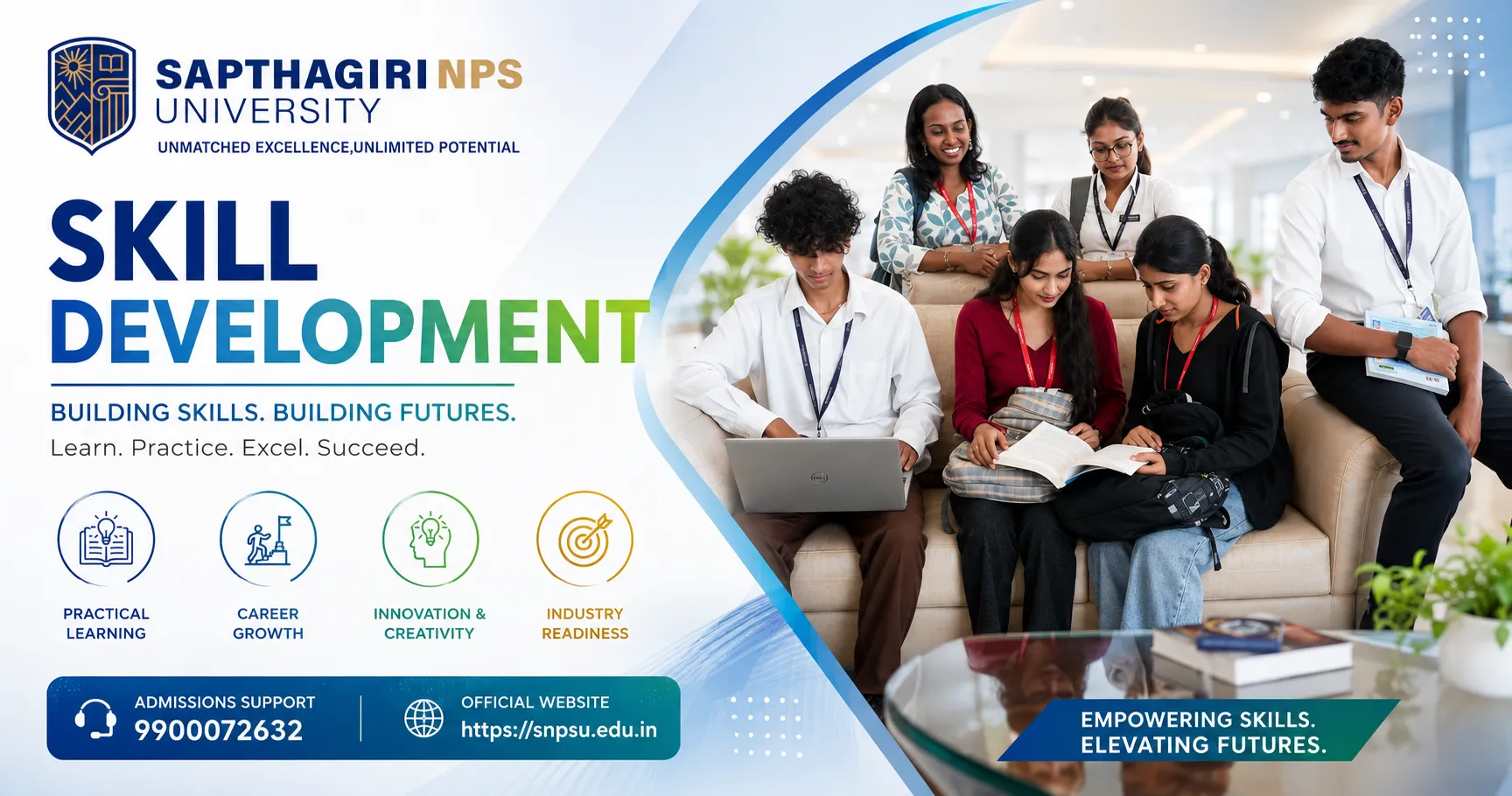
Career growth begins with developing the right combination of knowledge, skills and professional confidence. At Sapthagiri NPS University, students are encouraged to build these capabilities throughout their academic journey instead of waiting until graduation. The University's placement and career initiatives include resume preparation, interview readiness, customized training, skill-gap development, upskilling, reskilling and cross-skilling.
Connect With Our University & Take the Next Step
| Connect With Us | Details |
|---|---|
| Official University Website | Visit Sapthagiri NPS University |
| Admissions 2026–27 | Apply for Admission |
| Admission Enquiry | Connect with an Admissions Specialist |
| Location | #14/5, Chikkasandra, Hesaraghatta Main Road, Bengaluru, Karnataka |
What Is Sapthagiri NPS University Skill Development?
Sapthagiri NPS University skill development refers to the continuous process of developing technical, practical, professional, interpersonal and personal capabilities alongside academic education. Our University views skill development as a journey that begins when students enter higher education and continues throughout their academic and professional lives. Academic knowledge remains an essential part of this journey. Students need a strong understanding of their chosen discipline before they can apply that knowledge effectively. However, knowledge becomes more meaningful when students have opportunities to practise and use it. Our University therefore encourages students to move beyond memorisation and develop the ability to understand, analyse, apply and communicate what they learn. Skill development can include technical capabilities related to a particular programme. It can also include communication, teamwork, leadership, problem-solving, critical thinking, creativity, time management, professional etiquette and adaptability. These capabilities complement one another and help students develop a more complete professional profile. For example, a student may have strong programming knowledge but also needs communication skills to explain a software solution. An engineering student may understand technical principles but needs teamwork and project management abilities to contribute effectively to a large project. A management student may understand business concepts but also needs analytical thinking and communication skills to make and explain decisions. Our University therefore promotes a balanced approach to education. The objective is not simply to help students pass examinations. The objective is to help them become individuals who can use knowledge effectively, approach challenges confidently and continue developing their abilities throughout their careers.
Our University Commitment to Meaningful Skill Development
Our University believes that skill development becomes meaningful when students have opportunities to learn, practise, apply and improve. We focus on creating an educational environment where academic knowledge is supported by practical experience, technical exposure, communication, innovation, teamwork and professional development. Through this approach, Sapthagiri NPS University skill development becomes a continuous part of the student journey rather than a short-term activity limited to career preparation. Our University encourages students to develop skills that can remain valuable beyond their academic years. Technical knowledge can help students perform specialised tasks, while communication, problem-solving, adaptability, leadership and collaboration can help them respond effectively to professional situations. By bringing these capabilities together, we aim to help students build stronger confidence in their abilities and develop a clearer understanding of their future possibilities.
Our University also recognises that meaningful skill development requires active participation. Students are encouraged to make use of practical learning opportunities, projects, internships, industry exposure, academic activities, innovation initiatives and career-development programmes. Every experience can contribute to personal growth when students approach it with curiosity, responsibility and a willingness to learn. Our commitment is therefore focused on developing more than job-ready graduates. We aim to encourage capable, adaptable and responsible individuals who can continue learning as industries and technologies evolve. Through Sapthagiri NPS University skill development, our University seeks to connect education with practical capability, professional confidence and long-term growth.
Importance of Skill Development at Our University
Skill development helps students transform academic knowledge into practical capabilities. Our University encourages students to strengthen technical knowledge, communication, problem-solving, teamwork, leadership, digital skills and professional confidence. Through structured learning and career development initiatives, students can gradually prepare for internships, recruitment opportunities, higher education, entrepreneurship and evolving industry requirements.
Our University also promotes practical learning through laboratories, projects, workshops, industry interactions, innovation activities and other experiential opportunities. This approach helps students understand how their academic learning can be applied in real-world professional environments.
Skill Development & Career Growth at Our University
| Area | How Our University Supports Students |
|---|---|
| Technical Skills | Practical learning, projects, laboratories and emerging technology exposure |
| Communication Skills | Communication, presentation and confidence-building activities |
| Career Preparation | Resume building, aptitude training and interview preparation |
| Industry Exposure | Industry interactions, visits, workshops and practical projects |
| Leadership Development | Teamwork, leadership and professional development activities |
| Innovation | Research, innovation challenges and entrepreneurship opportunities |
| Internship Readiness | Practical exposure and preparation for professional environments |
| Placement Support | Campus recruitment training and career guidance |
Turning Student Potential Into Professional Capability
Every student enters Our University with a unique combination of interests, abilities, aspirations and experiences. Some students begin their academic journey with a clear understanding of the career they want to pursue, while others discover their interests gradually through subjects, projects, practical experiences and interactions with the professional world. Our University believes that education should provide students with the environment and opportunities needed to transform this potential into meaningful capability. Professional capability develops through experience. Academic knowledge provides the foundation, but students become more confident when they have opportunities to apply what they learn. A classroom concept can become more meaningful through a practical activity. A technical subject can become a useful skill through a project. A project can become valuable professional experience when students learn to plan, develop, test and present their work. An internship can then provide another level of understanding by placing students in a professional environment where communication, responsibility, teamwork and deadlines become part of everyday learning.
Our University encourages students to take an active role in this transformation. Rather than waiting for skills to develop automatically, students can identify the areas they want to strengthen and seek opportunities to practise them. A student interested in technology may explore programming, artificial intelligence, data analysis or emerging digital applications. An engineering student may develop practical abilities through laboratory work, design projects and technical activities. A management student may strengthen business understanding through case studies, presentations, analytics, internships and entrepreneurial activities. This individual approach allows students to build capabilities that are connected with their interests and future ambitions. The transformation from student potential to professional capability also involves developing the confidence to take responsibility. When students work on projects, they learn to manage tasks, meet timelines, communicate with team members and respond to unexpected challenges. When they participate in presentations, they learn to express ideas clearly. When they take part in collaborative activities, they learn to listen, contribute and respect different perspectives. When they experience setbacks, they learn to review their approach and identify opportunities for improvement.
This process makes Sapthagiri NPS University skill development more than a collection of training activities. It becomes a gradual journey in which students develop the ability to learn independently, apply knowledge practically and respond constructively to challenges. Our University encourages students to understand that professional capability is built through consistent practice rather than achieved through a single course or certificate. Another important part of this transformation is the ability to connect specialised knowledge with transferable skills. A technically capable student also needs communication skills to explain ideas. A creative student needs problem-solving and planning abilities to turn an idea into a workable solution. A future manager needs analytical thinking as well as leadership and interpersonal skills. An entrepreneur needs technical or business knowledge combined with communication, decision-making and resilience. Our University therefore encourages students to develop a balanced profile instead of focusing exclusively on one category of skills.
Practical experiences can also help students understand their own strengths more clearly. A student may discover an interest in research after completing an academic project. Another may develop a passion for entrepreneurship after participating in an innovation activity. Someone else may realise that they enjoy working with data, technology, people or business strategy. These discoveries can influence future academic choices, internships, certifications and career plans. Our University believes that professional capability should also include the ability to learn continuously. The technologies and processes students encounter today may change significantly during their careers. Therefore, the most valuable outcome of education is not simply knowledge of a particular tool. It is the ability to understand new information, learn unfamiliar technologies, evaluate new situations and adapt when requirements change.
This is why curiosity plays an important role in student development. Students who ask questions are more likely to explore beyond the immediate syllabus. Students who experiment can discover new possibilities. Students who seek feedback can identify weaknesses. Students who reflect on their experiences can understand how they are progressing. Over time, these habits can create independent and adaptable professionals. Our University also recognises the importance of professional confidence. Confidence should be built on preparation and capability rather than assumption. Students become more confident when they know their subject, understand their projects, gain practical experience and learn how to communicate their abilities. Every successful presentation, completed project, internship experience and problem solved can contribute to this confidence.
Professional capability also involves understanding responsibility. Students need to recognise that their work can affect others, particularly when they become part of professional teams. Meeting commitments, respecting deadlines, communicating challenges, maintaining professional standards and accepting accountability are important qualities that can be developed during university life. Through Sapthagiri NPS University skill development, Our University aims to create opportunities where students can move progressively from understanding to application, from participation to responsibility and from potential to capability. The objective is not to make every student follow the same path. Instead, we encourage students to discover their individual strengths and develop the combination of skills that can support their chosen direction.
The journey may begin with a classroom lesson, but it does not end there. It continues through practical learning, projects, internships, industry exposure, innovation, collaboration, communication and independent exploration. Each experience adds another layer to the student's professional development. Ultimately, turning student potential into professional capability means helping learners understand what they can achieve and giving them opportunities to prove it through action. Our University remains committed to creating an environment where students can learn with purpose, practise with confidence, explore with curiosity and develop the capabilities needed to approach their future with greater clarity.
Building Skills for a Changing Professional World
The professional world is continuously changing, and the skills required for a successful career can evolve along with technology, business practices and industry expectations. Our University recognises that students preparing for their future need more than knowledge of today's requirements. They need the ability to understand change, learn new concepts and adapt their skills as professional environments develop. This makes adaptability an important part of Sapthagiri NPS University skill development and a valuable quality for long-term career growth.
Technology has become an important part of almost every professional field. Artificial intelligence, data analytics, cloud technologies, automation, digital communication and other emerging developments are influencing the way organisations operate. Students from technical disciplines may work directly with these technologies, while students from management and other fields may use them as part of their professional responsibilities. Our University therefore encourages students to develop digital awareness alongside their specialised academic knowledge. However, being prepared for the future does not mean trying to learn every new technology. The more important objective is to develop the ability to understand new tools and determine where they can create value. A student who has strong fundamentals can learn new technologies more effectively because they understand the principles behind their field. Our University encourages students to build these foundations while remaining curious about emerging developments.
Adaptability also involves being comfortable with unfamiliar situations. Students may encounter new software, different project requirements, new team structures or unfamiliar professional responsibilities during their careers. Instead of viewing change only as a challenge, students can learn to approach it as an opportunity to develop new capabilities. This mindset can help them remain productive and confident when circumstances change. Our University encourages students to develop learning habits that support this adaptability. Reading beyond the syllabus, exploring new tools, participating in workshops, working on independent projects and following developments within their chosen industries can help students remain connected with their fields. These activities also encourage students to take responsibility for their own professional development.
Communication is another important skill in a changing workplace. As teams become increasingly collaborative and multidisciplinary, professionals may need to communicate with people who have different areas of expertise. A technology professional may need to explain a technical concept to a business team. A manager may need to understand information presented by technical specialists. An analyst may need to communicate findings to decision-makers. Our University encourages students to develop the ability to explain ideas clearly and adjust communication according to their audience. Problem-solving becomes equally important when professional situations are unfamiliar. Students cannot always rely on previously memorised solutions. They may need to investigate the situation, identify relevant information, consider alternatives and develop an appropriate response. Practical projects and experiential learning can help students develop this ability before entering the workplace.
Our University also encourages students to understand that adaptability does not mean abandoning their core expertise whenever a new trend appears. Strong professional development requires a balance between depth and flexibility. Students should develop meaningful expertise in their chosen areas while also building transferable skills that allow them to work across changing situations. For example, a computer science student can build strong programming and software development foundations while exploring artificial intelligence or cloud technologies. An electronics student can develop core engineering knowledge while exploring embedded systems, automation or intelligent technologies. A management student can build strong business knowledge while developing analytics, digital tools and communication skills. This combination of specialised knowledge and adaptability can create a stronger professional foundation.
Another important aspect of future readiness is the ability to learn from experience. Professional development does not happen only through formal courses. Students can learn from projects that do not work as expected, internships that present unfamiliar challenges, presentations that require improvement and teamwork experiences that reveal different perspectives. Our University encourages students to reflect on these experiences and identify what they can learn from them. Continuous improvement can become a professional habit. After completing a task, students can ask what worked well, what could have been better and what they would change next time. This simple process encourages students to become more self-aware and proactive. Over time, it can help them develop a mindset focused on progress rather than perfection.
The ability to adapt is also connected with confidence. Students may hesitate when they encounter something unfamiliar because they believe they need to know everything before beginning. Our University encourages a different approach. Students can begin by understanding the basics, asking questions, seeking guidance and practising gradually. Confidence can then develop through experience.Future-ready professionals also need to understand the importance of responsible technology use. Digital tools and artificial intelligence can provide significant opportunities, but professionals must evaluate information carefully, protect sensitive information and consider the consequences of their decisions. Our University encourages students to combine technological curiosity with professional responsibility.
Ultimately, preparing students for a changing professional world means developing people who can continue learning. A specific technical skill may change over time, but curiosity, critical thinking, communication, collaboration and adaptability can remain valuable throughout a career. These capabilities can help graduates respond to new opportunities rather than feeling limited by the skills they developed at one particular stage of their education. Our University therefore views future readiness as a continuous process. Students are encouraged to build strong academic foundations, develop practical competence, explore emerging areas, gain professional exposure and remain open to learning. Through this approach, Sapthagiri NPS University skill development can support not only the transition from university to employment but also the continued growth that follows throughout a professional journey.
Why Skill Development Matters in Modern Education
The expectations associated with higher education have changed considerably. Employers increasingly value graduates who can combine academic knowledge with practical competence. Organisations need professionals who can learn quickly, communicate clearly, understand technology, analyse information and work collaboratively. A graduate entering a professional environment may be expected to manage several responsibilities simultaneously. They may need to understand technical information, prepare reports, participate in meetings, communicate with colleagues, meet deadlines and contribute to problem-solving activities. These abilities are developed through repeated practice and experience.
Our University therefore considers skill development an essential part of the student experience. We encourage students to use their academic years as a period of exploration, practice and professional preparation. Every project can become an opportunity to solve a problem. Every presentation can become an opportunity to improve communication. Every internship can provide workplace exposure. Every team activity can strengthen collaboration. Every challenge can provide a lesson. This approach also encourages students to become more responsible for their own development. The University can provide learning opportunities, guidance, infrastructure and academic support, but students must actively participate, practise their skills and seek continuous improvement. A strong skill development environment therefore involves a partnership between the institution and the learner. Our University provides the environment and opportunities, while students contribute curiosity, effort, discipline and commitment.
Our University Approach to Skill Development
Our University follows a broad approach to skill development that connects academic education with practical and professional development. We believe students should have opportunities to develop skills progressively rather than trying to acquire everything during their final year. The first stage involves developing strong academic foundations. Students need to understand the principles of their chosen discipline. Once these foundations are established, they can begin exploring practical applications and specialised areas. The next stage involves practice. Laboratory work, assignments, workshops and academic activities allow students to apply concepts in controlled environments. Students can make mistakes, ask questions and improve their understanding. Project-based learning then allows students to integrate multiple skills. A project may require research, planning, technical development, testing, documentation and presentation. This makes projects particularly valuable for skill development. Internships and industry exposure can then introduce students to professional expectations. Students gain an understanding of workplace communication, deadlines, teamwork, organisational structures and practical applications.
Education That Builds More Than a Degree
Our University believes that a student's higher education journey should create a transformation that can be seen not only in academic performance but also in confidence, capability, curiosity and professional maturity. A university degree is an important achievement, but the years spent pursuing that degree can provide much more. They can become a period in which students discover their strengths, explore new possibilities, develop practical abilities and begin shaping the professional identity they will carry into the future. This philosophy gives special importance to Sapthagiri NPS University skill development. Our University views every student as an individual with potential that can be developed through the right combination of knowledge, practice, guidance and opportunity. Skill development is therefore not treated as an isolated training activity. It becomes part of the larger student experience, influencing the way students learn, participate, communicate, experiment, solve problems and prepare for their future. The professional world does not remain unchanged. Industries introduce new technologies, organisations adopt new methods and career roles continue to evolve. Students need an educational experience that prepares them not only for the opportunities available today but also for the responsibilities and challenges they may encounter tomorrow. Our University therefore encourages students to develop a mindset that values continuous improvement and lifelong learning.
Discovering What Students Can Become
Every student enters university with a different combination of interests, abilities and aspirations. Some students may already have a clear career objective, while others may still be exploring their options. Our University believes that both situations are natural parts of the learning journey. The university experience can provide students with the time and environment to discover what they enjoy, what they are good at and what kind of problems they want to solve. A student who begins with an interest in programming may gradually discover a passion for artificial intelligence. An engineering student may become interested in automation or electric mobility. A management student may discover an interest in analytics, entrepreneurship or marketing. These discoveries are valuable because career development is not always a straight line. Students may learn more about themselves through projects, internships, competitions, academic subjects and interactions with professionals. Our University encourages students to explore rather than restrict themselves too early. The objective is to help students make informed choices based on experience and understanding.
Connecting Academic Knowledge with Practical Learning
Academic knowledge provides the foundation for professional competence. However, students need opportunities to understand how concepts operate outside textbooks. Our University encourages students to connect theoretical learning with practical application. This approach helps students understand the relevance of their subjects and develop confidence in using their knowledge. For example, a computer science student may learn programming concepts during classroom sessions. Laboratory activities can provide opportunities to write and test code. A project can require the student to use programming to solve a practical problem. An internship can then provide exposure to professional software development practices. Similarly, an engineering student may learn theoretical principles, perform experiments and eventually apply those principles to a project. Management students can learn business concepts and explore them through case studies, presentations, research assignments and internships.
Understanding the Importance of Skill Development in Higher Education
A university education should provide students with knowledge that can support both academic progress and professional growth. Subject knowledge gives students the foundation required for their chosen discipline, while practical and transferable skills help them apply that knowledge in different situations. For this reason, skill development has become an important part of modern higher education. Students who develop technical knowledge alongside communication, problem-solving, teamwork and adaptability can approach academic and professional challenges with greater confidence.Our University encourages students to understand the practical value of their education. Classroom learning introduces important concepts and theories, while practical activities provide opportunities to apply those concepts. Projects encourage students to solve problems and work with others. Presentations develop communication and confidence. Internships can introduce students to professional environments. Industry interactions can help students understand changing workplace expectations. Career preparation can help them communicate their capabilities during recruitment. Each stage contributes to a broader educational experience. This integrated approach makes Sapthagiri NPS University skill development relevant throughout the student journey. Rather than treating skill development as something that begins only before placements, we encourage students to develop professional capabilities from the early stages of their education. This allows students to identify their strengths, recognise areas for improvement and gradually build a stronger professional profile.
Our Academic Approach to Skill Development
Academic education remains the foundation of every successful professional journey. Students need a clear understanding of their subjects before they can confidently apply their knowledge. Our Faculty members support students through structured academic learning while encouraging curiosity, discussion and practical application. Classroom sessions, assignments, laboratory work, academic projects, presentations and other learning activities can contribute to the development of both subject knowledge and transferable skills. Different programmes naturally require different areas of expertise. Engineering students may focus on technical concepts, engineering principles, analytical reasoning and laboratory applications. Computer applications students may develop programming, software, database and digital capabilities. Management students may strengthen their understanding of business, finance, marketing, operations, communication and leadership. Regardless of the programme, students can benefit from developing broader abilities such as problem-solving, teamwork, communication and adaptability. Our approach encourages students to see academic learning as more than preparation for examinations. Understanding why a concept matters and how it can be applied can make learning more meaningful. Students who actively participate in discussions, practical activities and projects can develop greater confidence in using their knowledge. This connection between academic understanding and practical application forms an important part of sapthagiri nps university skill development.
Practical Learning That Connects Knowledge With Application
Practical learning gives students an opportunity to move from theoretical understanding to real application. Reading about a concept can provide initial knowledge, but applying that concept can help students understand its relevance more deeply. Our students can develop practical capabilities through laboratory sessions, academic projects, technical activities, demonstrations and programme-specific learning experiences. Practical activities also encourage students to observe outcomes, identify problems and improve their approach. When an expected result does not occur, students can examine possible reasons and consider alternative solutions. This process develops analytical thinking and patience. It also teaches students that professional problem-solving often requires experimentation, evaluation and improvement. Project-based learning can provide an especially valuable practical experience. Students may need to identify a problem, research information, plan their work, select an appropriate approach, collaborate with peers and present their results. These activities can strengthen technical knowledge while also developing communication, teamwork, time management and responsibility. Through this combination of academic and practical learning, sapthagiri nps university skill development becomes connected with the capabilities students can use beyond the university environment.
Building Technical Competence for Emerging Career Opportunities
Technology continues to influence a wide range of professional sectors. Students entering technology-focused careers may encounter areas such as artificial intelligence, machine learning, data science, cloud computing, cybersecurity, data analytics, Internet of Things, robotics and other emerging technologies. Developing awareness of these areas can help students understand the changing professional landscape. Our University encourages students to develop strong fundamentals within their chosen disciplines while remaining open to emerging areas. Technical education should not focus only on learning individual tools or technologies. Students should also understand how technology can be used to solve practical problems and create meaningful outcomes. For example, programming knowledge becomes more valuable when students can use it to develop applications or solve computational problems. Data knowledge becomes more useful when students can analyse information and draw meaningful conclusions. Artificial intelligence concepts become more relevant when students understand potential applications and limitations. This application-oriented perspective helps students develop technical confidence while also encouraging continuous learning. As professional technologies change, the ability to learn new tools and understand new concepts becomes increasingly important. Our approach to sapthagiri nps university skill development therefore encourages both technical capability and adaptability.
Communication Skills for Professional Growth
Communication is an essential part of professional life. Graduates may need to explain ideas to colleagues, participate in meetings, present projects, communicate with clients or prepare written documents. Strong communication can therefore complement technical knowledge and help students express their capabilities more effectively. Our students can develop communication skills through classroom presentations, seminars, group discussions, project demonstrations, academic activities and student events. These experiences can gradually build confidence in expressing ideas before different audiences. Effective communication is not limited to speaking. Students also need to listen carefully, understand questions, organise information and respond appropriately. Written communication is equally valuable because professional environments frequently require emails, reports, presentations, project documentation and other forms of written interaction. Developing these abilities during university can make the transition into professional environments more comfortable. Students who can explain their knowledge clearly may find it easier to participate in interviews, discussions, presentations and workplace activities. For this reason, communication remains an important dimension of sapthagiri nps university skill development.
Developing Analytical Thinking and Problem-Solving
Professional challenges rarely come with ready-made answers. Graduates may encounter unfamiliar situations where they need to understand a problem, examine available information and determine an appropriate course of action. Analytical thinking helps students approach these situations systematically. Our academic environment encourages students to examine problems, compare alternatives and develop reasoned solutions. Assignments, projects, case studies, laboratory activities and discussions can provide opportunities to practise analytical thinking. Problem-solving also requires students to understand that mistakes can become part of the learning process. When an approach does not produce the expected result, students can review their assumptions, identify possible causes and consider improvements. This process can strengthen resilience and encourage students to approach challenges constructively. Analytical thinking can be useful across disciplines. Engineering students may apply it to technical challenges. Management students may use it to evaluate business situations. Computer applications students may use it to identify software or data-related problems. The specific application may differ, but the underlying capability remains valuable.
Teamwork and Collaborative Learning
Professional environments often require people to work with colleagues from different backgrounds and areas of expertise. University provides an important opportunity for students to learn how collaboration works. Group projects, academic activities, clubs, events and other student initiatives can encourage students to share responsibilities and work toward common objectives. Students learn that effective teamwork requires communication, respect, accountability and coordination. Working in a team can also expose students to different approaches to the same problem. One student may contribute strong technical knowledge, while another may offer creative ideas or organisational abilities. Learning how to recognise and use different strengths can become an important professional competency. Our University encourages students to participate actively in collaborative experiences because teamwork contributes significantly to holistic development and sapthagiri nps university skill development.
Leadership Opportunities Through University Life
Leadership development does not begin only after students enter management positions. It can begin with everyday responsibilities during university life. Students can develop leadership by coordinating a project, organising an activity, taking responsibility for an event or guiding a team toward a shared objective. Leadership involves more than giving instructions. It requires listening, planning, decision-making, accountability and the ability to work with different people. Students may encounter challenges while coordinating activities, and these situations can provide valuable opportunities to develop confidence and responsibility. Our student community provides opportunities for learners to participate in academic, cultural, technical, sports and innovation-related activities. Active participation can help students discover their strengths and become more comfortable taking responsibility. These experiences can complement classroom learning and contribute to the wider objective of preparing students for professional environments.
Industry Exposure and Professional Awareness
Academic knowledge becomes more meaningful when students understand how it connects with professional environments. Our University encourages industry-oriented learning through opportunities that can help students understand workplace expectations, emerging technologies and professional practices. Industry interaction may include expert sessions, workshops, industrial visits, live projects, internships and other professional activities. These experiences can introduce students to practical situations that may not always be visible through classroom learning alone. Students can learn how organisations operate, how teams communicate, how projects are managed and how professionals approach challenges. Industry exposure can also help students understand the importance of punctuality, professional communication, accountability and continuous learning. Such experiences can help students connect their current academic efforts with future career objectives. This connection strengthens the practical relevance of sapthagiri nps university skill development.
Sapthagiri NPS University Career Opportunities and Professional Growth
Career opportunities can develop from a combination of education, skills, experience, personal interests and professional preparation. Our University encourages students to explore career possibilities rather than limiting themselves to a single pathway. Through academic guidance, career-development activities, projects, internships and industry exposure, students can gain a broader understanding of the professional landscape. Students from technology-oriented programmes may explore areas such as software development, data analytics, artificial intelligence, cybersecurity, cloud technologies, engineering and other digital careers. Management students may explore areas such as marketing, finance, human resources, business analytics, operations, consulting and entrepreneurship. Other programmes can provide pathways into specialised professional fields based on the student's academic background and interests. Career development also requires students to understand their own strengths. Some students may perform strongly in technical problem-solving, while others may demonstrate communication, leadership or analytical abilities. Our Career Development Team can help students understand how different capabilities relate to professional opportunities and how they can continue strengthening areas that require improvement. This individualised perspective adds depth to sapthagiri nps university skill development, because professional preparation becomes connected with the student's personal strengths and career aspirations.
Sapthagiri NPS University Courses and Academic Skill Development
The choice of academic programme has a direct influence on the skills students develop during university. Students should therefore consider their interests, academic strengths and future aspirations before selecting a programme. Our University offers academic opportunities across areas including engineering, technology, management, computer applications and other disciplines. Each programme provides a different academic foundation and can support different career directions. Engineering education can help students develop technical reasoning, practical knowledge, analytical abilities and problem-solving skills. Technology-oriented programmes can provide exposure to computing, software, data and emerging technologies. Management education can strengthen business understanding, communication, decision-making and leadership. Computer applications can develop programming, software and digital capabilities. Students should explore the detailed curriculum of their preferred programme and understand how academic subjects connect with practical and professional development.
How Students Can Maximise Sapthagiri NPS University Skill Development Opportunities
Students receive the greatest benefit from university when they participate actively in the learning environment. Attending classes regularly provides the academic foundation, but students can strengthen their development further by participating in projects, workshops, internships, clubs, competitions, presentations and career-development activities. Students should also develop the habit of seeking feedback. Faculty members, mentors and career professionals can help students identify strengths and areas for improvement. Constructive feedback becomes more valuable when students use it to make specific improvements. Another important habit is maintaining a record of achievements. Students should document projects, internships, certifications, workshops, competitions, leadership activities and other relevant experiences. This information can later support resumes, interviews and higher-education applications. Active participation can transform university education from a passive experience into a continuous development journey.
The Long-Term Value of Sapthagiri NPS University Skill Development
The real value of skill development extends beyond the first job after graduation. Professional careers can involve multiple changes in roles, technologies and responsibilities. A graduate may begin with one technical skill and later need to learn another. A management professional may move into a different business function. An engineer may transition toward project management or entrepreneurship. A computer applications graduate may develop specialised expertise in an emerging technology. The ability to learn, adapt and communicate remains valuable across these changes. This is why our approach to sapthagiri nps university skill development focuses on building a strong foundation rather than preparing students for only one immediate outcome. We want students to develop the confidence to continue learning and growing throughout their professional lives.
Frequently Asked Questions About Sapthagiri NPS University Skill Development
1. What does Sapthagiri NPS University skill development include?
Sapthagiri NPS University skill development is a broad approach to helping students build the academic, technical, practical and professional capabilities required for their future. Our University connects classroom education with practical learning, academic projects, communication development, industry exposure, internships, career preparation, innovation, leadership and student activities. The purpose is to help students understand their subjects while also developing the confidence to apply their knowledge in practical situations. Students can strengthen problem-solving, teamwork, analytical thinking, communication, time management and professional behaviour through different stages of their university journey. Skill development is therefore not treated as a single workshop or short-term activity. It is a continuous process in which students learn, practise, apply their knowledge, receive feedback and improve their capabilities over time.
2. Why is skill development important for students at Sapthagiri NPS University?
Skill development is important because academic knowledge alone may not address every requirement of modern professional environments. Students may need to communicate with teams, solve unfamiliar problems, work with technology, manage responsibilities and adapt to changing situations after graduation. Our University encourages students to develop these capabilities alongside their academic knowledge. Through projects, practical activities, presentations, internships, industry interactions and career-oriented programmes, students can gradually become more comfortable applying what they learn. This approach can also help students recognise their strengths and identify areas where additional development is required. Sapthagiri NPS University skill development therefore supports both academic growth and long-term professional readiness.
3. How does Sapthagiri NPS University connect academic learning with practical skills?
Our University encourages students to understand the practical relevance of their academic subjects. Classroom learning provides important theoretical foundations, while laboratory activities, projects, assignments, presentations and other practical experiences allow students to apply those concepts. A student may learn a technical principle in class and later use that knowledge during laboratory work or a project. Similarly, management students can connect business concepts with case studies, presentations and practical activities. This relationship between theory and application helps students understand how knowledge can be used to address real-world situations. It also encourages students to become active participants in their learning rather than relying only on memorisation.
4. Does Sapthagiri NPS University provide career development opportunities?
Our University supports career development through a range of activities designed to improve student preparedness for professional environments. Career-oriented support can include resume preparation, aptitude development, communication training, interview preparation, mock interviews, technical preparation, industry interaction and professional guidance. Students are encouraged to begin career preparation before their final year so that they have sufficient time to develop their capabilities. Projects, internships, certifications and extracurricular experiences can also contribute to a student's professional profile. Our Career Development Team encourages students to understand their strengths, explore potential career pathways and continuously improve their readiness for professional opportunities.
5. How can internships contribute to Sapthagiri NPS University skill development?
Internships can provide students with practical exposure that complements academic education. During an internship, students may experience professional communication, project responsibilities, deadlines, teamwork and organisational processes. These experiences can help students understand how knowledge is applied in a workplace and what professional behaviour may be expected. Internships can also help students evaluate their career interests because practical exposure may reveal areas they enjoy or skills they want to develop further. Our students are encouraged to approach internships as learning opportunities rather than simply as certificates. The knowledge and experiences gained through internships can later support project discussions, resumes and interviews, making internships a valuable component of sapthagiri nps university skill development.
6. How does the University help students develop communication skills?
Communication development is an important part of the wider student experience. Our students can practise communication through classroom discussions, presentations, seminars, group activities, project demonstrations and other academic and extracurricular opportunities. These experiences can gradually help students become more comfortable expressing ideas before different audiences. Communication also involves listening, understanding questions and responding appropriately. Students can therefore develop both speaking and listening abilities through collaborative learning. Written communication is equally important because professional environments may require emails, reports, presentations and project documentation. By practising communication during university, students can become better prepared to interact with colleagues, employers and other professional stakeholders.
7. How does Sapthagiri NPS University support technical skill development?
Technical skill development depends on the student's selected programme and academic interests. Our University provides programme-specific academic learning supported by practical activities, projects and technology-oriented education. Students pursuing engineering and technology-related programmes may encounter areas connected with computing, artificial intelligence, data, electronics, electrical systems and other emerging fields. Computer applications students can develop programming and digital capabilities, while management students can build business and analytical competencies. Students are also encouraged to remain aware of emerging technologies and develop the ability to learn new tools. This combination of academic fundamentals and practical application supports sapthagiri nps university skill development and can help students prepare for evolving professional requirements.
8. Does student life contribute to skill development at Sapthagiri NPS University?
Yes. Student life can provide important opportunities for developing skills that complement academic education. Our students can participate in cultural activities, sports, clubs, technical initiatives, innovation activities, events and other campus experiences. These activities can strengthen teamwork, communication, creativity, leadership, organisation and confidence. For example, organising an event can require planning and coordination, while participating in a team activity can develop collaboration and responsibility. Sports can encourage discipline and teamwork, while student clubs can provide opportunities to explore interests and interact with peers. Active participation can therefore make university life an important part of the broader sapthagiri nps university skill development journey.
9. How can students develop leadership skills during their university journey?
Leadership develops through responsibility, practice and experience. Students can begin developing leadership by taking responsibility for academic projects, student activities, events, clubs, competitions or other initiatives. Leadership requires more than directing others. Students need to communicate clearly, listen to different perspectives, organise responsibilities, make decisions and accept accountability for outcomes. Our University encourages students to participate actively in activities where they can practise these capabilities. Even small responsibilities can help students become more confident in making decisions and coordinating with others. These experiences can later become valuable when students enter professional environments where initiative, responsibility and teamwork are important.
10. How does Sapthagiri NPS University prepare students for placement interviews?
Placement preparation can involve several stages because recruitment processes may assess different capabilities. Our career-oriented activities can help students prepare resumes, strengthen aptitude skills, practise communication and participate in mock interviews. Students can also work on explaining their academic projects, internships, technical knowledge and career interests. Mock interviews provide an opportunity to practise responding to questions and receive constructive feedback. Students can use this feedback to improve their responses, communication and professional presentation. The objective is to help students become familiar with recruitment situations and communicate their capabilities with greater confidence and clarity.
11. What role does project-based learning play in skill development?
Project-based learning allows students to bring multiple skills together in one practical experience. A project may require students to research a problem, plan their approach, work with resources, collaborate with team members, complete tasks and present their findings. During this process, students can develop technical knowledge alongside problem-solving, communication, teamwork and time-management abilities. Projects can also teach students how to respond when an approach does not produce the expected result. They can review the situation, identify possible causes and consider improvements. This process encourages analytical thinking and resilience. Project-based learning therefore plays an important role in connecting academic education with sapthagiri nps university skill development.
12. Does Sapthagiri NPS University encourage innovation and entrepreneurship?
Our University encourages students to explore innovation, creativity and entrepreneurial thinking as part of their broader educational experience. Innovation encourages students to identify problems and consider new approaches to solving them. Entrepreneurship can introduce students to areas such as idea development, market understanding, customer needs, planning, financial awareness and communication. These experiences can help students develop initiative and creative thinking. Entrepreneurial skills can also be useful for students who choose corporate careers because organisations value professionals who can identify opportunities, improve processes and approach challenges constructively. Innovation and entrepreneurship therefore provide additional pathways for sapthagiri nps university skill development.
13. How does industry exposure support student career readiness?
Industry exposure can help students understand how professional environments operate. Through expert interactions, workshops, industrial exposure, internships, live projects and other industry-oriented activities, students can gain insights into workplace expectations and emerging professional trends. They may learn how teams collaborate, how projects are managed and how professionals approach practical challenges. Industry exposure can also help students understand the difference between academic knowledge and workplace application. This awareness can encourage students to identify the technical and professional skills they should strengthen before graduation. Industry interaction therefore supports a more practical approach to career preparation and contributes to sapthagiri nps university skill development.
14. How can students make the most of skill-development opportunities?
Students can maximise their university experience by participating actively rather than limiting themselves to classroom requirements. Regular attendance, project participation, internships, workshops, presentations, student activities and career-development programmes can provide additional learning opportunities. Students should also seek feedback from Faculty members, mentors and career professionals and use that feedback to improve. Maintaining a record of projects, certifications, internships, competitions, leadership experiences and achievements can also help students build a stronger professional profile. Most importantly, students should develop a habit of continuous learning. When students consistently practise and improve their abilities, sapthagiri nps university skill development becomes a meaningful part of their overall academic journey.
Our University Approach to Building Future Talent
Our University believes that future talent is developed through a combination of knowledge, experience, curiosity, discipline and continuous learning. Students enter higher education with different abilities, interests and aspirations, and their potential can grow significantly when they receive opportunities to explore, practise and apply what they learn. Our University therefore approaches student development as a gradual process in which academic learning is connected with practical experience, professional awareness, personal confidence and the ability to adapt to changing expectations. Building future talent begins with creating strong academic foundations. Students need a clear understanding of their chosen discipline before they can confidently apply their knowledge to practical situations. Our University encourages students to engage deeply with their subjects and understand the principles behind what they study. Rather than viewing academic learning only as preparation for examinations, students are encouraged to recognise how concepts can contribute to real applications, professional responsibilities and future innovation.
Practical exposure gives this academic foundation greater meaning. Our University encourages students to move beyond understanding concepts and explore how those concepts work in practice. Laboratory activities, practical assignments, academic projects and experiential learning can provide opportunities for students to test ideas, identify challenges and develop solutions. Through repeated application, students can gradually become more comfortable using their knowledge independently. Projects play an important role in this development because they bring several capabilities together. A student working on a project may need to conduct research, define objectives, select an approach, manage resources, complete technical tasks, document progress and present the final outcome. Each stage develops a different capability. The student is not only learning about a subject but also learning how to manage a process from an initial idea to a completed outcome.
Our University also recognises the importance of learning through challenges. Practical work does not always produce immediate success. Students may encounter technical problems, unexpected results, changing requirements or difficulties within a team. These situations can become valuable learning experiences when students analyse what happened and consider how the situation can be improved. This process can strengthen resilience, critical thinking and problem-solving ability. The development of future talent also requires strong communication. Professional environments depend on people who can explain ideas clearly, listen carefully and communicate appropriately with different audiences. Our University encourages students to develop communication through presentations, discussions, project demonstrations, reports and collaborative activities. The objective is to help students become comfortable expressing their ideas while also learning to understand different perspectives.
Teamwork forms another important part of our approach. Modern professional projects often involve people with different areas of expertise working towards a common objective. Students therefore need opportunities to experience collaboration before entering the workplace. Through group projects and collaborative learning, students can learn how to divide responsibilities, coordinate tasks, respect different opinions and contribute to shared outcomes. Our University also encourages students to develop leadership through responsibility. Leadership is not limited to formal positions. A student can demonstrate leadership by taking ownership of a project, coordinating a team, helping resolve a challenge or taking initiative when an opportunity arises. These experiences can gradually develop decision-making, accountability, communication and confidence.
Another important element of future talent development is curiosity. Our University encourages students to look beyond the immediate requirements of their curriculum and explore subjects that interest them. Curiosity can encourage students to learn about emerging technologies, investigate new ideas, participate in innovation activities and develop independent projects. This habit can become valuable throughout professional life because industries continue to change and professionals need to remain willing to learn. Technology also has an important role in shaping future talent. Digital transformation is influencing almost every sector, creating new opportunities as well as new expectations. Our University encourages students to develop appropriate digital awareness while maintaining strong foundations within their chosen disciplines. Students can explore areas such as artificial intelligence, data analytics, digital systems, automation and other emerging technologies according to their academic interests and career aspirations.
Our University believes that future-ready talent does not mean learning every new technology. Instead, it means developing the ability to understand new developments, evaluate their relevance and learn unfamiliar tools when required. Strong fundamentals combined with adaptability can help graduates respond more effectively when technologies and professional responsibilities change. This adaptability is closely connected with continuous learning. A student's education does not end when a degree is completed. Professional roles evolve, organisations adopt new systems and industries introduce new requirements. Our University encourages students to develop independent learning habits so that they can continue strengthening their capabilities throughout their careers.
Internships and professional exposure can further support this development. Students can gain a clearer understanding of workplace expectations by experiencing professional environments. They can observe how teams communicate, how responsibilities are managed and how projects move from planning to execution. Such experiences can also help students understand the relationship between academic knowledge and professional practice. Our University encourages students to approach internships as learning opportunities rather than simply as achievements to list on a resume. Students can observe carefully, ask meaningful questions, participate responsibly and reflect on what they have learned. The experience can help them identify both strengths and areas that require further development.
Career preparation is another part of building future talent. Our University encourages students to gradually develop professional readiness instead of waiting until graduation. Resume development, interview preparation, communication practice, aptitude development, project presentation and professional etiquette can help students become more comfortable with the transition from university to employment. A strong professional profile should also demonstrate evidence of capability. Our University encourages students to document meaningful projects, internships, certifications, research activities, competitions and leadership experiences. Such evidence can help students communicate what they have actually learned and accomplished.
This approach supports Sapthagiri NPS University skill development by connecting learning with measurable experience. Students can gradually build a profile that reflects their academic understanding, technical capabilities, practical exposure and professional qualities. Future talent also requires the ability to think creatively. Our University encourages students to look at problems from different perspectives and consider alternative solutions. Innovation can begin with a simple observation that something could be improved. Students can then investigate the problem, understand user needs, explore possible approaches and develop practical solutions.
Entrepreneurial thinking can strengthen this process. Students who learn to identify opportunities, understand needs, evaluate possibilities and take initiative can contribute valuable ideas in both startups and established organisations. Entrepreneurship therefore becomes more than a pathway to business ownership. It becomes a mindset that encourages initiative, responsibility and value creation. Our University also gives importance to analytical thinking. Students need to learn how to evaluate information, identify relevant evidence and make reasoned decisions. This capability is valuable across disciplines. Engineers use analytical thinking to evaluate systems. Technology professionals use it to solve technical problems. Management professionals use it to understand business situations. Researchers use it to evaluate evidence and develop conclusions.
Professional responsibility is equally important. Future talent should not be defined only by technical ability. Responsible professionals understand the impact of their decisions, respect professional standards and recognise the importance of integrity. Our University encourages students to develop accountability, discipline, respect and ethical awareness alongside their academic and technical capabilities. The development of future talent is therefore a multidimensional process. It involves knowledge, practical ability, communication, collaboration, creativity, leadership, adaptability and responsibility. No single activity can develop all these qualities. They grow gradually through different experiences across the student's academic journey.
Our University encourages students to see their university years as an opportunity to build a personal foundation for the future. Every subject can contribute knowledge. Every project can provide experience. Every presentation can strengthen communication. Every team activity can develop collaboration. Every challenge can teach resilience. Every internship can provide professional insight. Every new skill can create another possibility. The result is not simply a graduate who has completed an academic programme. It is a graduate who has had opportunities to understand their strengths, explore their interests, practise their abilities and develop greater confidence in their potential.
Our University also recognises that future careers may not follow predictable paths. Students may begin in one role and later move into another. A technology graduate may progress into management. An engineering graduate may explore entrepreneurship. A management graduate may develop specialised analytical expertise. A professional may return to higher education or research after gaining industry experience. This is why adaptability and transferable skills are so important. Technical expertise can open a professional pathway, while communication, problem-solving, collaboration and learning ability can help graduates continue progressing along that pathway.
Sapthagiri NPS University skill development therefore represents a broader commitment to preparing students for professional growth rather than focusing only on their immediate transition into employment. Our University aims to help students develop capabilities that can remain valuable as their responsibilities, industries and ambitions evolve. Building future talent also means encouraging students to take ownership of their development. The University can provide learning environments, academic guidance and opportunities, but students need to participate actively. They need to practise, ask questions, seek feedback, explore possibilities and remain committed to improvement.
Connect With Us
| University Portal & Support | Details |
|---|---|
| Official University Website | Visit the Official University Website |
| Online Admissions Portal | Apply Through the Official Admissions Portal |
| Admissions Counsellor | Talk to Our Admissions Counsellor: Click Here |
| Skill Development | Explore sapthagiri nps university skill development, practical learning, internships, career development and professional opportunities |
| University Address | #14/5, Chikkasandra, Hesarghatta Main Road, Bengaluru, Karnataka, India |
Begin Your Skill Development Journey
Sapthagiri NPS University skill development brings together academic knowledge, practical learning, industry exposure and career preparation to help students build meaningful professional capabilities. Our University encourages students to learn with curiosity, develop with confidence and prepare for an evolving world of opportunities.
Leave a Comment